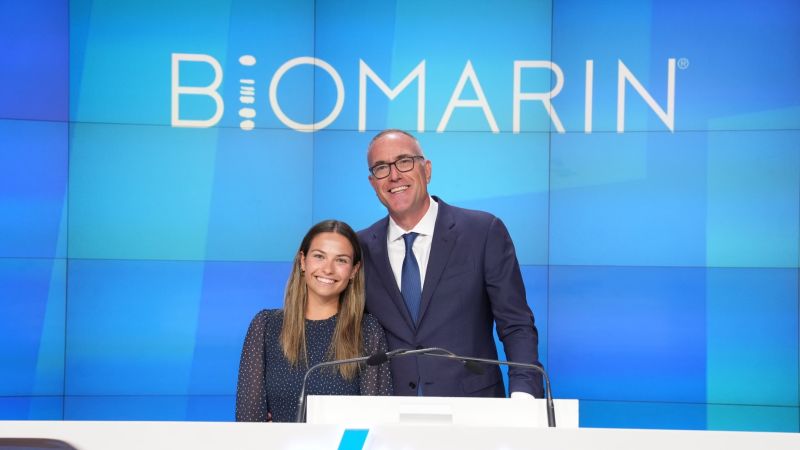
At Nasdaq in New York, Alexander Hardy had company. His daughter Coco, who lived in the city, joined him for BioMarin’s opening-bell celebration. There was the corporate occasion: 25 years on the exchange, an Investor Day, a gathering of colleagues. And there was the family occasion: father and daughter getting to see their picture in Times Square. Even a chief executive is allowed to enjoy a very large photograph of himself.
The picture is cheerful, public and satisfyingly uncomplicated. The career that brought Hardy to it took a less direct route. Before becoming BioMarin’s president and chief executive in December 2023, he had worked in different companies, countries and functions. His responsibilities had ranged from a national business in Denmark to a region spanning 19 countries. He had left Genentech for wider responsibilities at Roche, then returned to run Genentech itself.
A résumé tidies all this into a column of dates. Read as a life in work, it suggests something more interesting: the usefulness of becoming unfamiliar with your surroundings again. Hardy’s advice to people early in their careers includes having the confidence to move sideways. He has supplied a fairly substantial working example.
Cambridge, Michigan, and the jobs between the titles
Hardy studied Land Economy at the University of Cambridge and earned his MBA at Michigan’s Ross School of Business in 1992. The combination places his formal education in the world of organizations, economics and management. It also makes a useful starting point for understanding his later work: his career has been about how enterprises function, how decisions get made and how ideas travel through large institutions.
An internship at Eli Lilly gave him an early look at the industry. After graduate school he joined the business then known as SmithKline Beecham, later GSK. PathoGenesis followed, then Novartis in Europe. He has described working in three European countries during the Novartis period. These were separate businesses with separate ways of working, rather than a single institution generously handing out a new title every few years.
At Novartis, his assignments included country head for Denmark, European market access leadership, and business and strategic planning responsibilities in the United Kingdom. There is a considerable difference between knowing a business from a headquarters presentation and being responsible for it in one country. A national role gives the abstractions an address. The regional role then asks you to understand why the same approach may work differently across borders.
That sequence gives substance to the sideways-career argument. A move can increase the number of things a person understands before it increases the number of people reporting to them. The later chief executive has something to draw on besides the memory of being promoted.
- CountryNovartis · Denmark
- RegionRoche · Asia Pacific
- GlobalRoche · Product Strategy
- EnterpriseGenentech → BioMarin
The long way back to Genentech
Hardy joined Genentech in 2005. He held senior management positions there before becoming head of Asia Pacific for Roche Pharmaceuticals in 2014. The regional responsibility covered 19 countries and more than 6,000 employees. Those numbers describe the scope of his assignment at that time, rather than the size of the company he leads today.
By 2016 he was heading Roche’s Global Product Strategy organization. The role involved cross-functional teams working across more than 100 countries. He also co-chaired the company’s late-stage portfolio committee. The geography had widened again; so had the distance between a decision in a meeting and the people responsible for carrying it out.
In January 2019, Genentech announced that he would return as CEO, effective March 1. He succeeded Bill Anderson, who had moved to lead Roche Pharmaceuticals. The appointment had the shape of a homecoming, with an additional complication: returning to a familiar organization does not mean returning to the same job.
Anderson highlighted Hardy’s connection to the company’s culture as well as his international experience. That pairing matters. A returning leader can understand the local vocabulary and still bring experience acquired elsewhere. Hardy had spent years seeing the organization from other vantage points. Coming back placed that accumulated perspective in the chief executive’s chair.
An inheritance with a calendar attached
When BioMarin announced Hardy’s appointment in November 2023, the succession involved an unusually long shadow. Jean-Jacques Bienaimé had led the company for 18 years. Hardy would take over on December 1, while Richard Meier became board chair. This was an established organization handing over responsibility after a lengthy period under one chief executive.
The board described a search conducted over several years. It wanted commercial experience, operational discipline and an understanding of product development. Hardy’s career offered those different kinds of responsibility in one person. The appointment therefore made sense as a choice about the next phase of a business, rather than a prize for collecting impressive employers.
Before his first day, he joined employees for a town hall with chief people officer Amy Wireman. The discussion covered his leadership style, family and years at Genentech and Roche. It is a modest but revealing detail in a succession story. The new person at the top was being introduced through a conversation, giving colleagues something more usable than a board announcement.
By September 2024, BioMarin had introduced a new corporate strategy and organizational structure. In his following annual letter, Hardy described changes to how the company operated and where it concentrated resources. Strategy had acquired the less glamorous obligations of execution. An announcement can be completed in an afternoon; changing how colleagues work together takes considerably longer.
The bell, the daughter, the photograph
The Nasdaq occasion belonged to that September 2024 period of setting out the company’s next direction. Hardy’s own account made room for the team, the anniversary and the Investor Day. Then he lingered on Coco joining him, and on the pleasure of their picture appearing in Times Square. The detail gives the occasion a scale that a corporate anniversary alone cannot provide.
His official biography places him in the San Francisco Bay Area with his wife and three daughters. The New York photograph shows one moment when work and family occupied the same frame. There is no need to make it carry a grand theory of balance. Sometimes the interesting fact about a public business event is that someone’s daughter could come.
It also offers a useful interruption in a career filled with institutional names. Cambridge, Michigan, Novartis, Roche, Genentech, BioMarin: the proper nouns can begin to crowd out the person. Coco and the Times Square picture restore a recognizable pleasure. A career may require a great deal of travel and responsibility. It can still produce a photograph you are happy to show the family.
What happens after the announcement
At a March 2025 conversation with TD Cowen analyst Phil Nadeau, Hardy appeared alongside BioMarin chief financial officer Brian Mueller. Their subject was the company’s strategy and how to explain its prospects to investors. It was a reminder that the public work of a CEO includes making the organization intelligible to people who have every reason to ask awkward questions.
The company’s ambitions soon included transactions. BioMarin acquired Inozyme Pharma in July 2025. In April 2026, it completed the acquisition of Amicus Therapeutics, an all-cash deal with an equity value of approximately $4.8 billion. These are completed corporate events, distinct from predictions about what the combined business might eventually deliver.
Acquisitions add another kind of leadership problem to Hardy’s collection. A signed agreement establishes ownership. Colleagues must then work through reporting relationships, decisions and responsibilities. For someone whose experience includes both country management and global strategy, the challenge brings together several earlier parts of the résumé at once.
The people responsible for that work remain part of the story. In October 2026, BioMarin appointed Cara Bauer chief people officer as Wireman retired from the role. Hardy credited Wireman’s counsel through business and cultural milestones. The announcement also noted her work on the Amicus integration. Here was a concrete example of how much of a corporate transition depends on people whose names never appear above the stock ticker.
- Hardy becomes CEO
- New corporate strategy
- Inozyme acquisition
- Amicus acquisition completed
A career that leaves room for another lesson
Hardy’s public leadership advice treats the job as something a person keeps learning. In a 2025 conversation at Michigan Ross, he described the value of colleagues speaking candidly and recalled a team leader recommending that a project be stopped after years of work. The anecdote turns attention toward the person willing to bring an unwelcome recommendation into the room.
That story belongs beside his advice about lateral moves. Both involve accepting that the next useful step may disturb the comforting appearance of uninterrupted progress. A colleague may have a better use for the team’s time. A new assignment may teach more than a familiar promotion. Neither proposition makes a particularly tidy celebration slide.
“Look at leadership as something you craft over your career.”
Alexander Hardy · 2025
His career now carries the authority of a chief executive and board member. Its earlier chapters contain internships, national assignments, regional responsibility and a return to a former employer. Those chapters give his advice its practical interest. He can recommend breadth because he spent years acquiring it, one organization and one geography at a time.
The Nasdaq bell is a pleasing place to put a photograph. The movement through unfamiliar jobs is where the longer story lives. Hardy arrived at the top with experience gathered along several routes. What he does with that experience remains open to judgment - by colleagues, directors and investors, and by the decisions that follow the next announcement.