The slide should have been forgettable. In one of Alexander Dungate's final undergraduate classes at the University of British Columbia, a fisheries problem appeared, received its allotted explanation, and prepared to surrender the screen to whatever came next. Fishing boats could carry cameras for entire trips, but the recordings still returned to shore and waited for a person to watch them. Thousands of hours. One fish, then another, then a long stretch of gray deck and weather. The cameras had scaled. Attention had not.
Dungate had arrived at exactly the right lecture with an unusually convenient pair of interests. Biology had pulled him toward fisheries science. Computer science satisfied his affection for puzzles. As professor Amanda Vincent explained the monitoring bottleneck, he recognized the object-tracking assignment from his other coursework hiding inside it. A regulation problem, an ocean problem, and a software problem had briefly become the same thing.
His reaction was less polished than the founding myths usually printed after a financing round. He remembered thinking, “Hold on. I think I could really make an improvement here.” The class moved ahead. He did not.
01 / The water firstA childhood of tide pools and hard questions
Dungate was born and raised in Vancouver, with much of his early education taking place outdoors and damp. He has recalled exploring Gulf Island tide pools and delighting in their “funky creatures.” With his family he caught prawns, crab, and sole. His great-uncle John, a lifelong fisherman and captain, took him fishing when Dungate could barely manage the reel. These are not cosmetic details attached to a founder biography. They explain why a tedious back-office process on a fishing boat could feel personal enough to rearrange a career.
The fisheries industry already understood its difficulty. At-sea observers were costly, and electronic monitoring shifted the burden rather than removing it. Several cameras might record around the clock. When a vessel returned, the footage joined a queue. Reviewers searched for catch, bycatch, discards, and evidence that the rules had been followed. Dungate described one Washington operation as roughly a year and a half behind. A tool meant to produce timely knowledge had become an archive of late answers.
He began calling people. As a student, he would write to a generic company inbox and sometimes hear back from the president or CEO. The responsiveness surprised him until the reason became obvious: the industry wanted a better answer, and little had changed for years. In later interviews, Dungate emphasized that he never intended to become an entrepreneur. Hundreds of conversations made the structure unavoidable. If the need was real, somebody had to build the product around it.
“Know the truth of what you're building.”Alexander Dungate on earning conviction through research
02 / The company appearsThree friends, a fish counter, and some useful prizes
In 2021, Dungate pitched the idea to two friends, Matthew Leighton and Sepand Dyanatkar. Dyanatkar and Dungate had known each other since grade six and later studied computer science together. The early team built an installable vision system intended to count and identify fish on deck. OnDeck Fisheries AI incorporated in Vancouver in April 2022.
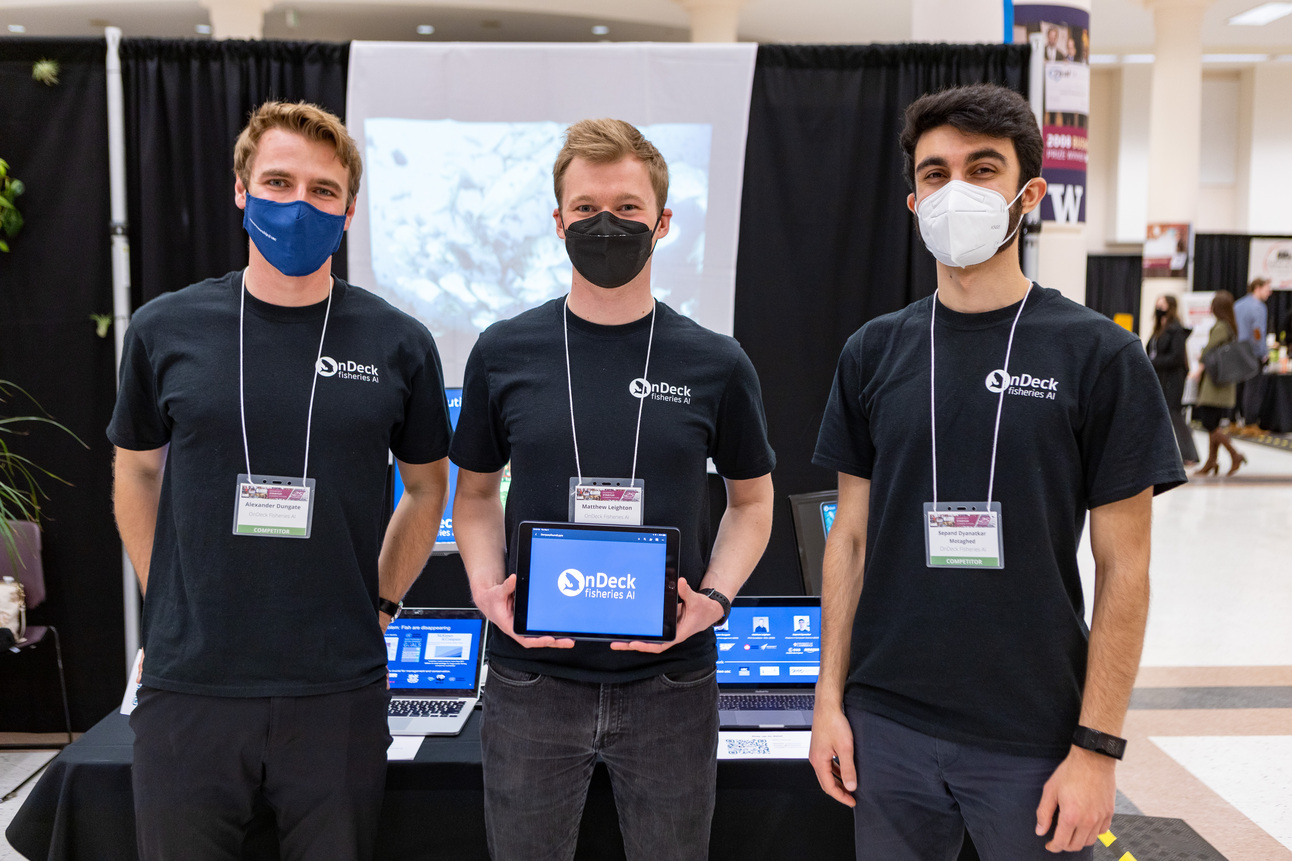
Competitions supplied early oxygen. OnDeck won the grand prize and the Internet of Things prize at the University of Washington's 2022 Dempsey Startup Competition. It also won Canada's Ocean Idea Challenge and a Sustainable Harvesting Spotlight at Ocean Impact Pitchfest. By early 2023, the company reported more than C$170,000 in grants and awards. The Trebek Initiative later awarded Dungate C$27,387 for a sustainable fisheries-monitoring pilot, work that made him a National Geographic Explorer. He was also named a Young Ocean Leader by the Sustainable Ocean Alliance.
The prizes mattered, but the boats mattered more. A project with Ha'oom, a partnership of five Indigenous Nations on Canada's west coast, showed what faster review could change. The cameras were already required. The resulting information, however, could disappear into systems the communities did not readily control. Automated review could reveal catches and discards, map fishing pressure, and return usable information to the people managing the fishery. In Dungate's compact diagnosis, “Fisheries are data-starved.” Better analysis offered speed, but also a path toward data sovereignty.
How a narrow problem widened
03 / The hard part travelsWhy ugly footage became a generous teacher
Fishing footage is a hostile place to make computer vision behave. Cameras differ. Light changes. Decks move. Water lands everywhere. The important event may be a few seconds inside a trip's worth of nothing much. A rare or previously unseen species can be precisely the thing a monitor cannot afford to miss. Conventional systems often demand a large labeled collection for every new task, followed by training and deployment. The ocean does not care for tidy datasets.
Those constraints pushed OnDeck toward a more general approach. In December 2024, Dungate co-authored a workshop paper with Sepand Dyanatkar and Angran Li on open-domain vision for ocean monitoring. Their preliminary method combined pretrained vision-language models with retrieval-augmented generation, allowing outside knowledge to help identify species without domain-specific training. The paper did not pretend the research was finished. It established a direction: systems that could meet an unseen class with something more useful than a shrug.
Task-specific vision
- Collect and label examples for a defined target
- Train a model for that particular task
- Rework the pipeline as conditions change
OnDeck's direction
- Describe the object, event, or behavior in language
- Search across unfamiliar, long-form footage
- Apply one vision engine across varied settings
By 2025, that research direction had outgrown the company's original noun. OnDeck joined Y Combinator's Summer 2025 batch and presented Perception-0, a model intended to find an object, event, behavior, or sequence in video without a customer training a bespoke model. The public customer list widened to include robotics research, security cameras, port monitoring, offshore oil and gas, autonomous surface vessels, and national defense organizations. The legal fossil of fisheries remained in the company's history. The product had sailed into a larger category.
This was a pivot in market, not a rejection of the first mission. Fisheries had forced the team to confront the generalization problem early. It supplied terrible cameras, scarce labels, rare events, and real consequences. A polished laboratory example might have been kinder. It would have taught less.
04 / The founder changes tooFrom reluctant entrepreneur to public operator
Dungate's public advice has the texture of someone who discovered the job after discovering the problem. He tells young founders to research first, confirm that people genuinely need the thing, and then act. He talks about feedback without dressing it as a pleasant experience. People will tear an idea apart. The useful response is to keep updating the underlying truth, separating a hard lesson from a shallow misunderstanding.
He also preserves a line that sounds as if it belongs on the side of a surf van: “Stay Stoked.” At OnDeck, it means holding on to the passion and energy behind the work even when company building becomes punishing. The phrase works because it sits beside, not instead of, the less decorative habits: customer calls, market research, technical publication, pilots, and the willingness to change course.
That operator has become more visible. In late 2025, Dungate wrote about meetings with the Canadian Army's commander and hosted a delegation from Singapore's Defence Science and Technology Agency in connection with an OnDeck partnership. He has also offered blunt advice about startup accelerators, arguing that founders should optimize for partners, founder networks, and track records rather than simply the largest headline cheque. The student sending messages into generic inboxes now sits across from institutions whose procurement processes can be as imposing as any ocean.
“Stay Stoked. Never lose the passion, and the excitement, and the energy.”Alexander Dungate on the internal OnDeck saying
05 / What remainsThe professional fisherman who has not fished professionally
There is a pleasing incompleteness to Dungate's relationship with the industry that started all of this. He grew up around fishing. He studied fisheries. He built software for fishing vessels. He has never been a professional or industrial fisherman. In 2023, he said it remained on his list and that he would love to try it. Founders are often encouraged to do the customer's job. Dungate may yet take the instruction literally.
Meanwhile, the company faces the more consequential test of making its broad claim useful. Video is abundant because cameras are cheap; understanding remains expensive because rare, subtle events refuse to announce themselves. OnDeck's wager is that language can become the interface to that backlog, and that a system trained to reason across scenes can travel farther than a cabinet of narrow detectors.
The origin still offers the cleanest explanation of Dungate's instincts. He notices the part of a system where human patience has become infrastructure. He asks the people living with it whether the pain is real. Then he brings an engineer's appetite for generalization to a biologist's respect for untidy reality. The first target happened to have fins. The next one might be a vessel behaving strangely, a robot crossing a boundary, or a brief sequence in a week of security footage.
A slide moved on. Dungate stayed with the problem long enough for the problem to grow.