Alex Lam once came close to a career in property development. In 2013, a job with Country Garden promised a doctoral candidate a respectable salary and a route into project management. There was a catch: geography. He wanted Guangzhou; the placement did not work out. Years later, remembering the rejection, he sounded grateful. A property developer had inadvertently helped send a financial researcher into Bitcoin.
It is a pleasingly untidy beginning for someone whose subsequent work has involved making complicated financial machinery easier to use. Lam became a founder of RockMiner, then a co-founder and the original chief executive of RockX. Across mining, staking and investment, the recurring question in his career has been practical: how does a person participate in this economy without having to master every machine underneath it?
The doctorate meets the electricity bill
Lam holds a doctorate in financial engineering from South China University of Technology. His early working life included an economic research institution connected with Shenzhen’s land administration. The qualification and the institution suggest an orderly professional route. His own account of those years is less reverent: he wanted freedom, and routine institutional work offered too little of it.
He also described an early reluctance to embrace Bitcoin. Rock Xie, whom he called his guide into the industry, kept raising the subject. Lam was occupied with research projects and reports. The idea took time to land. That hesitation matters. His entry into crypto involved a change of mind, a friend’s persistence and an unfamiliar business to learn.
RockMiner began in late 2013. The name attached itself to the tangible end of a supposedly intangible currency: mining machines, facilities and the work of keeping equipment productive. A digital asset can acquire a wonderfully airy vocabulary. Mining brings the conversation back to premises, hardware and power. The electricity supplier remains impressively indifferent to anyone’s philosophy of money.
The following downturn tested the operation. By 2015, Lam had chosen to leave chip manufacturing behind and concentrate on mining farms and cloud mining. Competing with manufacturers able to pour money into research demanded resources RockMiner could not match. Giving up that contest narrowed the business and helped it survive. In Lam’s career, subtraction deserves a place beside invention.
Run the farm.
RockMiner’s mid-decade pivot concentrated the business on mining operations and services.
That decision changes how the later ventures read. A founder who has already stepped away from one expensive race has reasons to examine the next opportunity carefully. The interesting achievement is the willingness to change which part of a system he operates. The machine can remain useful even when making the machine becomes somebody else’s business.
A second way to keep a blockchain running
By the time Lam turned toward proof of stake, RockMiner had expanded to three mining farms. Six years of operating experience gave him a particular view of participation: the technical work was substantial, and newcomers had to decide whether to undertake it themselves. RockX grew out of the possibility of doing some of that work for them.
His co-founder Xinshu Dong brought a different background. Dong, a computer scientist and former chief executive of Zilliqa, had worked on secure systems and blockchain engineering. Lam brought mining operations and financial training. Their collaboration joined experience of running a crypto business with experience of building the networks on which such businesses depend.
RockX launched in 2019 with staking services for individual and institutional customers. The proposition was straightforward enough to explain without a whitepaper: token holders could use a service to participate in supported networks and receive staking rewards. The difficult work lived inside the service. Lam also spoke about verified transactions, governance and connecting networks with their token holders.
RockX’s early description of the problem was unusually concrete. It identified volatile prices, uneven access to information, complicated wallets and exchanges, and the expertise needed to run mining or staking operations. Those are different obstacles, requiring different responses. A clearer interface can help someone navigate a service; it cannot settle every question about an asset. The company’s proposed answer included choosing products and making the operational experience easier. Its challenge was to make those choices useful to people arriving with different levels of knowledge.
There was a useful restraint in that ambition. An industry can invent a new method of coordination and still leave its users struggling with the controls. A service business earns its place by making those controls manageable. For Lam, the commercial opportunity lay partly in the distance between an interesting protocol and a person willing to use it.
and farm operations
and validator nodes
In May 2020, RockX described a business with a Singapore headquarters and a Shenzhen team. Its first validator had been for IoTeX. The team also discussed research, onboarding tools and industry information alongside node operations. That mix is revealing: helping people enter a technical market requires explanations as well as working software.
The adoption problem has people in it
Lam’s thinking about wider adoption extended beyond staking. Speaking about cashless payments in 2019, he welcomed faster transactions and lower settlement costs, while acknowledging that people dependent on cash could be left behind. He raised security concerns too. Those qualifications gave his enthusiasm a practical boundary: a payment system has to accommodate the people expected to use it.
He regarded Singapore’s combination of policy initiatives, projects, funds and exchanges as a useful environment for blockchain development. The attraction was an ecosystem of institutions and capabilities. A network needs participants; a company trying to serve that network needs a surrounding business world. For a founder moving between Chinese mining operations and a Singapore venture, that was a consequential distinction.
His comments on custody exposed another accommodation. Large financial institutions, he argued, would want the confidence that established custodial arrangements could provide. He acknowledged concerns about concentration while supporting institutional participation. Decentralization, in this account, had to coexist with customers who expected someone identifiable to take responsibility for handling their assets.
This is where Lam becomes more interesting than a list of ventures. His public positions allow for the inconvenience of actual customers. They may want rewards without running nodes, security without managing everything themselves, or new financial tools with familiar operational assurances. Serving them involves compromises. A business built around access has to live with those compromises every working day.
Twenty million dollars, with developers attached
In September 2020, RockX announced a five-year, $20 million investment programme for the Polkadot ecosystem. Individual projects could receive up to $500,000 worth of DOT, alongside technical support. RockX would receive tokens or equity. The announcement made the company’s role broader: an operator could also help finance and build the applications that might bring people to a network.
These were the programme’s announced terms. At launch, no project had yet been accepted, and discussions were preliminary. Keeping that distinction preserves what was significant about the decision. Lam was committing RockX to a method of supporting an ecosystem; the announcement itself could not establish what every subsequent investment would achieve.
He described two interests within Polkadot: essential components that could attract users and developers, and projects exploiting the network’s particular capabilities. Governance and communication between chains featured in that thinking. The selection logic was more specific than simply backing a fashionable name. It asked what builders would need and what the network allowed them to do differently.
A wallet partnership, then another experiment
In January 2021, RockX partnered with Moonstake to support Polkadot staking, and Lam was appointed an adviser to Moonstake. The arrangement connected node operations with a wallet provider. It offered a concrete version of the access problem: put the specialist service within reach of people through a product they could already use.
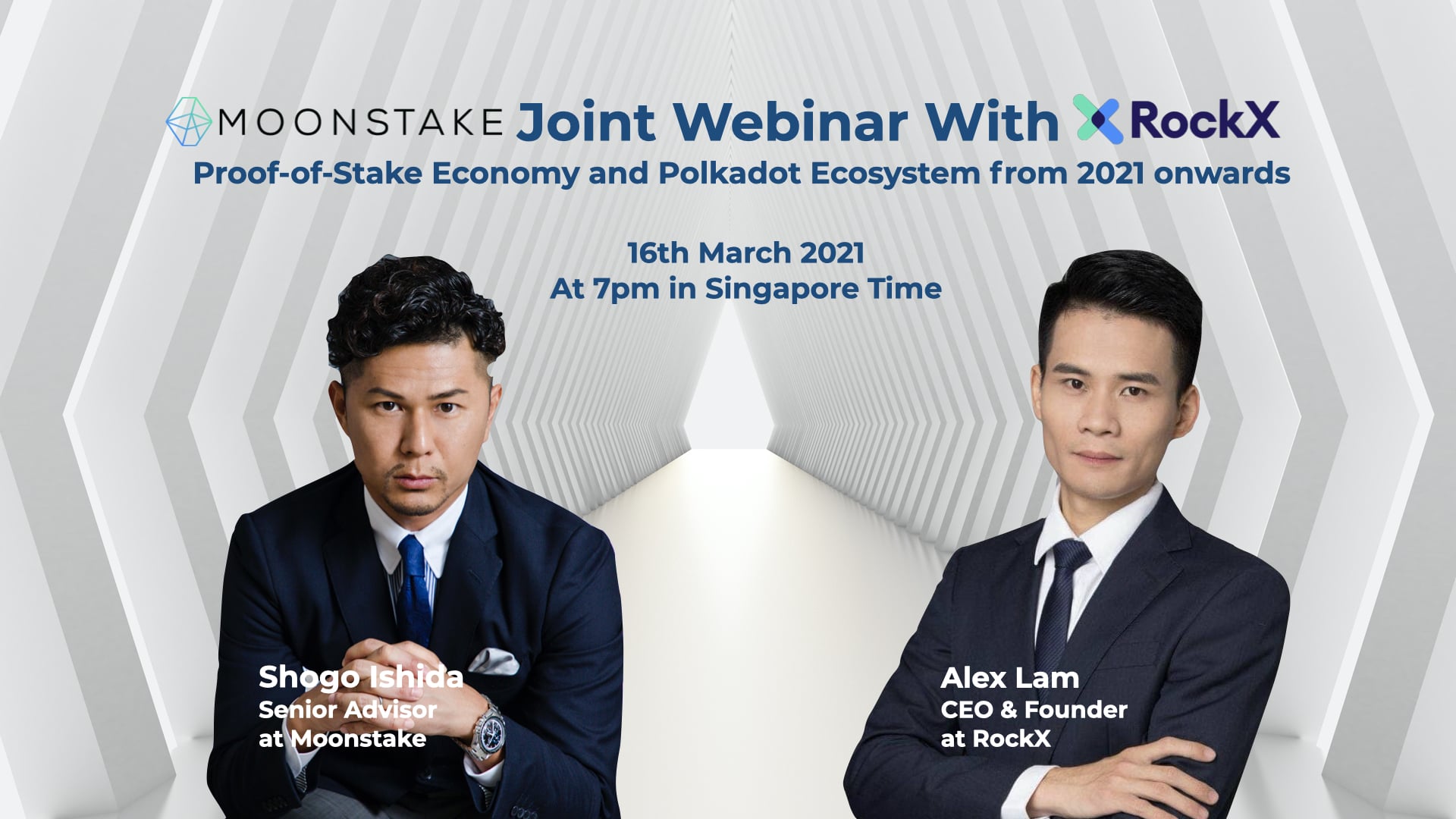
The partnership also had an explanatory side. A March webinar paired Lam with Moonstake adviser Shogo Ishida to discuss Polkadot and the staking economy. The agenda included how participation worked and what the two businesses hoped to accomplish together. Teaching the customer was part of making the service usable. Infrastructure, occasionally, needs a microphone.
That year, Lam appeared as project lead for Stone, discussing yield management and the use of staked assets within decentralized finance. Some RockX developers were working on it. He described a strategy that would assess credibility and the durability of returns, rather than choose a protocol simply because its advertised yield was high.
“I like the challenge of life.”
Alex Lam, January 2021
The line is brief enough to resist the solemnity that often surrounds founder biographies. Away from work, Lam has said he enjoys films, particularly blockbusters, and swimming. He named Satoshi Nakamoto as an admired figure. The combination feels apt: large imagined worlds on screen, an anonymous inventor in finance, and a working life concerned with what makes an elaborate system function.
The business beneath the interface
RockX now describes its work in terms of institutional staking, node access and validator infrastructure. Its current offering gives a company’s perspective on the direction Lam helped establish in 2019: operating blockchain services so customers can concentrate on their own products. The emphasis has become more explicitly institutional, while the underlying problem remains recognizable.
Lam’s route into that problem began with a doctorate, a rejected property job and a friend’s persistent interest in Bitcoin. It continued through manufacturing decisions, mining farms, a collaboration with Dong and services for token holders. The career is best understood through those choices about where to work inside a changing industry. Each opened a different way to make participation possible. Even a business built around digital assets eventually comes down to somebody keeping the equipment running.
Keep reading & follow
- RockX · company website ↗
- Alex Lam · X ↗
- RockX · LinkedIn ↗
- The 2020 conversation · original Chinese interview ↗
- RockX team spotlight · 2019 ↗
- Cashless payments · interview ↗
- RockX and Oasis · node operations ↗
- The Polkadot investment announcement ↗
- Polkadot builders · Lam’s investment interests ↗
- Moonstake partnership · 2021 ↗
- Stone · January 2021 AMA ↗
- Custody and institutional participation ↗
- RockX · company blog ↗