Zhenwu Shi once slept with his phone under his back. According to InfStones’s company history, the point was to feel incident alerts before a customer felt the incident. His early collaborator, Sili Zhao, worked from a dormitory; Shi worked from a bedroom. Between them, they handled sales, infrastructure, and round-the-clock response. It is an unusually intimate origin for a business whose eventual product would be distance: the distance between building a blockchain application and being responsible for its plumbing.
- InfStones runs blockchain nodes, supplies data APIs, and operates staking infrastructure.
- Its buyers include developers, exchanges, wallets, custodians, and blockchain protocols.
- The bargain: buy operational expertise so your team can spend more time on its own product.
01 The chore beneath the revolution
A blockchain can be decentralized and still require somebody to maintain a computer. Applications need access to transactions and balances. Validators need reliable operation. Software changes; machines need attention. The grand promise of an independent network rests on a collection of rather dependent activities.
InfStones occupies that gap. It sells the connection to the network and the work behind the connection. An exchange adding another asset, a wallet checking balances, or an analytics team reading transaction history can use its infrastructure instead of assembling every component themselves. Its published customer materials name Binance, Circle, OKX, BitGo, and CoinList. These are different businesses with a shared appetite for fewer operational surprises.
Shi founded the company in 2018 after working as a software engineer at Oracle. The company says two other early founders left during the crypto downturn. What failed early was confidence among part of the founding group. The surviving business focused on work that customers still needed, however fashionable the industry became.
02 Three doors, different errands
The platform presents three main choices: Node, Staking, and API. That separation matters. Someone who wants blockchain data is buying a different service from someone who wants a validator operated. A node is the machinery; an API is a way to ask that machinery questions; staking involves participating in a network’s validation and reward system.
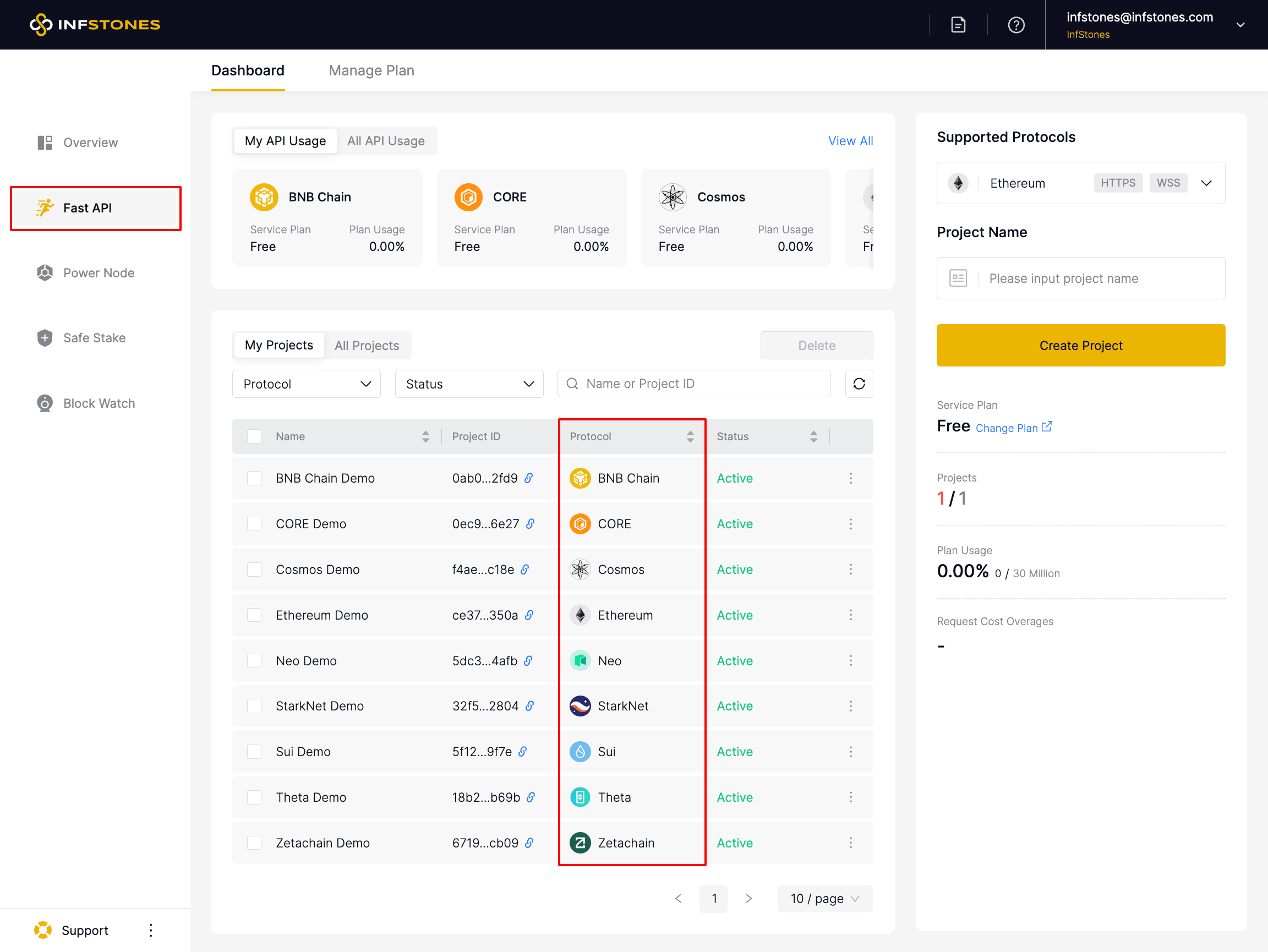
Fast API documentation gives developers a practical starting point: find a project, obtain its endpoint, and connect the application. The endpoint can support balance lookups, transaction submission, and smart-contract interaction. Dedicated node services offer another route when a customer needs its own resources. The useful distinction is how much infrastructure the customer needs to control.
Staking services address a separate burden: operating validators while the customer retains custody under the relevant product’s model. Non-custodial does not mean consequence-free. Protocol rules still determine withdrawal timing and penalties. InfStones’s EigenLayer withdrawal guide, for example, describes an Ethereum validator exit followed by an additional seven-day escrow period.
“Our goal is to bring the AWS experience to Web3.”
Zhenwu Shi · February 2022
03 The bill follows the work
The commercial model resembles other infrastructure services: start small, then pay as requirements grow. Fast API offers a free plan and paid upgrades. Its documentation distinguishes request cost from a simple request count. Checking the latest block number is relatively light; a large log query can consume considerably more resources. Ten polite questions and ten enormous questions should not be mistaken for the same workload.
For a buyer, the lesson is to test actual traffic. A prototype’s cheapest plan may say little about a production application’s bill. Dedicated resources introduce another purchasing decision. Choose capacity and access around the application’s needs, then compare the price of that arrangement with the staffing and maintenance it replaces.
There is investor money behind the arrangement. InfStones announced a $33 million Series B in February 2022, alongside a self-service interface for nodes and APIs. A $66 million financing followed in June, led by SoftBank Vision Fund 2 and GGV Capital. The stated spending plans covered team growth, product development, new markets, partnerships, and possible acquisitions.
04 A surprisingly economical database
A joint Oracle engineering account offers a less ceremonial measure of expertise. In 2022, InfStones’s query service worked over billions of records. Some first-run queries were too slow. Engineers reorganized data to match the query index, reducing physical input/output eightfold. The account quoted $0.64 per database hour for two OCPUs of compute, excluding the rest of the operating bill. The copyable lesson is data locality: inspect how records are retrieved before buying more hardware.
less physical I/O
after reorganizing the data
05 Trust also needs maintenance
In July 2023, researchers identified a vulnerability associated with the open-source library Tailon. InfStones’s November account said it removed the library, blocked affected external access, and rotated credentials. It reported no exploitation in its investigation. The potential impact was disputed; the public Lido governance discussion also considered precautionary validator exits and key rotation.
That episode gives buyers something more useful than an immaculate sales pitch: a record to examine. InfStones announced SOC 2 Type I attestation in November 2023 and Type II in January 2025. Those attestations address controls; they cannot promise that nothing will ever go wrong. Ask how incidents are disclosed and handled, alongside the familiar questions about uptime.
06 The next interface is a question
The newer products keep shortening the route to useful information. An April 2026 Ethereum dashboard aggregates multiple wallets, but only validators and rewards associated with ETH staked through InfStones. July brought Blockchain Intelligence for Claude: 14 read-only tools for Ethereum and BNB Chain, including failed-transaction investigation and fund-flow tracing. It does not sign transactions or move funds.
InfStones competes in overlapping markets with providers such as Blockdaemon, Alchemy, and Infura. Its proposition combines managed nodes, staking, and API access. Whether that combination helps depends on the job: supported networks, required control, traffic patterns, and withdrawal constraints. Buying an endpoint is easy. Buying the right arrangement requires knowing which responsibilities you are handing over. Somewhere behind the effortless interface, a person still has to answer the alert.
Take the next step
Explore the platform, try a connection, or follow the company’s updates.