Imagine two payments trying to touch the same bank balance. One adds money; the other spends it. Doing both at once sounds efficient until the second payment reads yesterday’s answer. That little collision explains rather a lot about Monad, a blockchain whose engineers want to accelerate financial software without asking everyone to learn a new language.
- Ethereum-compatible contracts, running on an independent Layer 1.
- 300-millisecond blocks and 600-millisecond full finality in current documentation.
- Live applications include Uniswap, Aave, and MetaMask’s Money Account.
Monad’s method is optimistic: begin transactions in parallel, check what they read, and repeat the work when an earlier transaction changes the answer. The final results still follow the block’s original order. The apparent shortcut preserves the accounting. Anyone who has waited for a payment confirmation can appreciate the ambition, even without wanting to meet the database.
A familiar language, a different factory
Keone Hon, James Hunsaker, and Eunice Giarta started Monad in 2022. Hon and Hunsaker brought experience from Jump’s trading world, where waiting is an engineering defect with a price attached. Their new problem was a blockchain industry with useful software, established developer habits, and considerable friction whenever users became busy together.
The Ethereum Virtual Machine, or EVM, supplies the instruction set behind a vast collection of smart contracts. Monad retains compatibility with that bytecode. Developers can bring existing contracts and familiar tools rather than translate an application into another programming environment. The pitch has an appealing courtesy: the customer gets faster machinery without being assigned an entire new vocabulary.
Underneath, the team built fresh execution and consensus clients in C++ and Rust. Parallel processing is one part. Asynchronous execution separates agreement about transaction order from doing the computation. MonadDb, a custom database, addresses the disk reads that would otherwise leave those eager processors waiting. Improving the checkout clerk accomplishes little if every receipt must be fetched from a distant cupboard.
- 01Agree on order
- 02Execute together
- 03Check & retry
- 04Merge in order
The stopwatch needs a footnote
Monad’s current documentation puts design capacity at more than 10,000 transactions per second for typical transactions. It reports 300-millisecond blocks and 600-millisecond full finality. These numbers describe different things. Capacity concerns how much work the system is designed to handle; block time concerns its rhythm; finality concerns when the ordering becomes settled.
A July 23, 2026 upgrade shortened blocks from 400 to 300 milliseconds and full finality from 800 to 600 milliseconds. Those are useful improvements for trading and liquidations, where delay can leave an application exposed to moving prices. They do not tell us how many customers have arrived. An empty motorway can be beautifully engineered.
Public testnet opened on February 19, 2025; mainnet followed on November 24. Uniswap supported both. That progression matters: developers could rehearse the experience before transactions involved real assets. The company also published its clients as open source, allowing other engineers to examine the machinery rather than admire its advertised specifications.
The market was waiting when Aave arrived
The more interesting test came on July 2, 2026, when Aave deployed 12 markets on Monad. By then, stablecoins, yield-bearing assets, and Chainlink infrastructure were present. A lending protocol needs assets worth borrowing against, dependable prices, and people who want to borrow. Speed helps the transaction happen; those surrounding pieces give it a reason to happen.
Monad’s September case study says that, after 46 days, the Aave market held $321 million in total value locked and ranked third among Aave deployments by weekly fees. That is a company-reported snapshot, not a permanent league table. Still, fees offer a useful clue: capital was doing something beyond sitting decoratively in a pool.
“Developers shouldn’t have to choose between speed, security, and usability.”
Keone Hon, at the November 2025 mainnet launch
MetaMask made the proposition easier to picture. Its Money Account launched on June 30, 2026, using Monad as its exclusive canonical chain. The self-custodial dollar account combines earning functionality and card spending through mUSD. A customer can encounter the infrastructure while managing a balance, rather than shopping for a blockchain. Financial plumbing rarely receives compliments; it receives repeat usage.
An expensive way to save everyone else a rewrite
The funding was substantial. Monad announced a $225 million round led by Paradigm in April 2024. A later token-sale disclosure lists approximately $262 million across funding rounds. Neither figure is a development-cost receipt. They describe money raised to support the work, not a documented total spent building the network.
The organizational arrangement also matters. Monad Labs became Category Labs; a separate Monad Foundation was introduced in December 2024. Category Labs develops core technology and sells professional services. The Foundation supports adoption and ecosystem development. Users pay network fees in MON, which also supports staking. A token purchase does not buy company equity or a claim on company earnings.
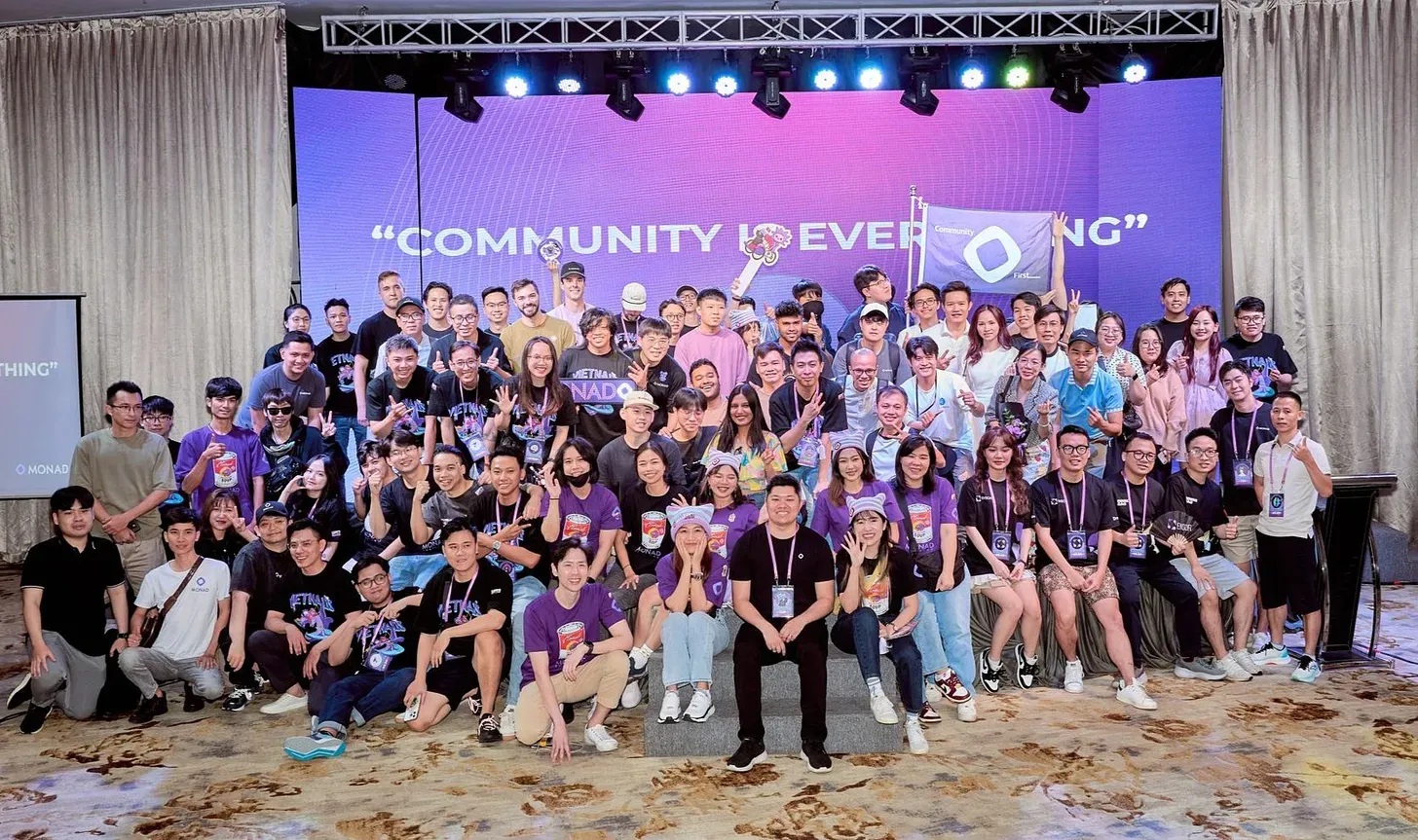
The engineering culture sits beside a sociable ecosystem of hackathons, Discord discussions, and meetups. Both have practical jobs: software needs contributors, and applications need people willing to try them. The cheerful purple gatherings make the project approachable. They cannot, by themselves, supply a lending market with borrowers.
Keep the interface. Check the bill.
A builder can copy the underlying lesson: preserve familiar interfaces while improving the expensive work behind them. On Monad, start with testnet, bring an existing contract, and test its assumptions. Compatibility does not erase operational differences. Transactions are charged against their gas limit, and historical-state access requires planning. An application that ignores these details can acquire a surprisingly expensive education.
Nor will parallel execution rescue every workload. Transactions that repeatedly compete for the same state need dependency checks and re-execution; a fast chain cannot manufacture liquidity or make an unsafe contract safe. Ethereum, its scaling networks, and Solana remain alternatives with their own ecosystems. Monad’s opportunity is to make familiar financial software useful at a different pace. Its customers will decide whether that pace is worth moving for.
Open the machinery
Explore Monad, the developer documentation, open-source client, and live applications.
Follow X, LinkedIn, Discord, or the Monad blog. Read Uniswap’s mainnet walkthrough.
Watch & listen
The Chopping Block: Monad’s parallelization with Keone Hon
The Scoop: How Monad aims to supercharge DeFi
Monad Foundation on YouTube