The founder of a company devoted to getting rid of paper had a piece of paper he wanted to keep. Alex Fielding framed a family property deed and hung it in his Ripcord office. Its value lay in a decision recorded there: when his parents left Africa, they left part of their property to the people who had worked for them.
A deed is an unlikely piece of startup décor. It has neither the motivational efficiency of a slogan nor the pleasing roundness of a funding announcement. Fielding kept it as a reminder of how he wanted to treat people. In an office building machines to make documents searchable, an old document was doing some searching of its own.
That small inversion is a useful way into his career. Fielding has worked on computers, location technology, document robotics and space data. The scale changes considerably. The frustration often looks familiar: something valuable exists, but the people who need it cannot readily find it, understand it or use it.
The document worth keeping
Fielding’s account of his childhood begins with a daily accommodation. His mother was Muslim; his father was Roman Catholic. They drove together to their respective places of worship, taking turns waiting while the other prayed. Their son grew up seeing the arrangement as ordinary. Only later did he recognize the generosity involved in letting another person remain themselves.
He described family conversations about public problems and what a person ought to do about them. The deed gave those conversations a physical form. It was evidence of a choice his parents had made, rather than an instruction they had given him. His essay ended with the observation that “entrepreneurship, like everything else, is a team sport.”
Keep that sentence in mind. It expresses an aspiration, and aspirations are useful precisely because conduct can be measured against them. A founder’s story becomes less useful when the admirable sentences are permitted to stand in for the entire record.
The staple problem
Fielding’s engineering career included Cisco and Apple, followed by work at Exodus Communications. In 2001 he co-founded Wheels of Zeus with Steve Wozniak. The name, conveniently shortened to WOZ, brought a little mythological grandeur to the practical business of location technology. Knowing where things are would remain a recurring interest.
His subsequent work included technology leadership at Power Assure and a vice presidency at Vigilent. He also worked as a contractor in NASA’s Office of the CTO. These roles took him through enterprise systems and government technology before Ripcord made the filing cabinet an engineering target.
Consider the distance between possessing a record and being able to use it. A company can preserve a document perfectly and still make it practically unavailable. Someone must know where to look, retrieve the right box, inspect the right folder and recognize the relevant page. A warehouse can become a remarkably expensive way of postponing a search.
Ripcord’s approach combined physical handling with software. Its robotic workcells removed staples, scanned pages and helped move records into a cloud system where they could be indexed and connected to enterprise applications. The company’s public launch in March 2017 came with a $9.5 million Series A led by Kleiner Perkins, with investors including Wozniak.
Conceptual comparison of the companies’ approaches. The steps describe functions, not measured performance.
The staple deserves a moment of respect. Software discussions tend to begin after information has arrived in a computer. Paper insists on being dealt with earlier. A fast search engine cannot do much with a page still fastened inside a box. Ripcord placed machinery at that awkward boundary between physical records and digital access.
It also offered a service rather than leaving customers to assemble every component. Handling a page, recognizing its contents and retrieving it later are connected jobs. A scanned image can be as frustrating as a paper folder if nobody can find the information inside it. Fielding’s business depended on completing that journey.
The culture question
The record at Ripcord includes a serious challenge to its founder’s account of leadership. In 2018, former employee Perry Coneybeer alleged harassment and said she had been dismissed after complaining about the workplace. Her allegations included inappropriate comments by Fielding. They were allegations, rather than findings establishing every claim.
Ripcord commissioned external investigators. The company said their review had not substantiated all claims, but had identified inappropriate behavior and aspects of the culture its board would not tolerate. In March 2018 it announced that Fielding would move from CEO to chief product officer while remaining a director. It also announced additional training, reporting mechanisms and board oversight.
That episode belongs beside the family deed and the language about teamwork. The subjects are connected by the responsibilities of running a company. Today, Ripcord lists Fielding as a co-founder and director. Sam Fahmy is its president and CEO. Fielding’s current executive role is at Privateer.
A friendship with an orbital address
Wozniak’s place in Fielding’s story extends beyond a recognizable name on a company announcement. Fielding was best man at his wedding. Their professional relationship has lasted across different ventures; their friendship has lasted through the intervals between them. When Wozniak discussed Privateer, he described Fielding as the person who brought him into the project.
Privateer was founded in 2021 with a third co-founder, astrodynamicist Moriba Jah. The combination matters. Building a useful space-data business calls for knowledge of orbital behavior, engineering and the practical work of organizing a company. A celebrated computer designer alone would make an interesting announcement. A working company needs people who can answer different questions.
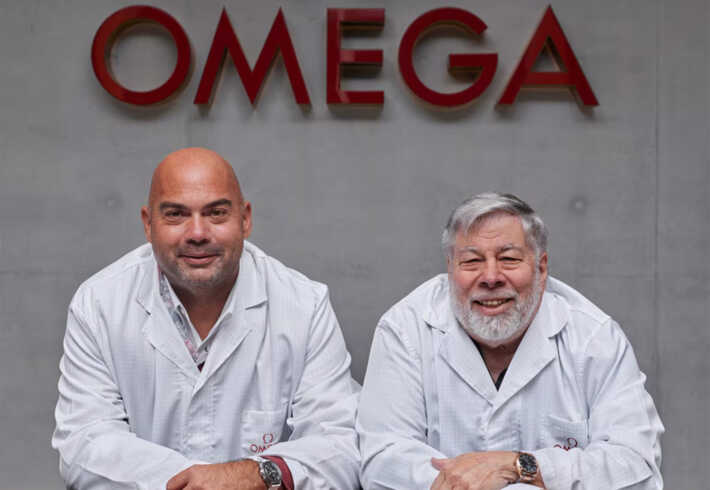
The photograph of Fielding and Wozniak in white coats at OMEGA supplies a pleasant detour. A watchmaking visit puts the pair among instruments built around precision and time. Their space venture deals with objects whose positions only become useful when time is part of the description. The coats, at least, are easier to keep track of.
Privateer’s early public identity centered on understanding the traffic above Earth. The company’s Wayfinder visualization made satellites and debris visible as an organized picture. Looking at a sky full of objects can make an abstract issue suddenly legible. Empty space begins to look rather more occupied when someone supplies the map.
In a 2022 conversation, Fielding, Wozniak and Jah discussed the relationship between orbital infrastructure and everyday activity on Earth. Navigation, agriculture and communications depend on systems people rarely see. Their discussion also reached beyond engineering into governance and stewardship. A useful map raises questions about who contributes information and who gets to act on it.
The view comes back to Earth
The business subsequently widened. In May 2024, Privateer announced $56.5 million in Series A funding and its acquisition of Orbital Insight. The acquisition brought Earth-observation analytics into a company associated with satellite tracking. It connected a view of the instruments overhead with a way to interpret the world those instruments observe.
Alongside its acquisition of Orbital Insight
There was a commercial reason for the change. Fielding described limited revenue prospects in space situational awareness alone. The acquisition expanded the services Privateer could sell. A technically important problem still needs a workable market, and the people who need a safer orbit are not necessarily the same customers who buy intelligence about a port or a supply chain.
Orbital Insight’s TerraScope platform brought a search-oriented approach to satellite imagery. Paired with Privateer’s tracking capabilities, it suggested a business in which observations could be connected and reused. The aim was to make existing information serve more customers, rather than requiring every question to begin with a fresh collection effort.
There is a recognizable family resemblance to the paper business. Collecting information is one expense; making it usable is another. A record can sit in a warehouse. An image can sit in a separate data system. In both cases, possession alone leaves the customer with work to do.
An island, and a wider field of view
Fielding’s public profile places him in Kihei, Hawaii. The location gives his story a different geography from the customary procession of Silicon Valley offices. Hawaii also appears in his explanation of Privateer’s outlook: a base connected to the wider world, with perspectives shaped by its position in the Pacific.
His ambitions now include tools for interpreting supply chains, infrastructure and other activity across Earth and orbit. Privateer’s April 2026 coverage emphasized supply-chain intelligence; a July 2026 interview returned to space data and private industry. The company’s current description includes combining ground-based sensors, optical systems, radio-frequency information and orbital datasets into a reconciled picture.
“Stay committed to the problem, not just your first idea of the solution.”Alex Fielding, 2025
That advice allows for a less orderly career than a polished biography usually admits. A company can begin with one service and discover that its customers need a broader one. An engineer can move from documents to satellites and still recognize a familiar obstacle. The job is to decide which parts of the original idea deserve to survive contact with the customer.
The family deed survives for a different reason. Its information was already accessible to Fielding; its meaning grew when he looked again. Across his businesses, the harder task has been to create that opportunity for other people: bring the material within reach, establish what it says, and make it useful. Somewhere between the box and the orbit, there is still a person waiting for an answer.
Follow the work
Privateer · Ripcord leadership · LinkedIn · X · Instagram
Watch: Fielding, Wozniak and Jah on the data highway above ↗
Fielding’s family-deed essay
The 2025 founder interview
The 2018 Ripcord leadership announcement
Reuters: the Orbital Insight acquisition