At 8 a.m. on Monday, March 22, 2021, Alex Feiszli noticed the clock. The ordinary next step was to open his IBM laptop and begin the workday. He had spent the previous stretch as a senior container DevOps engineer, solving multi-cloud problems inside one of computing's old institutions. The less ordinary next step was the one he took: he left. In an essay published that morning, he gave the decision a clean title - Risk vs. Regret.
The gamble was not on a sparkling consumer app. It was on networking, a subject Feiszli himself has called less than sexy. Networking is the infrastructure industry's plumbing: essential, technical, and most visible when something refuses to connect. As applications scattered across cloud providers, Kubernetes clusters, offices, data centers, and edge devices, Feiszli saw an awkward gap. Compute had learned to travel. The network still behaved like a landlord with a clipboard.
He and IBM colleague Dillon Carns had first imagined something even broader - a cloud provider that owned no infrastructure and drew its capacity from users. The idea required a fast mesh VPN capable of joining machines in different places. They surveyed what existed, found no fit for the job, and built the missing piece. The prerequisite soon became the point.
“So, we built Netmaker to solve our problem.”Alex Feiszli, on the product's origin
A career spent collecting useful friction
Feiszli did not arrive at this problem from a dorm-room thunderbolt. His path moved through the places where enterprise systems acquire their rituals. He worked at Deloitte from 2015 to 2017, then in Red Hat consulting roles at Crossvale, and joined IBM in 2019. Y Combinator's profile says he worked with more than 20 enterprise clients on DevOps, Kubernetes, and multi-cloud implementations. He also appears among the research contributors to Deloitte's Tech Trends 2018.
That sequence matters because Netmaker's problem is clearest when viewed from inside a large system. A company might own servers, rent several clouds, run a Kubernetes cluster, keep equipment in a branch office, and deploy devices at the edge. Each environment can be perfectly competent alone. Making them communicate securely, quickly, and predictably is where the diagrams begin to develop unfortunate personalities.
There was an earlier tell. In 2013, Feiszli created Group Maker, a web application that helped professors form project teams from student survey data. It is a modest project, but the instinct rhymes with his later work: take a fussy coordination task, encode the constraints, and let software make the arrangement.
The side project finds its users
Netmaker was released on GitHub in March 2021. It used WireGuard, a lean VPN protocol, and added the orchestration around it: distributing configurations, managing keys, updating peers, and letting an operator define a network without hand-editing every machine. Feiszli has described the product in several ways - a WireGuard controller, Docker for networking, and a virtual private cloud for distributed systems. The metaphors all try to domesticate the same unruly beast.
People arrived. Some ran it in home labs. Conveniently, many home-lab people have day jobs in IT. Feiszli later wrote that business use grew from none at the beginning to roughly 45 percent of the user base by Netmaker's first birthday. Personal experimentation became professional adoption through the same pair of hands.
The team kept adding the things real networks demand: ingress and egress, private DNS, relays, clients for more operating systems, access controls, metrics, and failover. It also rebuilt major pieces. During Y Combinator's Winter 2022 batch, the architecture shed gRPC and gained a message-queue broker. The charming myth of software is that progress looks like accumulation. Much of the serious work looks like removing the thing you were certain about six months earlier.
After YC, Netmaker announced a $2.3 million round with investors including Lytical Ventures, Uncorrelated Ventures, SaxeCap, Y Combinator, and Pioneer Fund. In the same period, the company said more than 1,200 organizations and individuals were running the platform. The money was assigned an unromantic job: hire people, develop the paid product, and keep writing better code.
Two IBM engineers take the mountain road
The partnership at the center of the company began before the company. Feiszli and Carns worked together building cloud software at IBM and led a multi-cloud platform engineering team. During the pandemic, both moved to Asheville, North Carolina. The city gave Netmaker an identity distinct from the usual startup map: Blue Ridge Mountains, breweries, and a young infrastructure company trying to connect machines scattered across the planet.
By 2022, Feiszli was explaining the premise in local and international conversations. On Adventures in DevOps, the subject was connecting Kubernetes clusters across clouds. On Asheville's Talking 'Ship, it was how the founders started, where the funding would go, and whether a 1990s film reboot could ever justify itself. He told technology reporters that distributed applications were outgrowing the networking tools available to control them. The setting changed; the diagnosis did not.
His current public profiles place him in Austin, Texas, while the company's early story remains tied to Asheville. That movement fits the thing he builds. Netmaker is less interested in where a machine sits than in whether it can join the right private network under the right policy. The founder, meanwhile, has carried an Appalachian company story to a city where infrastructure software can find plenty of people willing to discuss it over coffee.
There was also the less visible migration from engineer to executive. A public recommendation from a colleague singles out Feiszli's willingness to give up coding time to grow the business. For a technical founder, this can feel like leaving the interesting room to work in the corridor. Customers, hiring, assignments, incentives, and check-ins become another control plane. The code may be cleaner than the calendar, but the calendar is now part of the product.
“Networking definitely isn't the sexiest topic out there, but it is fundamental to everything we do.”Alex Feiszli, 2022
Four years to earn a zero
In 2025, Netmaker finally called a release 1.0. Feiszli said the team had asked itself for years when that label would be deserved. The answer eventually came down to three conditions: a broad enough feature set, a zero-trust framework, and confidence in platform stability. The release added identity-provider synchronization, system settings in the interface, audit logs, and multi-factor authentication for basic authentication.
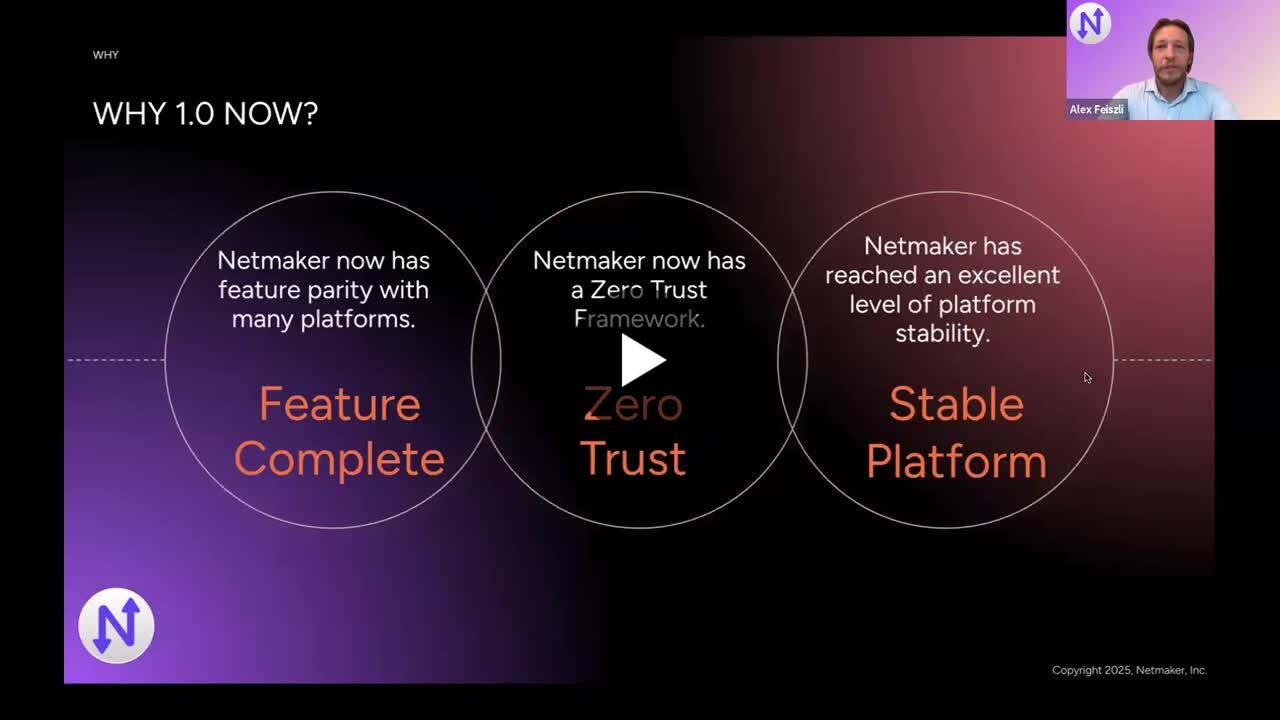
The patience is revealing. Infrastructure companies sell confidence while working in a medium famous for surprises. Calling software complete enough is partly a feature decision and partly a promise about how many alarms it will cause at 2 a.m. Feiszli's framing treated stability as product work, not housekeeping.
The tinkerer at the controls
Feiszli's official biography prefers the word “fiddling.” He says he spends his time fiddling with Netmaker, WireGuard, VPNs, networking, routers, cloud, security, DevOps, and Go. When not doing that, he helps customers improve their network management, automation, and security. It is an engineer's understatement: the list contains most of a modern infrastructure department.
Public recommendations from colleagues describe an approachable, technically adept leader who accepts feedback and avoids micromanaging. One recalls that he deliberately surrendered some coding time to focus on growing the business. Another, a contractor, remembers Feiszli proactively raising his rate. Those details give the founder story a useful correction. The heroic coder is a popular figure; the person who notices when someone should be paid more is often more useful.
There is humor, too. Years before Netmaker, Feiszli wrote LinkedIn essays about algorithmic literacy and a neighbor's tiny dog. In late 2025, he warned followers about a seasonal security exploit involving an unsecured chimney, a nocturnal actor, and mysterious package installation. Recommended mitigations included patching the fireplace and clearing all cookies. Network security rarely gets a decent Christmas joke. He supplied one.
Still building the glue
Netmaker 1.6.0 arrived in June 2026. Its features show how far the project has traveled from basic WireGuard automation: an applications catalogue for access to cloud services, native export to security platforms such as Splunk and Datadog, site-to-site access controls, narrower rules for resources behind an egress route, and improvements to enrollment and just-in-time group access.
The vocabulary became more enterprise, but the original idea survived. Machines live in different places. People need them to behave as one controlled system. The network should be fast, secure, and manageable by someone who would rather be working on the application.
Feiszli once compared WireGuard's potential in networking with Kubernetes' effect on computing. That is an aspiration measured in years, standards, integrations, and a spectacular quantity of edge cases. He has also admitted that building a VPN is very challenging. Both statements can be true. Ambition provides the direction; inconvenience writes the weekly schedule.
The useful thing to steal from his story is not a protocol choice. It is the habit of noticing a dependency everyone tolerates, building the piece you need, and publishing early enough for users to correct your assumptions. A grand vision may open the door. Sometimes the stubborn little prerequisite is the company waiting on the other side.