Before Alejandro Flores-Hernández worried about a grocery order crossing Maracaibo, he worried about machinery that could fill a building. He trained as a mechanical engineer at Universidad del Zulia, then spent more than ten years as a field service engineer installing gas turbines around the world. His public résumé connects that chapter to General Electric, Rolls-Royce and Siemens. The job rewarded a particular temperament: arrive where the machine is, understand how its pieces depend on one another, and make the system work outside the comfort of a diagram.
That background makes his second career look less like a pivot than a change of scale. QUIK, the company he co-founded with designer Mauricio Martínez, takes on another apparatus full of interdependent parts. This one begins when somebody wants lunch, groceries or a household item. It must recognize how they can pay, find a participating merchant, coordinate a delivery and keep the experience simple enough that the customer does not need to admire the plumbing. A turbine announces complexity. A buy button hides it. The engineering obligation remains.
Where the edge cases are the market
QUIK grew from a Venezuelan checkout problem. Paying could mean dollars or bolívares, cash or a transfer, PayPal or Zelle, with crypto in the mix. Change could be awkward. Money sent by relatives abroad still needed to turn into useful spending at home. Delivery added a second set of handoffs. Software built for tidier markets could arrive looking polished and remain entirely unprepared. In a 2022 interview, Flores-Hernández said QUIK supported more than 15 payment methods, a number that sounds excessive only if you have the luxury of one reliable default.
The product bundled the mess into a consumer app: order food and goods, pay through a preferred rail, use a wallet, scan a QR code at participating businesses and let QUIK handle delivery. Its business-facing ambition was broader still. QUIK Pro was presented as a suite for a merchant’s website, inventory and logistics, synchronized with the consumer marketplace. The phrase “operating system for business” is common startup furniture. Here it describes a literal effort to stop several commercial subsystems from behaving like strangers.
“Lo desarrollamos con las uñas, con muy poco dinero.”Alejandro Flores-Hernández, 2022
The line translates roughly as building it with their fingernails, with very little money. It is a better startup image than a garage because it describes effort without pretending the surroundings were quaint. Flores-Hernández and Martínez were not merely importing a playbook. They and their team developed the platform themselves, which meant feedback from early users could become a product change without a translation layer. QUIK moved from testing to an official launch in January 2021. By March 2022, its founders said it had 40,000 users in Maracaibo.
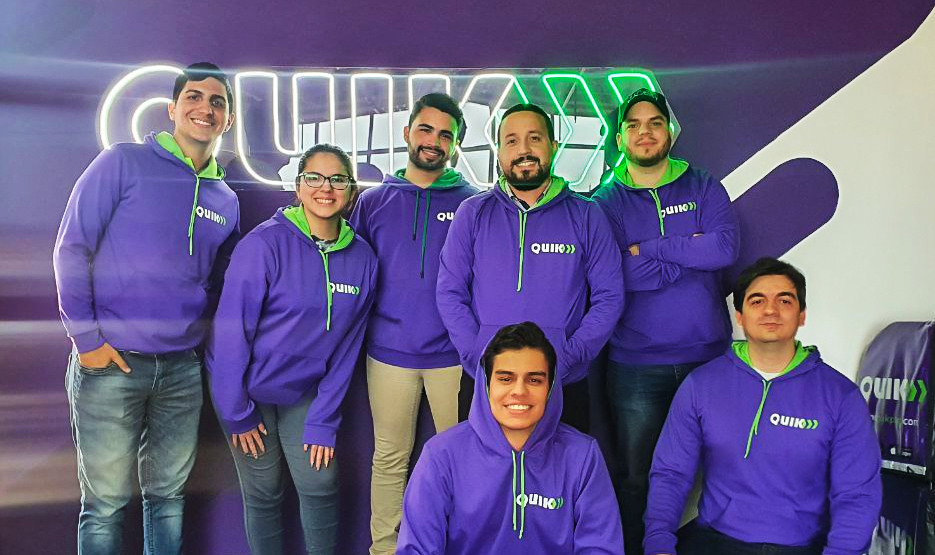
Maracaibo as an unfair advantage
Both founders are from Maracaibo, a city they treated as more than a hometown pin on the company map. They adopted a local saying, “Si pega en Maracaibo, pega en todos lados,” and turned it into a meme: if it works in Maracaibo, it works anywhere. The claim is playful, but the product logic is serious. Build amid hard constraints and the happy path stops dominating the roadmap. Payment exceptions, merchant habits and delivery quirks are present from the first day. The founder cannot wave them away as somebody else’s emerging-market problem.
That intimacy supplied context, and context was the scarce technology. Martínez argued that an app produced elsewhere could be technically competent yet locally disoriented. The team lived the same commercial confusion as its customers. This made Maracaibo a useful stress test and gave QUIK a story larger than inconvenience: a company designed in Venezuela, by Venezuelans, for conditions they understood directly. In 2022 it became part of Y Combinator’s Winter batch. The accelerator still lists QUIK as active in Maracaibo and Flores-Hernández as an active founder.
The engineer did not disappear
Flores-Hernández describes himself as “a mechanical engineer by education and a system engineer by heart.” It is a compact explanation for why a founder would look at an online order and see an architecture. A transaction contains dependencies: identity, currency, merchant stock, software, routing and trust. The customer experiences only whether those dependencies cooperate. This is field service in a new costume. The machine is distributed across phones, shops, drivers and ledgers, and it cannot be repaired with a wrench.
His earlier work also lends QUIK’s ambition an operational accent. Flores-Hernández did not present the company simply as a wallet or a courier. He spoke about taking the model built in Maracaibo across Venezuela, while the company described a longer path toward Latin American business infrastructure. That requires more than a consumer interface. It means giving merchants a digital presence, tracking inventory and coordinating logistics without losing sight of the buyer waiting at the end. The unglamorous connections are the product.
A résumé built for handoffs
The details of Flores-Hernández’s technical education make the continuity clearer. His professional profile records training in heavy-duty gas-turbine fundamentals, maintenance and hands-on service, along with coursework on Rolls-Royce RB211 and Trent equipment. It also lists project-schedule management and technical writing. Those subjects live at different ends of an engineer’s notebook: what the machine does, when the work must happen and how another person can understand it. QUIK requires the same range in compressed form. Code must express the transaction, operations must move the order, and instructions must survive contact with a shopper who has better things to do than study a payment system.
His LinkedIn history places parts of his earlier career in Venezuela, Mexico City and Abu Dhabi. Y Combinator’s biography reduces those years to a clean sentence about installing turbines around the world. The geography matters because field work is an education in variation. The same class of equipment meets a different crew, timetable and site. Commerce software faces its own version of that lesson: a product category may travel, but assumptions do not always clear customs. Flores-Hernández’s public description of himself as a systems engineer “by heart” feels less like a title claim than a preference for looking at the spaces between jobs, where one team’s output becomes another team’s problem.
The idea worth borrowing
Let the customer’s complete job define the product boundary. Industry categories are tidy; real errands rarely are.
There is restraint hidden inside the breadth. The company began in one city. The founders used a place they knew to learn how a larger system might work. Their 2022 expansion plans named Venezuela first and opportunities abroad later. Local depth was the method for earning regional ambition. It also prevented “Latin America” from becoming a decorative market label. For QUIK, the region began with a specific cashier unable to make change, a relative sending money home and a merchant who needed an online storefront to agree with the stock on a shelf.
“Queremos llevar ese modelo implementado en Maracaibo hasta Venezuela.”Alejandro Flores-Hernández, 2022
A machine made of choices
Flores-Hernández said the company believed users should retain freedom to choose among competitors and payment methods. That position fits the architecture. QUIK’s appeal depended on accommodating plurality rather than declaring one victorious rail. A stable-looking experience could sit on top of unruly options. The same philosophy explains the combination of consumer and merchant tools: neither side of a marketplace becomes useful alone, and delivery does not become real because an icon moved across a screen.
The story remains an unusual joining of biographies. A mechanical engineer met a graphic designer and marketer, and together they built a company in a city rarely treated as the default location for venture-backed software. One founder brought years of seeing complex equipment in the field; the other brought the language of design and customer attention. Their product sat between the two disciplines. It had to coordinate serious operational machinery while feeling like a click.
Flores-Hernández’s career offers no magical turbine trick for founders. Its value is more practical. Expertise travels sideways. The habits acquired while commissioning industrial equipment - tracing dependencies, respecting local conditions, taking responsibility when theory meets a site - can survive an industry change. QUIK gave those habits a new object. Instead of making energy equipment run, he began trying to make commerce flow through a difficult environment with fewer visible seams.
A customer ordering dinner will never applaud the architecture. That is the bargain. If the system works, complexity disappears into an ordinary act: choose, pay, receive. For a founder who spent a decade around machines, invisibility may be the most mechanical achievement of all.