Alec Zhou’s preferred unit of recruitment appears to be one cup of coffee. The invitation recurs in his public hiring notes: send the résumé, name the role, and if there is a fit, he will buy. It is a modest ritual for a company operating in a less modest moment. AfterQuery is growing in San Francisco by turning professional judgment into material that artificial intelligence systems can learn from. Zhou, its Founding Talent Lead, has the neatly circular job of finding that judgment in human form.
His work sits behind the part of an AI company that is easiest to overlook. Models need chips, capital and code. A company trying to teach them how experts reason also needs engineers who can build training environments, operators who can turn a difficult idea into a repeatable process, and specialists whose instincts have been sharpened by actual work. All of those people have alternatives. Many receive the same messages from many ambitious companies. The recruiter has to make one opportunity legible amid the general roar.
Zhou’s public biography is economical. He studied at the University of California, Berkeley from 2021 to 2024. Where another profile might inventory societies and seminars, his reduces the extracurricular portion to three repetitions: “Startups, startups, STARTUPS!” His summary is shorter still: “Builder or Operator?” The question reads like a personal classification problem, left deliberately unresolved. His career so far suggests that he prefers the slash.
The useful education of a blank page
Before AfterQuery, there was Amya Agency. Zhou describes his year there as building an agency “from the ground up,” a phrase that can be made to sound cleaner than the experience. In his telling, the year meant doing a little of everything: working alongside founders, creating systems that did not exist, and solving messy problems every day. The glamour of zero-to-one work is mostly visible after the one has appeared. Before that, it tends to look like a calendar full of exceptions.
Agency work offered him a broad window into young companies. A recruiter can watch founders decide what they value when the answer must become a person, a salary and a seat. The job exposes the difference between a role written from a template and a role arising from a real constraint. It also teaches the cost of a weak process. A misplaced interview, an unanswered candidate or a fuzzy decision may look small in isolation. Repeated fifty times, it becomes company culture with an inbox.
Zhou credited Kam Jamshidian for mentorship during that period and thanked the Amya team when he left. The note mattered because his next role preserved the central lesson while changing the vantage point. Instead of helping several founders assemble their companies from the outside, he would join one company and help build its people system from within.
“Building an agency from scratch meant doing a little bit of everything.”Alec Zhou, on his year at Amya Agency
A recruiter moves inside the machine
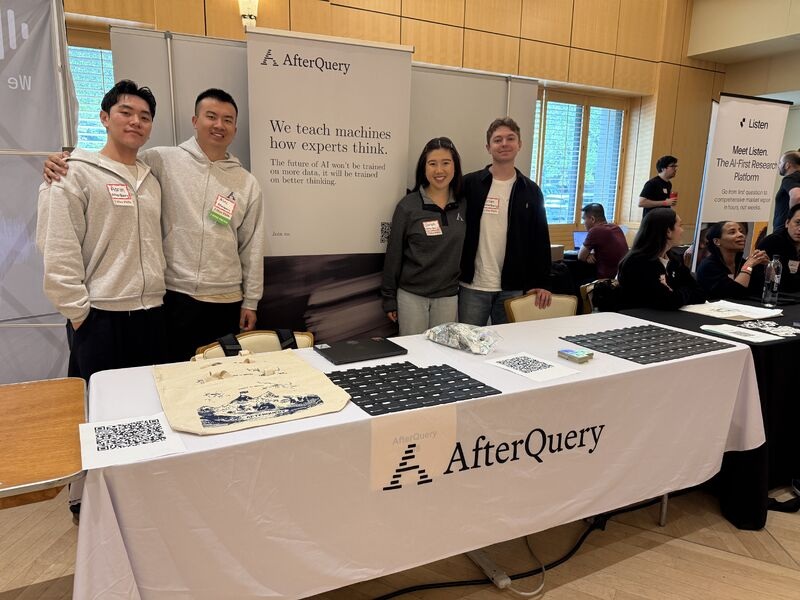
In March 2026, Zhou announced that he was joining AfterQuery as Founding Talent Lead. His explanation began with data. AI systems, he argued, had consumed oceans of noisy internet material, generic datasets and synthetic output. Better performance on complicated professional work would require another kind of input: data shaped by domain expertise, careful validation and the sequence of decisions that experts make.
That is also AfterQuery’s stated premise. The company describes itself as an applied research lab that turns real-world work into training data. Its products include supervised fine-tuning examples, reinforcement-learning tasks with grading rubrics, tool-rich agent environments and recorded computer-use trajectories. The connecting idea is that expertise does not live only in the final answer. It lives in the tradeoffs on the way there.
For Zhou, the thesis gives recruiting unusual proximity to the product. Talent is not merely a support department serving a laboratory. The company’s raw material is human capability, both among employees and within the wider expert network. Finding people with judgment, and building systems that preserve their judgment rather than flatten it, belongs near the center of the work.
His first public call named software engineers across product, applied AI, machine learning and infrastructure, along with strategic-project leads, growth and go-to-market talent. The list crossed the familiar border between technical and commercial hiring. At an early-stage company, borders are often penciled in. A founding talent lead has to recruit for the organization that exists on Monday and the one its leaders expect to need by Friday.
The candidate hidden inside the job description
AfterQuery announced a $30 million Series A in April 2026 at a $300 million valuation and said it had passed a $100 million annualized revenue run rate. Five months later, a new financing was reported at a $3.2 billion valuation. The numbers explain the velocity around the company, but they do not explain what Zhou looks for. For that, his candidate descriptions are more useful.
He has invited former founders who want to build again, engineers who want ownership from beginning to end, bankers and consultants prepared for a quicker tempo, and operators comfortable with real scope and little bureaucracy. The categories sound different on paper. Their common trait is appetite. Each describes someone willing to exchange an established track for a messier field of action.
There is a selective honesty in the pitch. Zhou writes that AfterQuery is not a place to coast. A sentence like that does two jobs. It attracts candidates who want intensity and gives everyone else useful permission to decline. Good recruiting is partly an exercise in exclusion without insult. A clear “no” from the right person saves time on both sides.
“If we want models that can truly reason, solve complex problems, and operate in the real world, we need a new generation of training data.”Alec Zhou, announcing his move to AfterQuery
Zhou’s style is visibly social. Congratulations arrive with rocket symbols. New colleagues are celebrated in compressed bursts. Open roles come with a direct-message invitation and the recurring offer of coffee. None of this constitutes a grand theory of personnel. It does reveal a preference for energy made public. Recruiting depends on private judgment, but momentum is easier to feel when people can see others joining.
Building the team that builds the team
By mid-2026, Zhou wrote that AfterQuery had doubled its headcount over the preceding months. His response was recursive: hire a technical recruiter and a talent coordinator. One person would source and close engineers in a market where many companies chase a narrow pool. The other would run a high-volume process without losing either the details or the candidate’s sense of being treated as a person.
Those two jobs reveal the operating system beneath recruitment. Sourcing creates possibility. Coordination converts it into an experience. Closing turns interest into commitment. Neglect any one and the funnel develops leaks, though “funnel” is a bloodless word for dozens of people making consequential decisions about where to spend their days.
The word “founding” in Zhou’s title is doing considerable work. It implies no inherited apparatus sturdy enough to disappear into. Every interview loop, scorecard, follow-up rhythm and hiring-manager habit can become precedent. Move too slowly and the company misses people it needs. Move without care and it acquires a culture by accident. The task is to give speed a shape.
This is where his agency year returns as preparation. Building systems from scratch is less about inventing novel boxes and more about noticing repeated friction early enough to name it. Which candidates stall? Which interviews produce signal? Where does ownership vanish between two calendars? The answers are not decorative human-resources work. In a company adding technical and operating capacity at pace, they determine how much attention everyone else has left for the product.
The paradox on his desk
Zhou now works inside a useful paradox. AfterQuery exists to make expert thinking teachable to machines, while his own job relies on forms of recognition that remain stubbornly human. A résumé can list experience. It cannot fully show how a person behaves when the process is incomplete, the role changes shape or the answer is not yet in the building. Someone must ask, listen and decide.
Perhaps that is why “Builder or Operator?” works as both biography and invitation. The two identities are less opposed than they appear. Builders make something new. Operators keep it coherent long enough to matter. Zhou’s career has moved from a university preoccupation with startups, through the untidy education of an agency, into an AI company attempting to codify expertise. At each stop, he has chosen the seam where an idea becomes a team.
The machines may learn to execute more professional work. For now, somebody still has to assemble the room in which that learning happens. Zhou is working on the guest list, the process and, when the match looks right, the coffee.