Aldo Carrascoso had been put on the waitlist at Babson College. He wanted to study entrepreneurship. Waiting quietly for somebody else to decide his future seemed an awkward way to begin. So he boarded a plane and appeared at the admissions office at seven in the morning, without an appointment.
An admissions director explained that this was an unusual contribution to the application process. Carrascoso had a question of his own: “Do entrepreneurs follow the process?” It is a splendidly inconvenient thing to ask an admissions office, an institution whose entire purpose involves having one. He eventually earned his MBA in 2008.
The episode offers a useful way into his career. Carrascoso has helped build businesses around finding partners, licensing videos and moving money between countries. Today he leads Vivum AI. The industries change; the question about the process keeps turning up. Who designed it? Who has to wait? What would happen if somebody built a different route?
“Do entrepreneurs follow the process?”
Aldo Carrascoso, on his Babson admissions visit
A psychology degree, with the computer left on
Carrascoso grew up in San Juan, in Metro Manila, in a family where technology was part of everyday life. He recalls writing code while still in grade school. Years later, describing those beginnings, he remembered a household that encouraged experimentation. The computer was already an object to work with, rather than a profession to discover at university.
At Ateneo de Manila University, he studied psychology. For someone who would become a technical founder, the choice has a practical logic. Software can encode a decision. Persuading a group of people to make that decision together is a separate undertaking. He has spoken about wanting to understand how people are motivated and how they grow.
The pairing survives in the titles he has held: chief technology officer, chief operating officer, chief executive. Each demands a different conversation. An engineer needs to understand the mechanism. A colleague needs to understand the purpose. A customer needs something that works. Carrascoso’s education gave him reasons to pay attention to all three.
Before the viral videos, a business needed a match
At Babson, a startup was part of the work. Verego grew out of that period, applying matchmaking to businesses looking for partners. In the winter 2009 alumni magazine, Carrascoso and fellow MBA graduate Brett Ackerman were already being described as two of its original founders. The company helped clients find local expertise across borders.
Carrascoso later used a deliberately familiar comparison: “Tinder for companies.” The joke does some useful explanatory work. A directory tells you that a business exists. A matching service has to decide whether two businesses belong together. The difference is the beginning of a product, and also the beginning of a considerable argument about what makes a good match.
Verego is an early example of his interest in the machinery between two willing parties. Buyers and suppliers can both be ready to do business and still struggle to find each other. The opportunity sits in that gap. A connection has value when it saves somebody the effort of making the wrong one.
Somebody has to do the paperwork for the pratfall
At Jukin Media, the willing parties were video creators and the companies that wanted their footage. Carrascoso became a founder and CTO, helping build the technology beneath a business devoted to discovering, acquiring, distributing and monetizing user-generated video. Jonathan Skogmo and Josh Entman were his fellow founders.
The public saw the clip. Behind it came ingestion, rights management and distribution: the less photogenic tasks that make a piece of footage usable by a commercial buyer. Carrascoso describes his role as building that infrastructure. A funny moment might travel by instinct. A licensing business needs a system that can keep track of where it went.
Jukin’s brands included FailArmy, People Are Awesome, The Pet Collective and WeatherSpy. In August 2021, Trusted Media Brands acquired the company. During 2020 alone, Jukin had licensed more than 2,000 clips for major advertising campaigns, alongside licensing for television and digital properties in nearly 100 countries. Those numbers belong to the company’s later development, rather than to one founder’s personal output.
There is a pleasing absurdity to the enterprise: elaborate technical and commercial arrangements built around the things people record by accident. Yet the work underneath is serious. Someone owns the footage. Someone else wants permission to use it. Making that transaction routine can be a business as consequential as making the next video.
A payment should arrive with fewer adventures
Carrascoso’s move into payments began with a familiar cross-border frustration. Sending money home, he found a gap between the amount he sent and what people received. In his telling, the fees and intermediaries turned a simple intention into an expensive journey. That personal experience helped shape the thinking behind Align Commerce, later renamed Veem.
He co-founded the business with Marwan Forzley and served as COO and CTO. Its approach used multiple payment rails, including blockchain, to move money between businesses. The useful distinction was between the customer’s task and the technology inside it. A business needed to pay another business. The route could be chosen behind the scenes.
Their names also appear together on the application titled “Multiple payment rail gateway and router,” filed in November 2015 and published in May 2017. The document describes choosing exchanges and routes using criteria such as fees and exchange prices. It gives the career story a concrete piece of engineering: a way to evaluate the journey a payment should take.
A router is an unglamorous protagonist. It selects, compares and directs. It does not need the customer to become fascinated by its internal life. That quality fits this chapter of Carrascoso’s work particularly well. The more elaborate the machinery becomes, the more valuable a straightforward experience can be to the person using it.
Different companies, different seats at the table
InterVenn Biosciences became another company he co-founded and led as CEO. He is now its former chief executive. Keeping those tenses straight matters in a career with several ventures: a founder’s connection to a business can continue after the operating job changes. The founding story and the present job are different entries on the same résumé.
His current position is CEO and co-founder of Vivum AI. His personal portfolio also lists him as a partner at Foundry1 and a co-founder of Hyperstellar. These are distinct roles, rather than interchangeable badges. Running a company, helping form companies and creating a market for computing capacity each puts him at a different part of the building process.
Read together, the roles suggest a continuing interest in the infrastructure beneath a visible result. That is an interpretation of the career, rather than a claim that every venture began with the same master plan. It is also a more useful way to follow him than treating each new industry as a complete reinvention.
Now the computer has to leave the room
Vivum works on intelligence for autonomous vehicles, robotics and devices operating at the edge. Its stated direction is adaptive, explainable autonomy that can function without depending on the cloud. In other words, the setting is the physical world, where connections can degrade and conditions continue changing whether the software is ready or not.
The company calls its approach Evolutionary AI and describes Dynamic Neural Models as central to it. Its design principles include independence from a single hardware platform and graceful degradation in difficult communications environments. These are the company’s engineering aims. They describe the requirements it has chosen to pursue, rather than a promise that every deployment has already met them.
Carrascoso has described partnering with Derek Whitley to build Vivum. In a public post introducing the work, he emphasized explainability and the ambition to make AI less demanding of resources. That concern changes the question a founder asks. Alongside what a system can do comes another test: what does it require in order to keep doing it?
The spare capacity next door
Hyperstellar approaches computing from the market side. Carrascoso’s description of the venture centers on connecting underused data-center capacity with AI demand. Discovery, routing, pricing and settlement are the proposed functions. The ambition is to make capacity that already exists easier to find and buy through a common network.
There is an echo here of Verego, though the thing being matched has changed. A business once needed a partner with the right expertise. A computing customer now needs available capacity. Hyperstellar’s proposed network begins with local markets and aims to connect them into a wider national fabric. It is a plan for coordinating supply, with the commercial work built into the architecture.
At Foundry1, where Carrascoso is a partner alongside David Riker, Eric Valle and Erwin Estigarribia, the emphasis is on forming companies around physical AI. The studio’s thesis concerns the control, sensing and other infrastructure required for systems to act in the world. Shared operations and an operating co-founder are part of its stated model. The recurring subject is the work between an idea and something people can use.
A long way from the waiting room
On September 27, 2025, Carrascoso received PhilDev’s Entrepreneurship Award at its Thrive Gala in San Jose. The event marked the Philippine Development Foundation’s fifteenth anniversary. The other honorees came from consulting, education, research and music. It placed his entrepreneurial career within a broader Filipino community, rather than within a single industry.
There is a less ceremonial description of his work in his own words: “I am a problem solver first, a technologist second.” It leaves room for both the psychology graduate and the CTO. It also puts a limit on the appeal of the technology itself. A tool earns its place by helping with the problem that brought everyone into the room.
The Babson visit remains a memorable opening because the obstacle was so ordinary. There was an application, a waitlist and an office. Carrascoso showed up early and asked a difficult question. Years later, the companies are more complicated, the networks larger and the job titles longer. The practical challenge remains recognizable: find the place where useful work gets stuck, and decide what to build there.
Follow the work
Conversations, company pages and further reading.
- Carrascoso’s personal website ↗
- LinkedIn ↗ · X ↗ · Facebook ↗
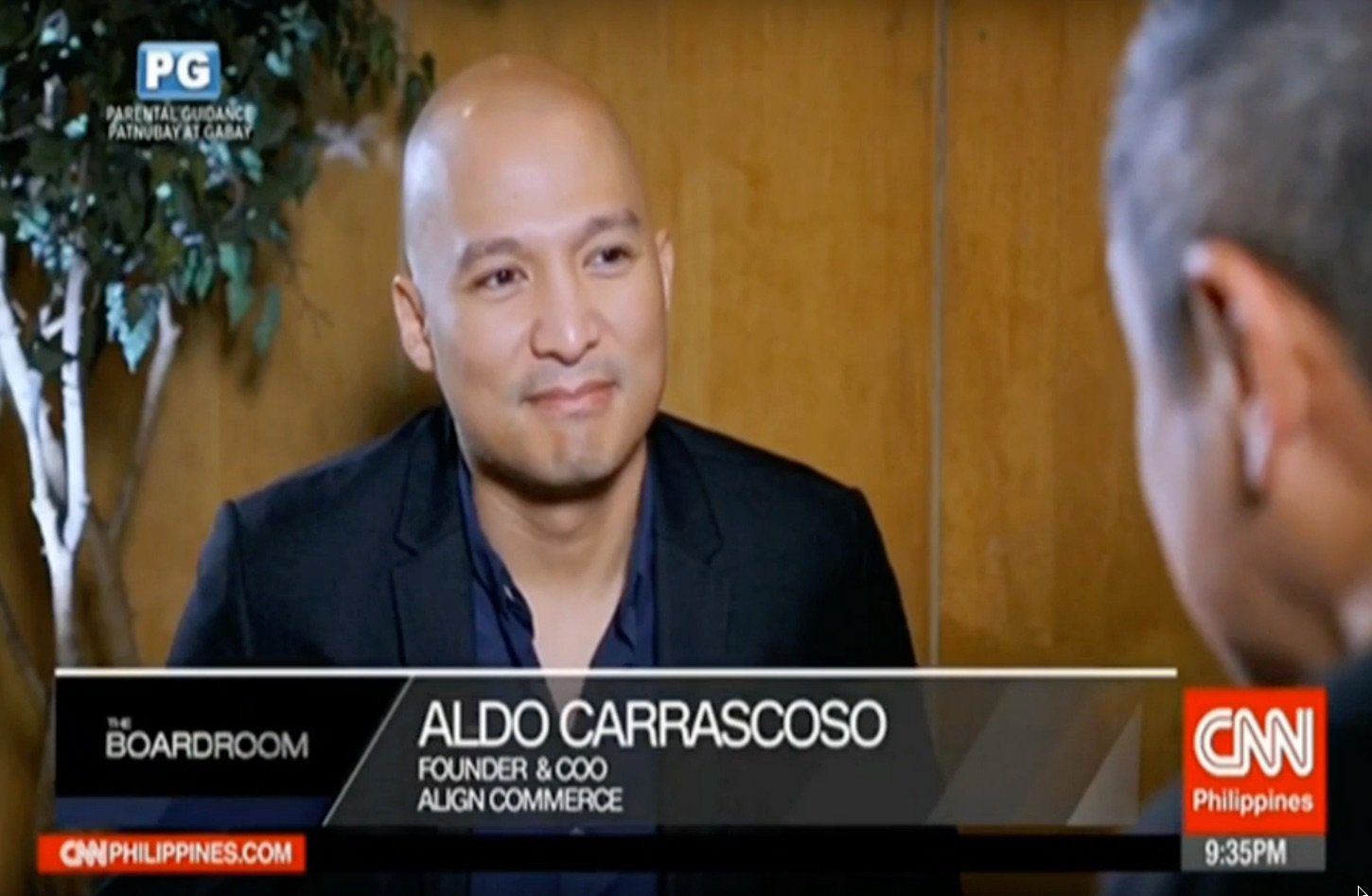
- Watch: CNN Philippines’ The Boardroom ↗
- Interviews and panels on YouTube ↗
- Babson: his entrepreneurial education ↗
- The American Dreams conversation ↗
- The payment-routing application ↗
- Jukin Media’s 2021 acquisition announcement ↗
- Vivum AI’s approach ↗ · Foundry1 ↗ · Hyperstellar ↗
- The 2025 PhilDev Thrive Gala ↗