Alan Carson was looking for a new chief executive for the company he had co-founded. At the start of 2023, he had decided Cloudsmith needed a change in management. The board agreed to explore it. Somewhere in that decision sat a demanding question for any founder: what does the company need next, and who should provide it? Carson’s answer involved recruiting someone else to do the job he was doing.
The decision fits a career with several changes of direction. An engineering problem became a business. A graduate who left Northern Ireland returned to build there. A founding CEO became a chief strategy officer. The through-line is a preference for getting somewhere useful over remaining attached to the original route.
The problem hiding inside the project
Carson graduated from Queen’s University Belfast in 2002, having studied computer science. Two days after graduating, he left Northern Ireland. He lived in the United States, then England, before coming home and joining a young startup. His later work at Wombat Financial Technologies put him inside another Belfast software business, one whose sale to the New York Stock Exchange in 2008 offered a tangible example of what a local company could become.
Wombat also brought him together with Lee Skillen. Working relationships have their own quiet incubation period: people discover how the other person thinks, what they consider worth fixing, whether they will still be useful when something breaks. By the time Carson and Skillen began Cloudsmith, their connection already had a history. Their co-founder partnership had emerged from work rather than a search for someone to put on a pitch deck.
The immediate route into Cloudsmith ran through a previous fintech startup. They needed a cloud-based artifact repository that made deployment and distribution straightforward. The available options failed to fit what they wanted. So they changed direction. The tool needed to build the business became the business they would build.
It is an origin story with very little theatrical scenery. Two engineers encountered a gap while trying to get other work done. They understood the inconvenience well enough to imagine a product around it. In an industry fond of revelations, there is something pleasingly practical about an idea arriving with an unfinished task attached.
The cupboard that software depends on
An artifact is something produced or used in the process of building software: a package, a compiled component, a container image. A software team needs somewhere to keep these things, control access to them and deliver them reliably. The application gets the applause. The repository gets a complaint if the build stops. There is a business to be made in keeping that second conversation short.
In their account of Cloudsmith’s early work, Carson and Skillen set out a particular requirement. They wanted a fully managed service built for the cloud, with security considered from the start and ordinary use made straightforward. Work began in 2016. The product launch followed in 2018. Those dates describe different stages of a process that required building before it could require selling.
PackagesSoftware ingredients→02
RegistryStore · control · distribute→03
BuildsWorking software
Carson’s comparison with GitHub helps explain the instinct. He and Skillen adopted GitHub in 2012. Source control could move away from a server somebody had to maintain. He wanted a similar release from routine maintenance for packaged software. His argument for Cloudsmith sitting alongside GitHub made cooperation part of the design: use the tools developers already work with, and connect the missing pieces.
That is a revealing ambition for an engineer turned executive. The thing being sold is complicated; the desired customer experience is less complication. Every additional system creates another obligation. A service earns its place by making an existing obligation easier to meet. Carson’s writing keeps returning to that practical relationship between infrastructure and the person trying to get through a working day.
In a platform engineering discussion, he described early customers ranging from small teams trying to automate their work to larger enterprises trying to bring disparate tools together. He recalled Australia’s MYOB arriving with about 50 developer teams. Different languages and development practices had to coexist. The challenge was to fit the tooling to the way people built software, rather than expect a whole organization to acquire one taste in programming.
“Blind optimism. Ambition needs to be tempered with realism.”Alan Carson, 2022
By 2022, recognition had arrived: Digital DNA Founder of the Year and a place among the EY Entrepreneur Of The Year Ireland finalists. Carson greeted personal awards with some awkwardness. He connected their value to the wider entrepreneurial community, where recognition could encourage other people to aim higher. The warning about optimism belongs beside those ambitions. A goal can be large and still require an honest account of the work.
A founder interviews his successor
For the next phase, Carson wanted a leader with experience growing startups and serving developers, based in Cloudsmith’s primary market, the United States. Glenn Weinstein, then chief customer officer at Twilio, entered the process. Carson remembered the relief of discovering Weinstein was first on a day’s schedule of second-round interviews. Their early rapport had already made an impression.
Weinstein started on August 21, 2023. Carson became chief strategy officer and signed off his welcome with a friendly challenge. The language has the flavour of a founder still very much in the room: pleased to have help, keen to see what happens next, and prepared to make the welcome slightly competitive.
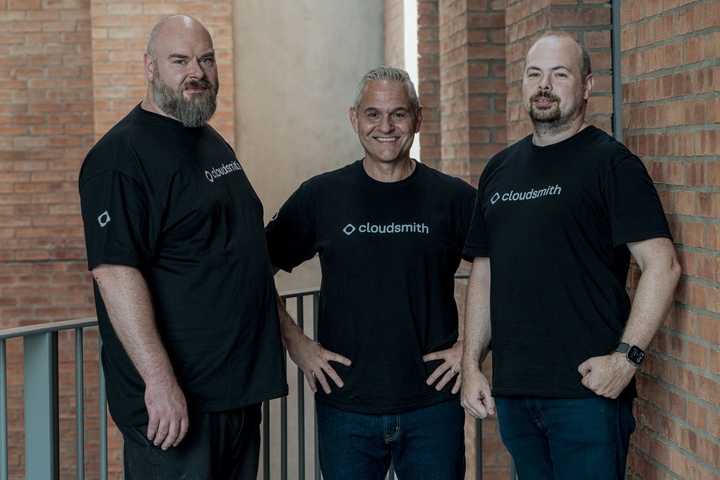
“I dare you to do better.”Carson welcoming Weinstein, 2023
The incoming CEO spent his first weeks meeting employees, customers and investors, as well as talking at length with Carson about the company’s beginnings. The handover carried a working history with it. Keeping both founders involved gave the new leader access to the reasoning behind the product and the relationships that had formed around it.
That arrangement makes an interesting point about continuity. The title at the top changed. The people who understood how the business began were still available to explain it. A successor can bring experience from elsewhere while learning the specific character of the company in front of him. The conversations between Carson and Weinstein continued well beyond the appointment.
An adventure with other people in it
Lauren Mills offered a view of Carson from inside the company in a reflection on her first year. She described choosing the CEO as much as the job, drawn to his honesty and ambition. More practically, she described being given authority to make decisions. A referral to her meant she had responsibility, rather than merely receiving someone else’s unfinished problem.
That distinction matters as a team grows. A founder cannot remain the necessary stop on every route through the business. Colleagues need scope to act and enough trust to use it. Mills’s account gives that idea a concrete workplace setting, with the warmth and occasional difficulty of a year spent building a company together.
Carson’s own reflection on a 2025 company offsite paid attention to people taking responsibility for their work. He singled out talks about sales development and customer onboarding, and the insights customers brought to the gathering. The founder’s attention had room for departments beyond engineering. A company needs someone to build the product, someone to help customers begin, and someone to notice when the beginning is harder than it should be.
His role as host of DevEx Unpacked extends that habit of listening. In one episode he sits down with Dan McKinney, an early Cloudsmith employee whose work developed from documentation and developer relations into solutions engineering. In another, he asks Weinstein about leadership, scaling and serving developers. The interviewer’s chair lets Carson draw out a company through the people doing its work.
The Weinstein conversation returns to their hiring process, the pressures of running a startup and the possibility of building in Belfast. Hearing a founder interview his successor gives those subjects an unusual proximity. These are colleagues discussing choices they have made together, with enough shared history to revisit the details. Company life becomes easier to understand when the people involved have time to talk through it.
Belfast keeps its place
Carson’s attachment to Northern Ireland is explicit. In February 2026, he wrote about wanting a stronger local software sector, more successful companies and more value flowing to employees through share ownership. He described the usefulness of connections with people from Northern Ireland living elsewhere. An introduction can cross an ocean while retaining the familiar sound of an accent.
On April 23, 2026, Cloudsmith announced a $72 million Series C. Carson used his own response to thank the people who had helped the founders learn how to raise capital and build a company. He acknowledged early backers, mentors and colleagues. Being ambitious at the beginning had still left plenty to learn. Advice, including uncomfortable advice about a pitch, had helped the pair advance.
Cloudsmith’s Series C financing, led by TCV, with participation from Insight Partners and existing investors.
The product around him had grown too. Cloudsmith reported a 352% increase in package delivery during 2025 and a 92% increase in headcount. These are company measures, with work behind them distributed across a team. They also give some scale to the operational demands facing the founders and the leadership they had assembled.
In the Series C announcement, the next product direction included stronger automated controls, richer information about where software components come from and support for AI-driven development. The original repository problem had acquired new urgency as software creation accelerated. Carson’s job now sits where a long-standing engineering concern meets a changing market.
A little room for the ridiculous
There is more texture to Carson’s public presence than a succession of funding rounds. His personal homepage introduces him through his beard and his Wombat/NYSE past. It credits him with formatting books, including titles about garden railways. The crossed-out suggestion that he was their editor gives way to the more modest description. Even a small homepage can make a useful distinction between the work someone did and the grander label available for it.
His software writing has room for jokes too. A 2020 set of horror stories recruited sharks and zombies to explain vulnerabilities and dependencies. It is an entertaining choice of teaching materials for a field that can disappear into acronyms. Technical risk becomes easier to picture when something is rattling the door.
Carson’s story is still being revised. The fintech idea gave way to infrastructure. The founding CEO made room for a successor. The ambition to build internationally kept Belfast as its starting point. Across those decisions, he has continued working with other people on a problem he first understood as an engineer. There is plenty left to build, and apparently enough time to keep a sense of humour about it.