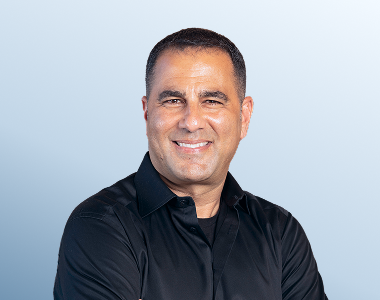
He runs a public software company and still talks about debriefs.
Walk into JFrog's Sunnyvale office and the first thing you notice is the frogs. Plush frogs on monitors. Origami frogs in the kitchen. A neon green amphibian above the door at 270 East Caribbean Drive. The second thing you notice, if you stay long enough, is that the man responsible for all of it does not act like the CEO of a Nasdaq listed company with 1,600 employees and over half a billion dollars in annual revenue. Shlomi Ben Haim acts like a major reviewing a mission tape.
He spent twelve years doing exactly that. From 1988 to 2000 he served in the Israeli Air Force, leading several units and leaving with the rank of major. He has told interviewers, more than once, that the Air Force gave him two sentences he still runs his company by. If you are focused and disciplined, you will deliver. If you debrief, you will always learn and improve. Founders love to talk about hard-won lessons. Ben Haim got his over a decade of flight lines and after-action reviews.
The civilian version started at AlphaCSP, a Java consultancy in Tel Aviv. Ben Haim joined in 2000, became CEO in 2006, and sat across the table from a developer named Fred Simon - the man who had founded AlphaCSP in the first place. The other regular was Yoav Landman, a quiet engineer with a side project nobody could quite categorize: a place to put binary artifacts. Java teams kept losing them, sharing them by email, hiding them in shared drives. Landman thought there should be a tool. He built one and called it Artifactory.
In April 2008 the three of them spun it out into a company. They called it JFrog because the J was for Java and the frog was for - well, it is hard to get a straight answer there. Ben Haim has hinted it came from the way developers leap between repositories. Whatever the origin, the name stuck, the mascot stuck, and the customers started referring to themselves as frogs without prompting.
For most of the first decade JFrog did one weird thing very well: it stored binaries. Not code, not source files, not the glamorous part of software. The compiled outputs. The packages. The containers. The Maven JARs and the npm tarballs and, later, the Docker images and Helm charts and Conan packages and every other format that nobody wants to think about until the build breaks. Artifactory became the universal artifact repository. Then JFrog added Xray for scanning, Distribution for shipping, Pipelines for building, and somewhere in there Ben Haim coined - or at least relentlessly popularized - the phrase that has become the company's whole pitch: liquid software.
The idea is straightforward and, if you think about it for thirty seconds, a little radical. Software should not arrive in versions. It should not arrive in upgrade windows. It should flow continuously from developer to production, secure, observable, signed, scanned, with no downtime. Updates as a state of nature, not an event. The fact that this still does not describe how most software gets delivered in 2026 is, in his telling, the entire reason JFrog exists.
By the time JFrog rang the Nasdaq bell on September 16, 2020, the pitch had become a business. The IPO priced at $44 per share and raised $509 million. The stock closed up 62 percent the first day, putting the company at a valuation of around $6 billion by the close. Ben Haim, who had become Chairman in January of that year, conducted his celebration interviews remotely from Sunnyvale - it was the middle of the pandemic and the trading floor was closed. He wore a frog tie. He thanked the community first.
That last detail is not incidental. Ask Ben Haim how to build a successful open source company and you will get a near-rehearsed answer. Respect the open source community. The most successful open source projects are those made by developers for developers. When building your business, don't go after developers with marketing or sales pitches but instead solve a specific pain point. He has been saying versions of this for over a decade, and he means it enough to point out, with mild pride, that JFrog has no field salespeople. Investors find this fact unnerving. Engineers find it persuasive.
The customer list does the heavy lifting. By mid 2020 some 5,800 organizations used JFrog. By 2026 the count includes all of the top ten technology companies and eight of the top ten financial services firms. In June 2025 NVIDIA selected JFrog as a core platform for its AI software supply chain - a deal that pushed the conversation past traditional DevOps into the question every AI team is suddenly forced to answer: where do your model weights live, how are they versioned, and who scanned them. Artifactory, it turns out, has opinions about all three.
Ben Haim's day job has shifted accordingly. The early years were product. The IPO years were investor relations. The current era is geopolitics. JFrog is headquartered in Sunnyvale but its heart is in Netanya, Israel, and Ben Haim spends a lot of time on planes and on cameras explaining to American audiences what is happening to Israeli engineering teams, and to Israeli audiences what is happening to American capital markets. He is, by temperament, the calmest possible person to do this. He does not raise his voice. He does not stage moments. He treats earnings calls and product launches with the same quiet seriousness he once gave a debrief.
What he does not do is act bored. After sixteen plus years as CEO of the same company - a tenure unusual for any founder, vanishingly rare for a public software CEO - he still narrates customer stories in his LinkedIn posts the way a new founder would. He still answers his own email, including the one address that has been on his profile since the early days. He still calls the customers frogs and gets away with it.
If there is a thesis underneath the career, it is that boring infrastructure matters more than anyone thinks until it doesn't. Binary repositories are not glamorous. Scanning a container for known vulnerabilities is not glamorous. Signing a build, attesting to its provenance, distributing it across a hybrid cloud - none of it makes a great keynote demo. But every time a piece of software has to move from a developer's laptop to a hospital, a bank, a fighter jet, an AI training cluster, something has to keep track of the bits. JFrog has spent sixteen years arguing that the something should be one thing, owned by the developer, audited by security, trusted by the board. Liquid software is the slogan. The frog is the mascot. Shlomi Ben Haim is the major still running the debrief.
Respect the open source community. The most successful open source projects are those made by developers for developers. Don't go after them with marketing or sales pitches. Solve a specific pain point.
- Shlomi Ben Haim, on building JFrogFrom Hangar to Headquarters
Five Sentences He Repeats Often
If you are focused and disciplined, you will deliver.
If you debrief, you will always learn and improve.
To this day, JFrog doesn't have a single sales person in the field.
The most successful open source projects are made by developers for developers.
Things Worth Knowing
The ticker is FROG. The team calls customers frogs. The logo is a frog. The CEO does not apologize.
Studied in the Negev desert at Ben-Gurion, then again at Clark University in Massachusetts.
Met co-founder Fred Simon at AlphaCSP. Their professional relationship is older than JFrog itself.
Rang the Nasdaq bell remotely from Sunnyvale during the September 2020 pandemic IPO.