Akshat Thirani began with an electric bill. As a Northwestern undergraduate living in an apartment, he wanted to know which appliances were consuming the power he was paying for. It was an ordinary domestic irritation with a promising engineering question attached. He started teaching himself how to build something that could answer it. The eventual business would concern factories, but the first customer problem was much closer to the kitchen.
He had been looking for problems to solve since high school. At college, that habit acquired equipment, collaborators and a name: Amper. The attraction of the home-energy idea is easy to understand. Electricity disappears into a wall; a bill arrives with an impressively definite total. There ought to be a way to explain the distance between the two. For a student learning to build products, it offered something tangible to investigate.
Prizes and accelerator interest followed. Those are pleasant things to receive when you are making a company. They can also make an idea harder to question. Thirani's early experience put that tension at the center of his career: how much encouragement can a product collect before anyone has established that it should exist?
A grant, a pitch, a change of mind
The early encouragement included a $1,000 grant after a hackathon. Thirani passed up a summer internship to keep building. Then came a ten-minute meeting with Y Combinator investors, who found enough problems in the smart-circuit-breaker concept to make him reconsider it. The attractive prototype had accumulated some rather unattractive business complications.
More conversations weakened the original premise. Meanwhile, HAX accepted the team into its Shenzhen hardware accelerator with a $100,000 investment. Thirani was heading toward a place equipped to help him make things while becoming increasingly doubtful about the thing he had chosen to make.
A visit to India supplied another direction. His parents ran a manufacturing plant. Looking at that familiar setting as a prospective entrepreneur, he saw production being tracked through paper, whiteboards, spreadsheets and older enterprise software. Visits to other factories revealed similar frustrations. He returned to Shenzhen to work on industrial prototypes. The useful question had become how to tell a factory what its machines were doing.
Three days to build. Much longer to learn.
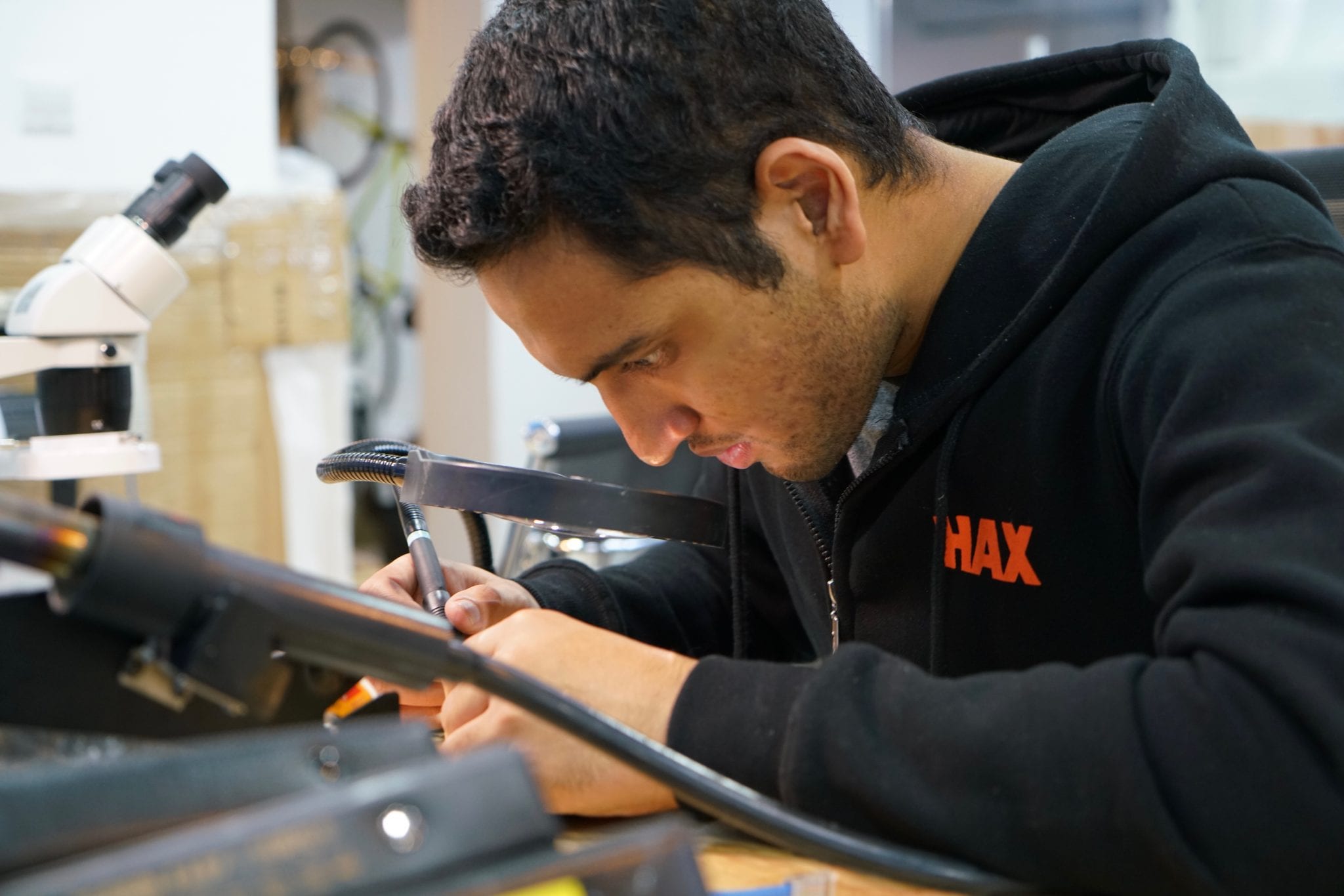
The Amper team moved to Shenzhen in August 2016. Over four months at HAX, prototypes could come together in three or four days. Thirani visited factories making products ranging from toys to smartphones. Manufacturing, which had been part of his family background, was now also a practical education in how other people turned designs into objects.
He picked up conversational Mandarin and practiced it daily. That detail gives the accelerator period a texture that the usual list of funding rounds misses. There were circuits to assemble and unfamiliar conversations to attempt. Both required leaving the comfort of knowing what one was doing.
By January 2017, the team had joined Alchemist Accelerator in San Francisco, where the emphasis shifted toward selling to businesses. Thirani credited Northwestern's Garage and its Wildfire program with pushing him into uncomfortable customer conversations. Hardware could be revised on a workbench. A business premise had to survive a less cooperative instrument: another person's needs.
Back to Chicago, with something to measure
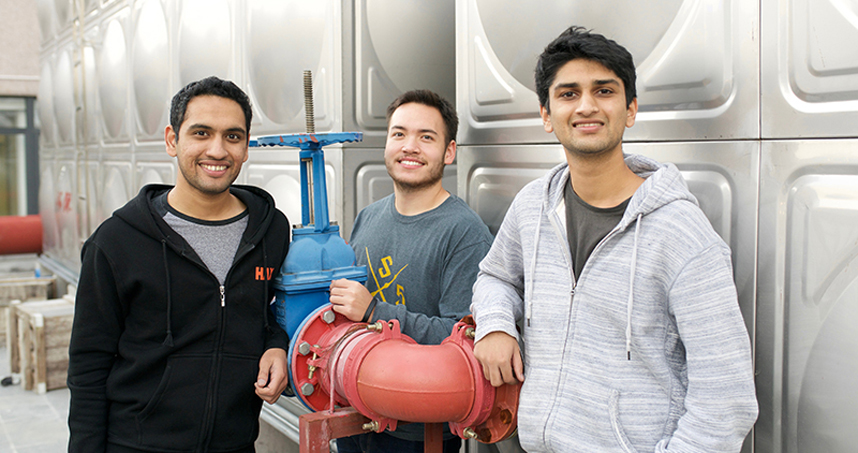
Amper's founding team included Thirani, Philip House and Sachin Lal. All three brought computer-science backgrounds to a problem located among physical machines. After HAX and Alchemist, the company returned to Chicago and joined mHUB in late 2017. The city's manufacturing base gave the young company a reason to put down roots there.
The first product used retrofit sensors to turn electrical signals into machine-performance information. At that stage, the system could be installed within an hour. By November 2017 it was in beta with ten customers, including two multibillion-dollar corporations. The team had also won the energy-efficiency prize in the 2016 MIT Clean Energy Prize competition.
These were modest, specific tests of the new direction: equipment connected, customers involved, information arriving. They were more useful than a general assertion that factories needed better software. A machine shop could examine its own results. For the founders, the next conversation could begin with what the equipment actually did during a shift.
The factory has a pulse
Thirani's explanation of machine monitoring begins with electrical current. Different operations leave recognizable patterns in a machine's electricity use. Read that signal, interpret it, and send it to a shared online system, and a manager gains a way to follow production without asking somebody to transcribe every event.
That approach mattered because workshops contain equipment of different ages. A useful system had to accommodate what manufacturers already owned. The software industry can be rather cheerful about replacing things. A factory owner, having paid for a machine that still makes parts, has good reasons to be less enthusiastic.
In his 2019 conversations with manufacturers, Thirani emphasized walking the shop and talking with the people doing the work before choosing a tool. What needs to improve? What information would help? Time spent manually collecting figures is time an experienced employee cannot spend using their judgment elsewhere. His product depended on algorithms, but his advice started with a conversation and a look around.
Recognition comes in a group photo
In 2018, Thirani appeared in Crain's Chicago Business' “20 In Their 20s.” Amper had begun in Northwestern's NUvention: Energy course in 2016; within two years its work on connecting factory equipment had brought its co-founder into Chicago's business spotlight. The early energy-monitoring project had found an industrial application in machining and injection-molding shops.
Then Thirani, House and Lal were recognized together in Forbes' 2020 Manufacturing & Industry 30 Under 30 class, announced in December 2019. The group recognition fits the story. Amper was built by a team translating computer science into a tool that had to earn its place beside somebody else's expensive machinery.
An $11 million Series A followed in April 2022. Funding bought room to develop the company further; adoption still depended on the everyday usefulness of the product. A prize can occupy a shelf indefinitely. Software has to keep giving a customer a reason to open it.
A dashboard enters the daily conversation
By September 2022, Thirani was discussing machine monitoring alongside Tom Schroeder on MakingChips. Schroeder's experience implementing Amper at PBC Linear moved the conversation beyond the founder's intentions. The questions were about choosing monitoring technology, getting it into a shop and using the information to support growth.
The presence of a customer changes that kind of discussion. Installation is only the beginning. A leader must decide what to measure, what the measurements mean and what the team should do next. Collecting data creates another responsibility: somebody has to turn it into a useful decision.
In a May 2024 conversation with Katrina Keys, Thirani addressed the organizational side more directly. Amper's stated values included facing reality, concentrating on customer success and operating leanly. The discussion covered trust, teamwork and giving operators a meaningful role in improvement. A clearer account of a shift can help a manager allocate resources, but it also gives the people closest to a machine more evidence to bring to the conversation.
“You can’t really improve what you can’t measure.”
Akshat Thirani · 2018
Even a racing team has a shop floor
Hendrick Motorsports became a revealing customer. After NASCAR introduced its Next Gen car in 2022, Hendrick expanded from making race-car parts into contract manufacturing. The work created a need to understand machine performance, costs and production decisions across its equipment, including older machines.
Amper's role was on that manufacturing floor. Real-time monitoring gave the team a way to examine performance and weigh quality, timing and cost. Racing supplies the glamorous association; the operational questions are familiar to a much less famous workshop. Which equipment is available? Where is time being lost? What should happen next?
There is a pleasing connection to Thirani's own student years. At Northwestern, he worked with the Formula Racing team's composites group, developing carbon-fiber components, CAD models and engineering analysis. Years later his company was working with a motorsports organization on the less visible work behind finished parts. The connection is concrete enough without needing a victory-lap metaphor.
A cold call, then a larger company
Looking back in December 2025, Thirani described visiting more than 50 factories in the early search for a workable business. A cold call led the founders to a Boston machine shop where they spent two months testing and revising the product. A willing shop owner had given them something an accelerator could only approximate: a working environment with real consequences.
He also described a difficult reinvention in 2023, involving changes across the product and the business. By the end of 2025, he said Amper served more than 250 customers. The path contained repeated revisions, including revisions made after the company had already found customers and grown.
On December 9, 2025, ECI Software Solutions announced its acquisition of Amper. Brad Bullington was Amper's CEO at the announcement. The platform had expanded into FactoryOS, combining machine information with job, scheduling and labor tools. ECI's stated plan was to connect that production information more closely with its enterprise planning software.
Thirani's work continued into the ECI chapter. A 2026 GTMfund event listing described it as “Scaling Amper at ECI.” The setting had changed again, while the underlying assignment remained recognizable: help manufacturers make better use of what is happening on their floors.
Back in 2018, his shorthand for Amper was simple: “You can't really improve what you can't measure.” The same principle offers a way to read his career. A promising idea met inconvenient evidence. He kept the question open long enough for a better business to emerge. It is an unusually practical use for an electric bill.
Follow the work
Conversations, company updates and more from the factory floor.