At about 13, AJ Brown had a job repacking damaged beer cases at his father’s Budweiser distributorship in Fort Myers. It was an unglamorous introduction to business, involving broken bottles rather than business cards. He liked the work and the people. His father ran a company with hundreds of employees. Before Brown had acquired the vocabulary of private equity, he had an example of a business he wanted to lead.
The adult résumé took him through finance, consulting and software. Yet the company he eventually co-founded, Apex Service Partners, brought him back to services: people, equipment, customers and work that has to happen somewhere other than a spreadsheet. There is a pleasing circularity to the journey. A long detour through prestigious institutions delivered him to an early ambition, considerably enlarged.
The family business, by way of Wall Street
Brown grew up in Fort Myers and earned a bachelor’s degree at Providence College. Goldman Sachs came first in his professional career, followed by Deloitte, where he became a manager. He later earned an MBA at Northwestern’s Kellogg School of Management and worked in private equity before taking an operating role at Avitru.
That sequence matters because it gave him experience on several sides of a business. An investor evaluates a company. A consultant helps a client think through it. An executive has to return the following morning and live with the decisions. Brown’s eventual move into operations put him in that last position, with responsibility for what happened after the presentation ended.
From 2016 through 2019, he served as Avitru’s CFO and head of corporate development. The construction software business served architects, engineers and building-product manufacturers. During his tenure, it grew at nearly a 100 percent compound annual rate through internal growth and acquisitions. He helped lead its sale to Roper Technologies in December 2018.
There was a life beyond transactions. His soccer experience included US youth national teams and college competition in the Big East. His interests included golf and time on the water with his family. The soccer connection supplies a useful way to read his management ideas: a captain must earn cooperation from the people alongside him.
“My one recommendation to everybody is to get your first hire right.”
AJ Brown
A first hire with room to grow
Brown co-founded Apex in June 2019. The public launch followed in July, when Alpine Investors announced that Frank Gay Services of Orlando would join Best Home Services of Naples as the foundation of the new business. Brown became CEO. Will Matson joined as CFO and head of mergers and acquisitions.
Alpine planned to invest at least $100 million of equity in founder-owned businesses over five years. The founding companies would keep operating under their respective names. Brown’s explanation emphasized what additional resources could buy: facilities, equipment, training and opportunities for employees. The starting proposition was concrete enough to be inspected in a workshop.
Matson became central to Brown’s account of building Apex. “Will Matson is really my co-founder,” Brown said. By the May 2026 investment announcement, both were identified as co-chief executive officers. The relationship had grown beyond the original division between running the company and managing its finances and acquisitions.
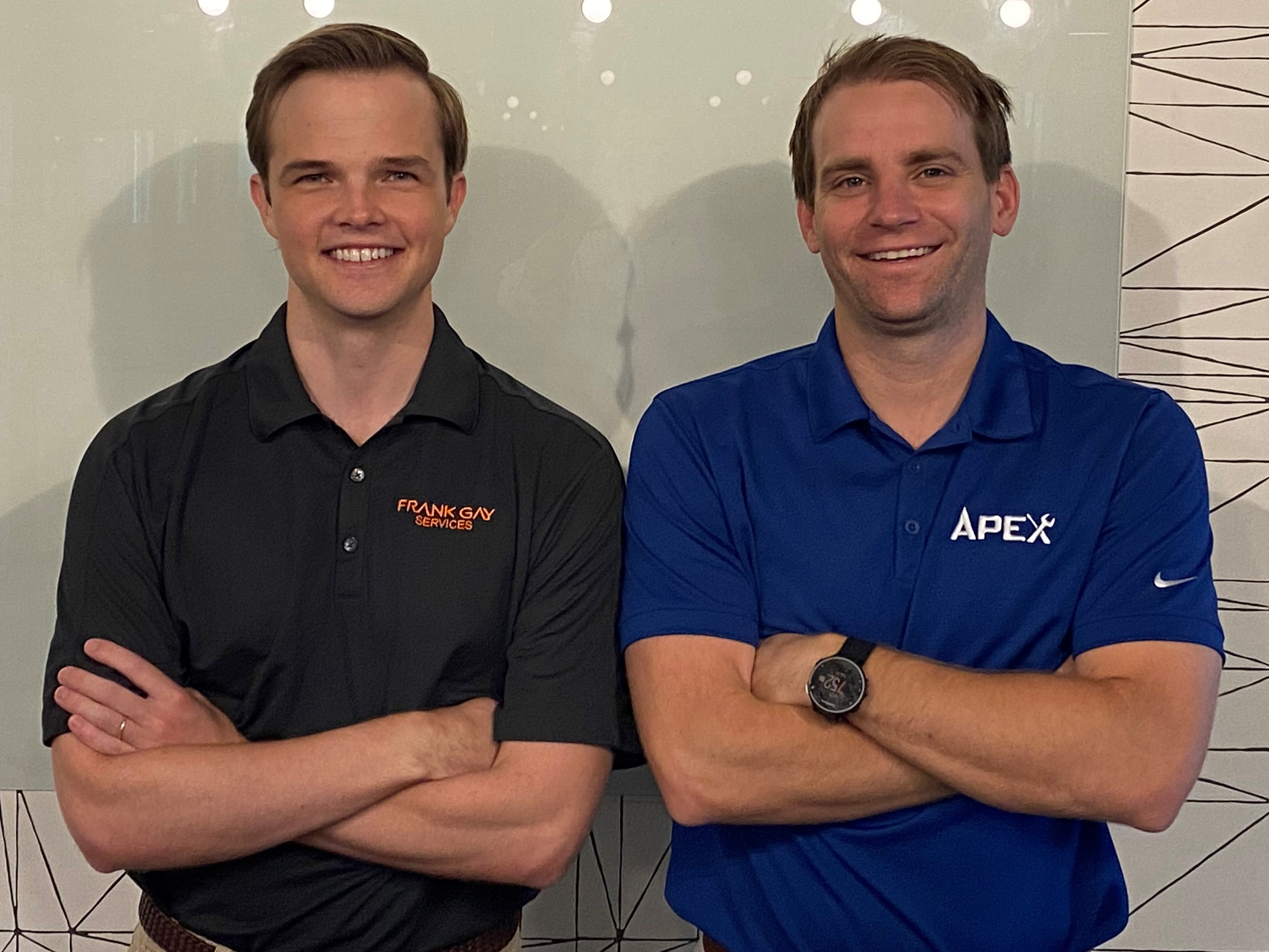
That progression gives Brown’s first-hire advice some weight. A growing business asks its leaders to change jobs without necessarily changing desks. Hiring someone capable of taking on more responsibility creates room for the founder to do the same. The quality of that relationship eventually affects decisions far beyond finance.
The name on the van still matters
In December 2020, Brown and Matson discussed their approach to partnerships in a 52-minute conversation. Their audience included contractors weighing the future of businesses they had built. These were owners with different ambitions: expansion, a gradual withdrawal from daily operations, or retirement. A single transaction structure would hardly suit them all.
Matson compared Apex’s support to a racing pit crew. The local operator remained important; the surrounding organization supplied resources. Brown’s advice to owners considering a financial partner was equally practical: “Do your diligence, like you would with any vendor. Call references. Make sure you find the right steward.”
A recommendation to call references is a useful check on the charm of an acquisition conversation. Both sides can describe the future attractively. Someone who has already worked with the prospective partner can describe the ordinary Tuesday that follows. For an owner, that is valuable information about what a promise might feel like in practice.
Brown also emphasized training and development. His argument was that companies providing similar services could distinguish themselves through their teams. Equipment can be purchased and software installed. Developing people takes repeated attention, and its value can extend well beyond the period in which the spending first appears.
Apex’s stated principles put a further obligation on that model. The company commits to keeping promises, acting honestly and building long-term value, even at the expense of short-term profit. It also promises access to capital in good times and bad. Each principle sounds straightforward until someone must choose between competing demands on time or money.
For Brown, these commitments make stewardship a daily operating question. A customer calling a familiar business is unlikely to be thinking about the capital behind it. The organization has to translate its resources into work the customer can recognize. A national structure earns its keep through those local encounters.
The people behind the expanding numbers
By October 2023, Apex employed more than 8,000 people nationwide. Alpine closed a $3.4 billion single-asset continuation transaction dedicated to the business. Its Fund IX invested $450 million alongside the continuation fund. The capital arrangement allowed earlier investors to receive liquidity, remain invested in part, or combine those options.
For Brown, the significance was continuity. Alpine would remain involved as Apex pursued its next stage. He described its support as extending beyond money into industry experience, resources and hiring, training and retention. Matson, then identified as president, would also continue leading the company.
The size of the transaction can overwhelm the less theatrical detail: people who wanted to leave an investment could do so while the operating company kept building. That is why the distinction between a financing event and the daily business matters. The company’s technicians still needed support regardless of which investment vehicle held a stake.
The later snapshot came in May 2026. Apex reported 75 prominent local brands across 46 states, more than 13,000 employees and annual revenue above $3 billion. Those figures describe the scale of the platform Brown and Matson were leading seven years after its formation. They also describe how far responsibility had spread.
The same announcement said Apex’s talent programs had supported more than 8,000 technicians and placed over 300 trained operating leaders. About 65 percent of senior leaders came from military backgrounds. These are company figures, but they help explain why the discussion of people has practical significance: a business this dispersed needs leadership well beyond two executives.
Brown’s own public posts return to that theme. He has highlighted veteran recruitment, celebrated local teams and described colleagues becoming teammates and friends. Those posts place community visits and the work of individual teams beside the larger financial milestones. They offer a sense of what he chooses to draw attention to.
A company that can keep its promises
On May 28, 2026, Apex and Alpine announced an agreement for Apollo-managed funds to acquire a minority interest. Alpine would make an additional investment. The transaction was expected to close in the fourth quarter, subject to customary conditions. Brown and Matson’s joint statement described an ambition to build a business that would thrive for decades.
A minority investment adds another participant to the company’s future. The announced priorities included expanding Apex’s reach, developing its services and advancing technology and talent infrastructure. For Brown, the operating question continues after the announcement: which investments give the people doing the work more ability to succeed?
The scale has changed since his father’s distributorship. The underlying attraction remains recognizable. Brown has built a career around businesses whose results depend on people turning up, knowing their jobs and trusting one another enough to work together. His leadership has increasingly required making room for those people to carry responsibility themselves.
There is a quiet demand hidden inside that approach. A founder who wants capable colleagues must allow them to be capable in ways he does not personally supervise. The first hire, the local manager and the next trained operator all make the organization less dependent on one person. Getting out of the way becomes part of the work.