The person calling an air-conditioning company on a sticky Florida afternoon is not shopping for a private-equity thesis. The house is hot. The dog is panting. A trusted local name, seen for years on trucks and Little League banners, carries more weight than a sleek national brand invented in a boardroom. Legacy Service Partners has built its business around that mundane but valuable fact.
Founded in Tampa in 2021, Legacy brings residential HVAC, plumbing, electrical, drain and sewer businesses into a common platform. The company supplies capital, finance, marketing, recruiting, technology, sales support and an operator network. What it usually does not supply is a new name for the van. Local leaders remain visible, and capable owners can stay in the general manager's seat. The company calls this decentralized. In plain English, the shop keeps its accent while the back office gains muscle.
That makes Legacy part investor, part operating system and part succession plan. A founder can realize some of the value built over decades without automatically handing the keys to a distant corporate manager. If the owner wants to step back, Legacy says it can help identify a successor. If the owner wants to keep running, the pitch is more interesting: continue leading, but with a deeper bench and a larger checkbook.
A rollup with the logo left on
Home services are unusually suited to consolidation. Demand is recurring, the work cannot be shipped overseas, and thousands of independent operators remain scattered across local markets. Heating systems fail, drains clog and electrical panels age regardless of the economic fashion. Yet the trade is also stubbornly local. Reviews, technician quality and neighborhood familiarity influence who gets invited through the front door.
Legacy's answer is selective centralization. Local teams make customer and market decisions. The platform provides shared expertise and measures performance. On its website, Legacy describes the desired outcome in the practical vocabulary of a service manager: more jobs, higher revenue per job and lower cost per job. It also screens for recognizable brands, strong residential focus, engaged employees and leaders who want to keep operating.
Those are the current figures Legacy publishes. Earlier snapshots show how quickly the map has changed: a June 2023 announcement described more than 30 brands, 1,500 team members and nearly half a million annual customers across 16 states. A 2024 release counted 34 local brands. Current language emphasizes service leaders rather than raw brand count, so the numbers are best read as dated views of a portfolio that is bought, combined and reorganized over time.
“Local leaders make the calls. The platform provides resources, not roadblocks.”Legacy Service Partners, operating model
The product is the boundary
Legacy does not sell homeowners one unified consumer product. Its local companies handle the visible work: furnace replacement, air-conditioning maintenance, leak repair, hydro jetting, sewer lines, electrical upgrades and EV-charger installation. Legacy's real product is the boundary between what remains local and what becomes shared.
One company, two operating layers
- Brand and reputation
- General manager
- Customer relationships
- Market-level decisions
- Community presence
- Capital and finance
- Recruiting and people systems
- Marketing and sales support
- Technology playbooks
- Operator peer network
Technology illustrates the bargain. One partner, Paradise Plumbing & Air, described joining a committee that helped define a common ServiceTitan setup. A tested software configuration lets incoming operators skip months of improvisation. But the configuration was shaped with field input, not simply dropped from headquarters. This is scale as a reusable template rather than a universal command.
Leadership development follows the same logic. The LSP Blueprint Program moves from the Foundations Forge for frontline managers to a GM Leadership Lab and then a senior Leadership Summit. The middle tier includes field time with a flagship partner and a six-month growth plan supported by executives. For a founder trying to build a succession bench, that curriculum may matter as much as acquisition cash.
The owner on the other side of the table
Consider the specific customer Legacy must first win: not the homeowner, but the person who built the company serving that homeowner. This owner may have spent 20 or 30 years answering late calls, training apprentices, signing vehicle loans and putting a family name on the building. A sale is financial, but it is also an argument about identity. The buyer has to explain what happens Monday morning, who approves a hire and whether a longtime dispatcher will recognize the place a year later.
Legacy's public material addresses those anxieties directly. It says strong local teams and brands are preserved. It offers two paths for leadership: stay and scale, or step back while the platform helps find the next operator. Neither path removes the need for integration. Finance has to report consistently. Technology has to communicate. Performance has to be compared across the network. The difference is that integration is presented as support around the branch, not replacement of the branch.
That distinction also shapes the companies Legacy wants. Its stated criteria favor residential businesses with a recognizable position in their market, low employee turnover and leadership teams eager to keep growing. These are not distressed assets waiting for a rescue crew. They are businesses with something worth protecting and enough operating strength to use additional capital productively. The better the local culture, the more careful the platform must be when introducing its own systems.
The network can then solve problems that are disproportionately difficult for an independent shop. Recruiting specialists, building reporting, purchasing software, creating management training and testing new marketing channels all demand time before they produce a return. A platform can employ experts once and spread their work across many branches. The branch gains access to skills it might not hire full-time; the platform gains many places to test and refine a playbook.
Peer access may be the least visible benefit. Independent operators often learn through local trial and error. Inside a network, a manager in Minnesota can compare notes with one in Florida without competing for the same homeowner. They face different weather but similar questions about call conversion, technician utilization, maintenance memberships and the handoff from a service visit to a replacement estimate. Legacy's committees are an attempt to turn those conversations into repeatable operating knowledge.
Who pays, and where value appears
Legacy is privately held, and its deal economics are not public. The model is recognizable: acquire or invest in durable local businesses, improve their organic growth and operating discipline, add complementary companies where useful, and build a larger platform whose cash flows and capabilities are worth more together. Gridiron Capital invested in Legacy in January 2023. The amount was not disclosed.
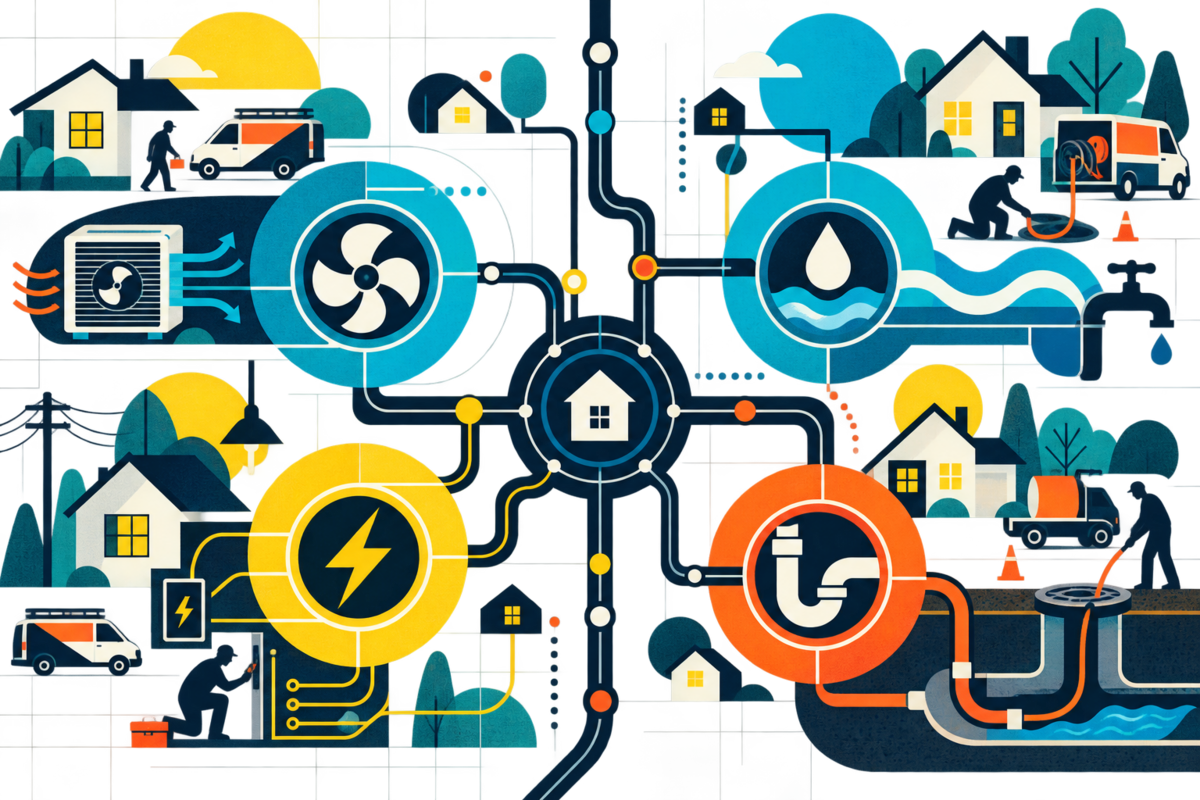
The work itself supplies several kinds of recurring demand. Heating and cooling systems need seasonal maintenance and eventually replacement. Plumbing and drain problems produce urgent calls that cannot be postponed for long. Electrical work ranges from repairs to panel upgrades and EV chargers. A company that serves more of these needs can deepen a household relationship and keep technicians productive across a broader set of jobs. Legacy's listed categories now span HVAC, plumbing, electrical, drain and sewer, giving the portfolio more than one route into the home.
Geography adds another layer. A cold snap in New Hampshire and a heat wave in Alabama do not arrive on the same calendar. A network spread across 19 states is still exposed to weather, labor availability and local housing conditions, but it is not tied to one season in one metro area. The practical challenge is preserving local judgment: a pricing plan or staffing rhythm that works in Fort Lauderdale may be clumsy in Wisconsin.
This is where the phrase "simple systems that scale," used in Legacy's public pitch, earns scrutiny. Simplicity is not the same as uniformity. The useful system establishes a common measure and leaves room for a branch to respond to its market. A standardized income statement can reveal where performance differs. It cannot, on its own, explain a storm, a permit delay or a competitor's promotion. The platform needs both the comparable number and the operator who knows why it moved.
For selling owners, the offer competes with several alternatives: remain independent, sell to a strategic buyer, join another sponsor-backed platform or adopt a franchise system. Other consolidators in residential services include TurnPoint Services, Wrench Group, Southern Home Services, Heartland Home Services and NearU. Capital is not the scarce part of that market. Credibility with operators is.
Franchising provides brand, systems and purchasing power but usually asks the local operator to adopt the franchise identity and pay according to its structure. A strategic sale can create immediate scale but may fold decisions into a regional hierarchy. Staying independent preserves control but leaves succession and investment concentrated in one company. Legacy positions its partnership between those poles. The local business enters a larger ownership structure while retaining a public identity and, when the fit is right, its operating leader.
The approach is not frictionless. Shared purchasing can conflict with a technician's preferred equipment. Central marketing can miss a local voice. Fast growth can stretch the supply of general managers. Performance targets can make autonomy feel narrower than advertised. Legacy's answer is alignment at the start: be explicit about the owner's ambition, the support required and the standards that will not bend. In a decentralized company, the acquisition conversation doubles as the first operating meeting.
Legacy tries to distinguish itself with operator accountability. One partner executive has contrasted the structure with generic stock options, saying his compensation depends on how his own business performs. That arrangement puts the local leader closer to the economics of decisions made in the branch. It also raises the standard: autonomy is paired with targets, shared reporting and a platform playbook.
The company's three published values make the expectation blunt: We Win Together, Performance Over Politics and Today, Not Tomorrow. Its careers page calls the central office a partner support center, not a corporate headquarters. That phrase does useful cultural work. It reminds the people making spreadsheets in Tampa that the revenue arrives through technicians crawling into attics, opening drain lines and talking to homeowners.
A network still being assembled
The acquisition trail makes the strategy concrete. In 2023, Legacy added McVay Plumbing, Heating & Cooling and Mister Sewer around Pittsburgh, plus Gator Drain and Plumbing in Cape Coral. In 2024, it bought four One Source brands spanning Alabama, Georgia and Tennessee, then added Albiero Plumbing & HVAC in Wisconsin and Triumph Home Services in New Hampshire. NJ Pipe Doctor followed in 2025.
The newest public additions extend both ends of the map. Willco Air Conditioning, founded in 1988 in New Jersey, joined in April 2026. Lunsford Air Conditioning and Heating, a family and veteran-owned Florida Panhandle company founded in 1981, joined in July. Both announcements return to the same promise: resources and systems arrive; community identity stays.
Leadership changed as the portfolio matured. Adam Taylor became chief executive in early 2026 after senior roles in large, technology-enabled service workforces. Co-founder Robert Millock, who led Legacy from launch, moved to the board. The other publicly identified co-founders are Jake Sloane and Frank Zhang. Taylor inherits the delicate part of any decentralized platform: keeping common standards strong enough to create value without making local autonomy feel ceremonial.
That tension is not a flaw in the model. It is the model. Too little central discipline and the network becomes a loose collection of logos. Too much and the strongest operators wonder why they stayed. Legacy's market position sits precisely between those outcomes, selling scale to founders who are wary of becoming branch managers in their own companies.
The truck is the last mile
A home-services platform can talk about capital structure, software tenants and acquisition pipelines. The customer still experiences it as a person arriving on time with the right part. Legacy's expertise is meant to improve the odds of that simple event: recruit better, route more efficiently, price coherently, train managers and fund the equipment required to grow.
For operators, the useful proposition is equally tangible. A local company can add trucks, enter an adjacent service line, make a small acquisition or build a leadership bench without inventing every process alone. It can compare notes with peers who understand the seasonal rush and the cost of an idle technician. The network turns isolated lessons into shared property.
Legacy Service Partners is therefore less a national home-services brand than a national backstage. Its name may never be the one a homeowner remembers. That is intentional. If the platform works, the customer remembers the familiar local company, the founder sees a bigger business, and the systems that connected them remain almost invisible.