At three in the morning, a broken data pipeline has a way of simplifying the conversation about artificial intelligence. Somebody must wake up. Somebody must restart the job. By breakfast, the report must be right. In one Agivant project, those interruptions were part of a larger maintenance burden: twenty engineering hours every week. The company says its rebuilt system brought that down to four.
- Agivant builds AI into enterprise systems, from data platforms to commerce and support.
- Its approach pairs embedded engineers with agents, reusable tools, and explicit controls.
- The practical lesson: pick a recurring failure, measure it, and automate around a clear approval point.
The 3 a.m. test
The client was a global engineering software enterprise. Operational information lived across monitoring tools, identity systems, configuration records, and support tickets. Failures sometimes stayed quiet long enough to produce incorrect reports. Recovery could take around three hours.
Agivant describes consolidating that information in a governed Snowflake warehouse, adding automated recovery and checks that catch bad data upstream. The platform ingests more than 250 gigabytes a week. Its published account reports recovery in minutes and maintenance falling 80%. The warehouse also supplies the trusted information that subsequent AI agents need.
A veteran starts again
Agivant was founded in 2023 by Sandeep Kishore, whose previous jobs included running Zensar Technologies and serving as an executive partner at Siris Capital. His career history makes the venture an experienced services executive’s response to a changing business. He is also a poet, an unexpectedly literary qualification for a company preoccupied with specifications.

The company’s market is enterprise engineering: the work connecting models to existing software, data, permissions, and operating processes. Buyers include technology, semiconductor, telecom, financial services, and commerce organizations. Its headquarters is in San Jose, with engineering offices in Pune and Hyderabad. The projects describe environments with substantial existing systems, where replacing everything would be a distracting answer to an immediate problem.
Write the rules before the code
Agivant calls its delivery approach Amp’d. It combines engineers working alongside client teams, production agents, and reusable engineering assets. Underneath is Bolt, which the company describes as its AI-native operating system. The organizing idea is a client-owned specification: write down the intended behavior, version it, then build against it.
That gives the sales vocabulary some engineering substance. An agent needs a defined job, a boundary on its permissions, and a way to check its work. Agivant’s framework emphasizes identity, evaluations, observability, and guardrails. Production behavior is supposed to trace back to the specification. The reasoning is straightforward: faster software is useful when someone can still explain what it does.
“The biggest limiting factor for enterprise AI right now is not intelligence, it is context.”
Ajay Malgaonkar · Databricks partnership
Its partnerships locate the business in a crowded market. Google Cloud provides the platform for its dedicated Gemini Enterprise practice, announced in April 2026. A Glean collaboration followed in May. Databricks supplies governed data capabilities; TigerGraph adds relationship-aware graph infrastructure. Agivant builds around these platforms. For buyers comparing engineering partners, its proposed advantage is the combination of integration work, reusable components, and responsibility for production.
The Gemini practice makes the offering concrete. Agentic Quote Accelerator assembles complex sales quotes. SourceX handles procurement intelligence. ZeroQueue targets IT service operations, while CPQ Lens addresses pricing-rule migration and auditing. These are starting points for an enterprise engagement, with connections to the customer’s existing CRM, service, and business systems. The practice describes standardized 90-day sprints. A procurement leader, a support manager, and a sales operations team can therefore approach the same engineering company with quite different queues of unfinished work.
Ten storefronts. One deadline.
A commerce project supplies a more tangible demonstration. A direct-to-consumer wellness business faced a platform shutdown within three months. More than ten storefronts had to move. Pages took eight to ten seconds to load; checkout failures were already hurting sales. Agivant says conventional migration and manual testing could not meet the deadline.
Engineers embedded with the client’s teams. Four agents divided the migration: data movement, validation, search redirects, and regression testing. At the first cutover, validation caught mismatches in 0.3% of metafields. People approved the launch. The case study reports all brands live before shutdown, with no revenue-loss downtime and 70% less manual migration effort.
- 01Move
the records - 02Check
the fields - 03Preserve
the URLs - 04Test
the checkout
The copyable idea is the separation of duties. Moving records and checking records are different jobs. So are preserving search traffic and testing a purchase. Each gets a defined task before anyone authorizes the cutover.
The invoice follows the work
Agivant sells consulting, implementation, and managed engineering services. In the commerce case, the engagement used fixed-scope phases. Its agentic support offering describes a different arrangement: billing on tickets resolved. Six agents cover work including triage, investigation, recommendations, and lifecycle management, with human approval for executing fixes.
The support business case models a team of more than 120 people and projects a 25% to 40% reduction in cost per ticket. That is a projection for a specified operating environment. The commercial question is whether the definition of “resolved” matches the customer’s experience, including reopened tickets and engineering escalations.
The published designs suggest practical conditions for success: accessible records, clear permissions, testable outcomes, and an owner for consequential decisions. Without those, an agent inherits the same confusion as the team it assists. A buyer can start by naming one workflow, its current cost, its failure rate, and who signs off.
Who gets to build the future?
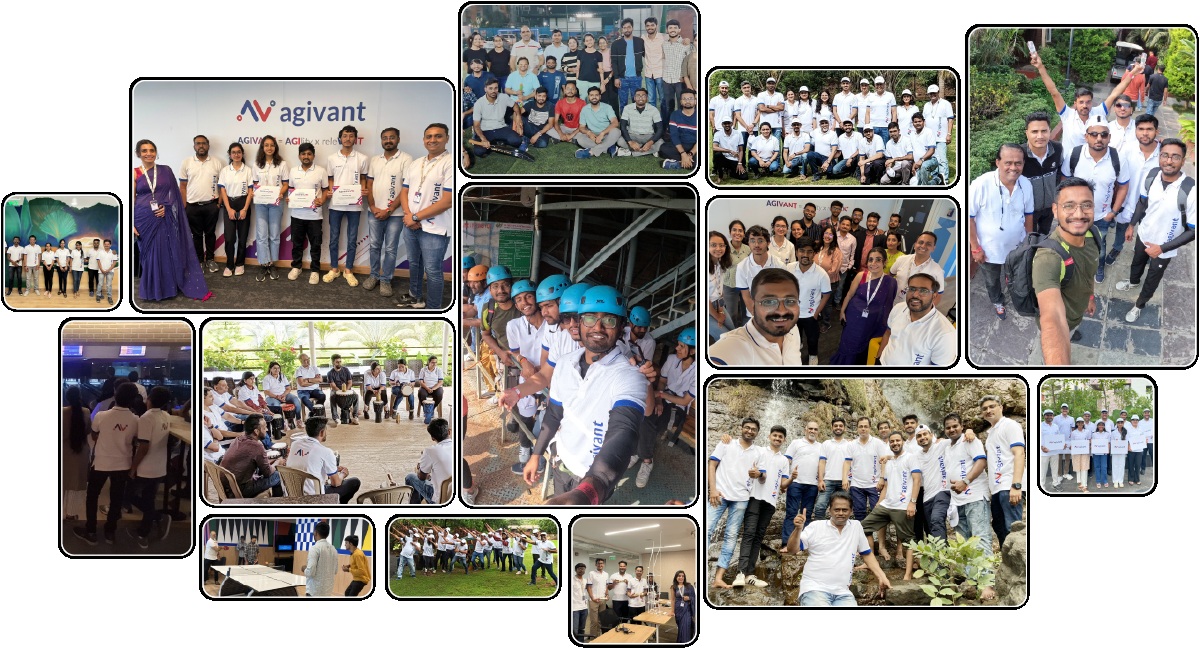
The people proposition sits beside the automation pitch. Agivant’s Propel program puts early-career engineers on live projects with experienced colleagues. VIBE encourages work beyond a current assignment, including experiments, mentoring, and improvements to the company itself. Agivant also states a commitment to impact 50,000 lives. That remains an ambition.
There is a useful test connecting both sides of the company’s promise. When routine work disappears, what happens to the engineer’s day? In the pipeline case, the answer begins with sixteen hours a week. What the team builds with those hours is the next result that matters.
Agivant website · Agent library · Google Cloud announcement · Glean announcement