Every marketing agency has a recurring ceremony nobody puts in the pitch deck. Someone opens Google Ads, then Analytics, then Search Console, then Facebook, then whatever call-tracking system the client insisted on. Numbers are copied. Screenshots are taken. A slide is nudged three pixels to the left. Finally, a report goes out to prove that the work everyone was busy doing all month did, in fact, happen.
AgencyAnalytics built a company around making that ceremony shorter. Its software connects to more than 85 marketing services, gathers a client's performance data, and turns the pile into branded dashboards and scheduled reports. An agency can add its own logo, colors, domain and email identity, give clients permissioned access, and make the machinery appear in-house. The vendor's most elegant product feature may be its ability to disappear.
The Toronto company says more than 7,000 agencies now use the platform. Its newsroom biography for co-founder and CEO Joe Kindness says revenue has passed $20 million, though it does not specify a reporting period. AgencyAnalytics says it remains bootstrapped, profitable and 100 percent employee-owned. That is a notably unfashionable route through software: no public funding rounds, no acquisition spree, and no attempt to sell the same dashboard to every possible department.
01 / THE PIVOTThe customer renamed the company
The story began narrower. Kindness and co-founder and CTO Blake Acheson were school friends, and search technology had occupied their attention for years. The company's help center says one co-founder built a rank tracker in high school in the early 2000s, back when AltaVista was still a serious search engine. In 2010 they started the business that became AgencyAnalytics around SEO tools. Its original name made the scope plain: MySEOTool.
Then agencies kept describing a larger problem. They were not merely short of rank data. They were drowning in the work required to turn data from many places into something a client could read. Interviews with agencies changed the center of gravity from an SEO utility to an agency workflow. In 2015, MySEOTool became AgencyAnalytics. The rename was not cosmetic; it marked the moment the company stopped defining itself by the measurement and started defining itself by the buyer.
That sequence is the business in miniature. AgencyAnalytics does not create a Google Ads conversion or an Instagram follower. It makes the output of many systems easier to collect, explain and deliver. This sounds like a smaller ambition than inventing the data. For an agency owner, it is closer to the cash register. A comprehensible report supports the conversation in which the client decides whether the agency is worth another month.
The durable product is not the chart. It is the recurring moment when an agency has to prove its value.YesPress analysis
02 / THE PRODUCTA nicer front door for messy data
The core platform covers automated reports, live dashboards, client portals, permissions, approvals, goals, alerts, tasks and white-label branding. Agencies can start with templates or drag widgets into custom layouts. Smart Reports and Smart Dashboards, introduced in 2024, attack the blank page directly: connect a client's accounts and the software chooses commonly used metrics to assemble an initial report or dashboard. The company branded the promise with comic precision - 11 seconds.
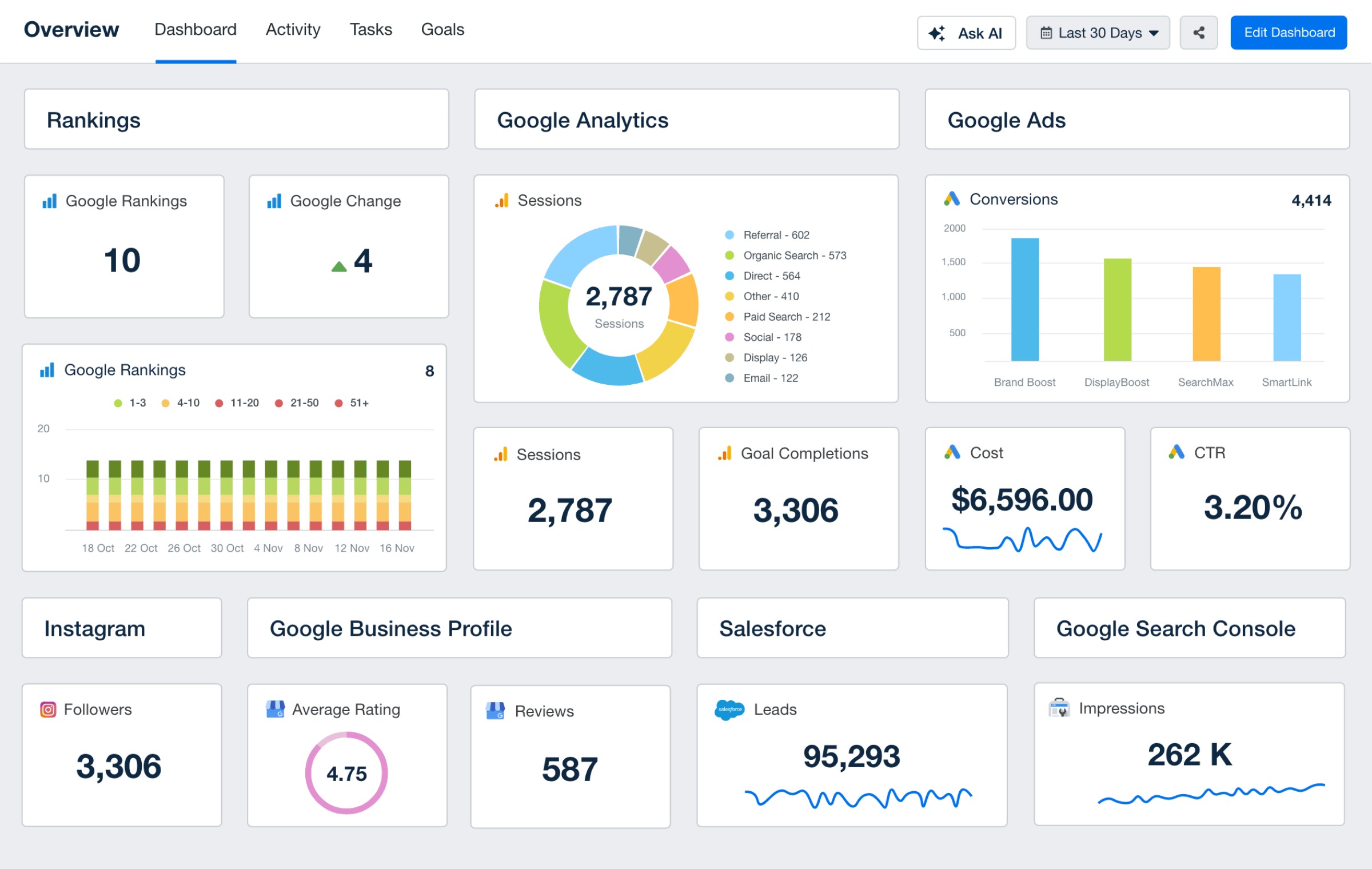
The newer features move beyond presentation. Benchmarks compare performance with industry medians. Forecasting projects trends; anomaly detection points at suspicious changes. AgencyAI answers natural-language questions, while AI summaries draft report commentary. In 2026 the company added an AI Tracker for brand visibility across answer engines and an MCP connection that lets staff query permission-scoped client data from tools such as ChatGPT and Claude. The dashboard is gradually becoming a data layer that can travel to wherever the account manager is already working.
There is still a human-shaped hole in the product. An AI can notice that traffic fell; it cannot reliably know that the client paused inventory, changed its sales team or rejected the best landing page. Generated commentary needs review. The useful division of labor is mechanical first draft, informed human judgment second. An agency that sends synthetic observations unchecked has automated the least impressive part of its relationship.
03 / THE MONEYCharge where the customer earns
As of August 2026, the public price is $20 per client per month when billed annually, with core features included and unlimited reports, dashboards and users. AI Tracker and Rank Tracker are paid add-ons; agencies managing 25 or more clients can request enterprise terms. The 14-day trial requires no card.
Pricing per client is tidy because it expands with an agency's book of business. It also creates the obvious objection. A solo consultant with five modest accounts can do the arithmetic and decide that Looker Studio, a spreadsheet and a stubborn afternoon cost less. At the other end, a sophisticated enterprise may want a warehouse, its own semantic layer and a BI tool with fewer opinions. AgencyAnalytics sits between those poles: enough clients to feel the reporting tax, but a stronger appetite for speed than for unlimited modeling freedom.
Customer examples explain the purchase more clearly than a feature grid. Optimise Online said a report that once took at least three and a half hours fell below 30 minutes, returning about 120 billable hours a month. HookedOnMedia had built its own reporting software, then found that updating APIs became an expense and a worry; moving to AgencyAnalytics reportedly cut reporting time in half. Those results will not transfer mechanically to every shop, but the calculation is copyable: multiply reporting hours by loaded labor cost, add the cost of connector failures, and compare that total with the subscription.
Unless you have a lot of budget and time, don't custom code your own reporting software. We've been there and done that.Andrew Thomas · HookedOnMedia
04 / THE LIMITEvery connector is a tiny hostage negotiation
Aggregation creates convenience and dependence at the same time. Google, Meta, LinkedIn, Shopify and dozens of smaller services control the APIs. They can rename a metric, change authentication, narrow history or retire an endpoint. Users sometimes experience that upstream turbulence as a missing field or a broken report inside AgencyAnalytics. Public reviews consistently like the ease of use and support, but also mention limited integration depth and connection issues. Both reactions can be true.
This is what failed first for agencies that tried the homemade route: not usually the first dashboard, but the ongoing maintenance. A connector works until it does not, and the repair arrives exactly when a report is due. AgencyAnalytics takes on that maintenance across a large customer base. In exchange, users accept the fields and filters each integration exposes. If a business needs obscure dimensions, complex attribution logic or instant control over a newly changed API, a custom stack may win.

05 / THE COPYABLE BITFind the ritual attached to renewal
The founders did not begin with a grand theory about an all-in-one operating system. They began with a tool, talked to a specific customer, and noticed the adjacent recurring pain was larger. Kindness has written about resisting shiny objects and venture money while keeping key metrics stable. Patient focus sounds dull until it compounds for 16 years.
The AgencyAnalytics playbook, minus the marketing gloss
- Choose one buyer with a repetitive, deadline-driven chore.
- Follow the output to a consequential conversation - renewal, payment or approval.
- Make a strong default before offering infinite customization.
- Let customers put their identity on the deliverable.
- Price along a unit that grows with customer value.
- Treat integrations as a permanent operations function, not a launch checklist.
This playbook breaks under identifiable conditions. It does not work when the ritual happens too rarely, when the output has no financial consequence, when every customer needs a unique data model, or when the underlying platforms can copy the workflow and distribute it free. It also struggles if the subscription grows faster than the agency's margin per client. The defensible part is not a PDF generator. It is the accumulated set of defaults, permissions, templates, integrations and habits around a client relationship.
AgencyAnalytics now has the familiar temptation of a successful focused product: expand from reporting into planning, collaboration, AI discovery and analysis without losing the simplicity customers bought. Its best releases reduce setup or interpretation. Its riskiest would make the product another complicated marketing suite that needs its own report. The company found its market by listening when agencies said reporting was the problem. Staying useful depends on remembering just how boring - and how valuable - that problem remains.