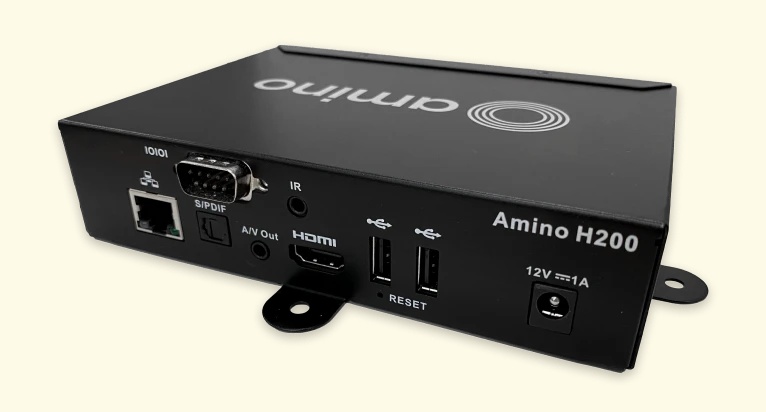
The little black box has mounting brackets, a row of ports and no ambition to be admired. Amino’s H200 is designed to disappear behind a screen and keep the picture moving. It is an apt object for understanding Aferian, the Cambridge video technology group whose products worked mostly out of public sight. Viewers saw the programme. Operators saw the equipment and software. In March 2026, creditors saw the sale proceeds.
On March 6, Aferian entered administration and sold all its subsidiaries to Sapphire Technology Group. Amino and streaming software specialist 24i continued under the buyer. The parent ceased trading operations. Its admission to London’s AIM market was cancelled on April 7. Anyone encountering an older description of Aferian as a listed streaming group needs that update before reading another word.
The distinction matters. A television platform can remain useful, retain customers and find a buyer while the company above it fails. Aferian’s story follows both tracks: the construction of a business spanning software and devices, and the shrinking financial room available to keep that business together.
A television company you never subscribed to
Aferian occupied the space between the people making video and the people watching it. Its customers included broadcasters, broadband operators, streaming services and enterprises. They needed programmes to arrive on different screens, interfaces that viewers could navigate, and equipment that support teams could manage. Aferian supplied technology for those jobs through two distinct brands.
24i handled the streaming platform and viewing experience. Amino supplied managed devices, software and support. The combination gave the group a place in both internet-delivered television and the installed world of operator equipment. Historically, it reported more than 500 service-provider customers reaching millions of viewers. Those viewers were the audience of its customers, rather than people paying Aferian a monthly entertainment subscription.
The revenue model mixed one-off and recurring income: sales of devices, software licences and support, plus ongoing platform and device-management fees. 24i described its platform as offered on a rental basis. The economic ambition was to build continuing service income around a customer relationship that might otherwise produce an occasional equipment order.
The corporate dates require similar care. The plc was incorporated in March 2004. The Aferian name arrived in June 2021, replacing Amino Technologies. Amino and 24i kept their commercial identities. That decision made the holding company less likely to be confused with its hardware business, while leaving customers with the brands they already knew.
Different tools. The same demand: make the viewing service work.
Buying the route beyond the box
The move toward software was deliberate and expensive. In July 2019, Amino announced the acquisition of 24i with total consideration of €21.4 million. The stated initial payment comprised €16 million in cash and €3.3 million in shares, with deferred consideration following. The attraction was practical: apps and user-experience expertise complemented a business already supplying the equipment underneath television services.
In May 2021, the group acquired Denmark’s Nordija for €5.3 million, adding streaming and pay-TV platform capabilities. A £9.4 million share placing that year had initially supported an unsuccessful bid for MobiTV. Management said the money would help pursue other acquisitions. The Filter followed in April 2022, bringing recommendation technology in a transaction with potential consideration of up to £4 million.
Read together, those transactions describe a supplier trying to earn more from what happens after a device is shipped. Software platforms, recommendations and managed services could deepen customer relationships and generate recurring revenue. But acquiring those capabilities also meant integrating businesses and carrying their costs while the older revenue stream remained exposed to hardware demand.
The remote control for the remote controls
Amino’s enterprise work makes the proposition unusually tangible. In November 2024, it announced that Paddy Power had deployed H200 players and the Orchestrate management platform across more than 500 locations in the UK and Ireland. The system put low-latency video, virtual games and customer information on shop screens. Here, video technology was part of running a retail operation.
The H200’s specifications explain its intended surroundings. It supports 4K video, has a rugged enclosure and mounting options for out-of-sight installation. Power over Ethernet allows a single-cable installation where the necessary network infrastructure is available. Those details are more relevant to an installer than the shape of a consumer remote or the colour of a box.
Orchestrate adds the operational layer: remote firmware and app updates, monitoring, logging and diagnostics. Its appeal is easy to understand when devices are scattered across buildings. Fixing a problem through a dashboard can avoid dispatching someone to the screen. The product is sold in feature tiers, with more extensive monitoring and control in the Premium offering.
Pay-TV operators have a related problem inside customers’ homes. Oklahoma’s OEC Fiber, which launched its OTT television service in 2020, identified Amino Engage as a reason for choosing the Amigo 7X Android TV device. The example shows how management software can influence a hardware purchase. A box that plays video is one requirement; a box the service team can support is another purchasing consideration.
What goes on the screen - and what pays for it
24i addresses a different set of decisions. Its Video Cloud combines content management, applications, personalization, advertising and video workflows. A broadcaster or streaming service can use those components to assemble and operate its viewing experience. The modular pitch is flexibility: adopt a connected platform without assuming every customer has the same catalogue, existing systems or commercial model.
Spain’s RTVE provides a useful example. In a January 2026 case study, 24i described personalization for RTVE Play that combined recommendation logic with editorial rules. Popularity and contextual signals could help shape discovery while editorial teams retained control. The problem was specific: make a large video and audio catalogue easier to explore without handing every programming decision to automation.
Advertising added another reason to connect the pieces. In April 2025, 24i announced an integration with Bitmovin for its Advanced Advertising offering, naming LGBTQ+ streaming network Revry as the first joint customer. The work combined playback with support for client-side and server-side ad insertion, targeting and attribution. For a service funded by advertising, the commercial question extends beyond whether the programme starts: can the service deliver and measure the advertising around it?
This placed 24i in a competitive field. Synamedia Go also markets a modular cloud video platform. In enterprise screens, BrightSign supplies commercial media players and remote-management capabilities. Aferian’s distinctive combination was the breadth of its two businesses. Modularity and manageability themselves were shared selling points, so buyers still needed to compare integrations, support and the cost of their particular deployment.
Hardware felt the shock first
The financial sequence undermines the comforting idea that an expanding streaming market must lift every supplier. Group device revenue fell from $67 million in 2022 to $21.3 million in 2023, a 68 percent decline. Aferian described customers reducing inventory as lead times shortened, alongside a tougher competitive environment. Customers could keep serving viewers while buying fewer new boxes.
Software and services initially held up better. The later results brought another setback: two significant 24i contracts ended at the close of the 2023 financial year. By 2024, group revenue had fallen to $26.3 million. Management also pointed to competition from commoditized, low-margin pay-TV devices. The pressure had moved beyond a temporary mismatch in warehouse stock.
Annual group revenue
US dollars. Financial years ended November 30. Bars share a zero baseline.
Aferian cut costs and pushed Amino toward enterprise video, digital signage and higher-value devices. The workforce was part of that adjustment. Its 2024 ESG report described approximately 140 people, including contractors, across 21 nationalities as of June 30, along with a management leadership programme. That is a dated picture of the working organization, not a claim about the size or mood of today’s teams.
A recovery with a repayment date
“Aferian is now a turnaround story,” chief executive Mark Carlisle said in the April 2025 results announcement. There was subsequent evidence of improvement. For the six months ended May 31, 2025, revenue rose 36 percent to $16.6 million and adjusted EBITDA reached a $1.7 million profit. Those measures showed better trading. They did not establish that the financing problem had been solved.
“Aferian is now a turnaround story.”
Mark Carlisle, chief executive · April 2025
The company had already raised approximately $4 million gross in a July 2023 placing at 12 pence a share. By February 2026, its $16.5 million secured banking facilities had gone through repeated short extensions, with Barclays, Bank of Ireland and HSBC agreeing a further deadline of March 20. The company was still pursuing a sale and needing working capital.
The formal sale process had begun in September 2025. By March 2026, Aferian reported no firm interest in buying the parent and no continuing discussions for such an offer. Lenders backed the alternative of selling the operating subsidiaries together. That was the documented change in course: an improving operation still needed a transaction its lenders would support.
The businesses changed hands. The loss stayed behind.
Sapphire paid $1.3 million upfront, with a further $700,000 contingent on specified 2026 revenue tests. The upfront share-sale consideration should not be mistaken for a normal-market valuation of every product and customer relationship. The sale announcement directed proceeds to administration costs and secured creditors and stated there would be no return for shareholders.
The buyer also brought a familiar figure: Sapphire is wholly owned by former Amino chairman Keith Todd. For customers, 24i said leadership and customer-facing teams would remain in place. This was an ownership change intended to preserve service delivery, rather than a direction to switch off the platforms.
For someone building or buying video technology, the useful lesson is concrete. Evaluate the support system alongside the device. Test how personalization fits editorial decisions. Examine the supplier’s financing separately from its product demonstration. A managed platform makes sense when its integrations and ongoing service solve enough operational work to justify the cost. Where a simple playback tool suffices, that breadth can be unnecessary.
Aferian assembled technology people continued to need. The sale preserved a route for supplying it. Its history is a reminder to ask two questions of any business behind a screen: does the service work, and can the company keep funding the work?