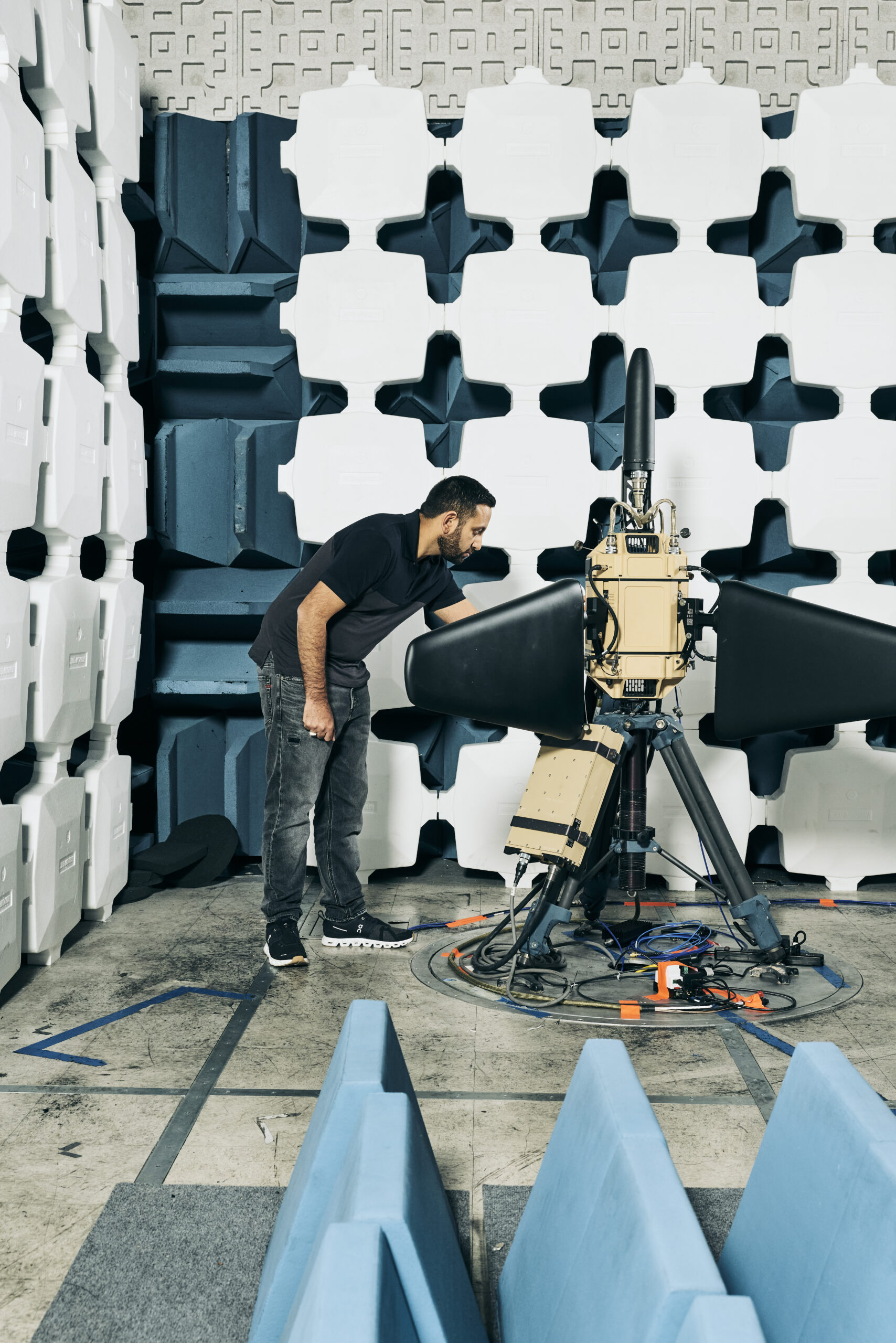
The first Anduril surveillance tower looked like a phone pole that had wandered into an electronics aisle. It carried a gaming PC in a weatherproof box, a pan-tilt unit of the sort used for stage lighting, and spikes to keep birds from fouling the sensors. Some parts came from Home Depot. Adnan Esmail was there in 2018, newly arrived from Tesla, helping turn an awkward prototype into equipment that could survive outside the workshop. By the end of his first week, he had already traveled to the southwest border to install one.
The setting at home base was equally instructive. Anduril's early operation occupied a building and then a hangar by Santa Ana airport, next to a dog kennel. There was little comfort and plenty of barking. Esmail claimed a closet with a little residual heat and made it his lab. The office furniture may have been modest; the engineering problem was not. How do you make a physical system see, decide and act when weather, distance and failure have opinions of their own?
That question has followed him through cars, drones and now general-purpose robots. In 2024 he left Anduril, where he had become senior vice president of engineering, to co-found Physical Intelligence. The San Francisco company is building models meant to control different robots across different tasks. Esmail's career supplies an unusually literal reason for wanting that: he has spent years watching each new machine demand its own custom stack of estimation, control and repair.
The six-hour detour
Esmail studied at MIT. He later worked on flood disaster relief in Pakistan, an early hint of the practical problems he found compelling. At Tesla, he worked on the Model X's Falcon wing doors, electromechanical vehicle systems, Autopilot sensors and technologies for future platforms. A door that must open gracefully in a cramped parking space is a different kind of challenge from a chatbot. Metal meets geometry; motors meet neighbors' cars.
He was happy at Tesla, he later wrote. Then, in July 2018, he had coffee with Anduril founder Palmer Luckey. The meeting was supposed to last half an hour. It ran six. Luckey described a company building defense technology on its own dime and putting products into the field quickly. Two months later, Esmail joined a team of roughly 20 people working near the airport. His colleagues at Tesla, he recalled, wondered about the move.
The early days were short on polish and rich in feedback. A broken component could require a 200-mile drive back to Santa Ana for repair and another trip out. Test drones fell into the rolling, protected terrain at night, where the team had to recover every piece. Glow sticks and beepers became navigational aids for finding their own machines in the brush. There is an almost comic precision to the image: advanced autonomy reduced, for a moment, to listening for a beep in the dark.
A control problem with consequences
One early Anduril product, Anvil, tried to intercept hostile drones with another drone. Esmail's account describes a first prototype that looked upward through an Intel camera and flew toward what it saw. At a White Sands test, the system intercepted about 40 percent of targets. That was enough to attract attention, and nowhere near enough for the team to relax. Glare, clouds and moving targets made the original approach brittle.
The response was a more capable radar and guidance system, informed in part by the automotive radar knowledge Esmail brought with him. His story of the program is full of the sort of details that escape tidy innovation diagrams: engineers taking drones apart in a hotel room before dawn, firmware loaded just in time, and a test that depended on the revised hardware actually meeting a target. Whatever one thinks of the defense market, the engineering lesson is plain. A working demo is an invitation to discover how much remains to be fixed.
“The best problems are the ones everyone else avoids, until they become impossible to ignore.”Adnan Esmail
His account also describes an unusual split in his days as the organization grew. Meetings and organizational problems took daylight hours. After dinner, he returned to the labs to debug with engineers, sketch calculations and write Python. He said he preferred letting teams own the credit for major victories; his absence from celebratory photos was deliberate. These claims are his own, but they add texture to a leadership style that kept one foot beside the test bench.
He eventually had to design more than products. Separate teams for every drone and sensor would have multiplied headcount and duplicated work. Under his leadership, Anduril organized product engineering around products, reusable core technologies and shared capabilities such as a machine shop. Flight computers and propulsion systems could become building blocks for new projects. The same principle would resurface, on a larger scale, in his next company.
What a larger team could not solve
By March 2024, Esmail says, his department had grown to 550 engineers working on 30 products across 15 product families. Scale had made many things possible. It had also sharpened a limit he had seen in autonomous hardware: capable physical platforms still depended on narrow, carefully built control systems. A new airframe could mean another round of state estimation, tuned controllers and edge cases. Change the body and much of the accumulated intelligence had to be built again.
In February that year, he was approached about advising a robotics startup and called Anduril co-founder Brian Schimpf to talk through the opportunity. Schimpf told him, “I've always seen you as a founder.” In Esmail's telling, that line made an old problem look like the next one to pursue. Artificial intelligence had made great strides in language and images. Physical labor remained more stubborn: a robot must sense a crowded, changeable world, make contact with objects and recover when an action goes wrong.
Physical Intelligence was founded in 2024 by a group that includes researchers Sergey Levine, Chelsea Finn, Karol Hausman, Brian Ichter and Quan Vuong, alongside Esmail and Lachy Groom. Levine has described Esmail as the company's head of hardware. Its aim is a general-purpose intelligence layer for machines. Instead of writing a separate set of behaviors for each robot, the team trains vision-language-action models to connect what a robot sees and is asked to do with the movement it makes. The promise is transfer: learning gathered from one set of tasks and machines should help with another.
That is a research program, not a finished household appliance. The difference matters. Physical Intelligence's first generalist policy, π₀, appeared in 2024 with Esmail among its credited contributors. Subsequent releases explored richer skills, longer sequences and learning from experience. The company's public examples are deliberately ordinary: folding laundry, preparing food, plugging in a cable. Ordinary, here, is the hard category. A textile changes shape in the hand; a connector has a very small target; a kitchen task requires remembering what has already been done.
The last few millimeters
A broad robot model may move a screwdriver to the right part of an assembly and still miss the screw. It can approach a socket and fail on the last few millimeters. Physical Intelligence's March 2026 research on reinforcement learning tokens addresses that precise stage. Esmail is among the named authors. The method lets a small policy practice on a real robot and adjust the difficult part of a motion without retraining the entire foundation model.
The researchers tested screwdriving, zip-tie fastening, Ethernet insertion and power-cord insertion. They reported that the precise phases became up to three times faster after practice, depending on the task, and that improvements could appear with as little as 15 minutes of real-world data. These are bounded experimental results, but the direction is notable. The robot arrives with general competence, then learns where a workplace's fixtures and tolerances demand more care.
From broad motion to precise contact
The company has also published work on robot memory: short-term visual context and a running language summary of what has already happened. Esmail described the distinction in a public post with a domestic example. A machine might need immediate visual memory to recover from a failed grasp, and longer memory to finish cleaning a kitchen without repeating a step. The exact architecture will change. The requirement will not: a useful robot has to remember enough to continue when the neat script runs out.
There is a throughline between that work and the glow sticks in the Anduril test range. Both begin with a physical system doing something imperfectly in an uncontrolled world. One solution helps humans find a fallen drone; the other tries to help a robot learn from a missed grasp. Esmail's move from hardware organizations to robot foundation models did not remove the mess. It changed the level at which he is trying to solve it.
The person beside the machine
Esmail's 2025 essay ends with a scene away from any company stage. In April 2024, he set up radar equipment on a hotel rooftop near the Hollywood Hills while his young son, fresh from the pool, asked what he was doing. Esmail had spent years bringing equipment to odd places at odd hours. Here was another example, with a curious child and damp hands far too close to electronics.
It is tempting to make that scene into a grand parable about the future. It works better as a small record of how engineering lives alongside ordinary life. The machines in his story are expensive and intricate; the people beside them are tired, curious, occasionally improvising, and sometimes looking for a lost drone at 2 a.m. That is the world into which any robot intelligence must eventually fit.
Esmail's stated ambition is to make physical intelligence reusable across machines and useful in real work. Whether Physical Intelligence can reach that scale is still an open technical and commercial question. For now, the measure is smaller and more tangible: a robot that learns the difficult contact, remembers the missed grasp, and comes back to the task with a better next move. After years spent building machines that had to face reality, Esmail is trying to teach reality back to the machines.