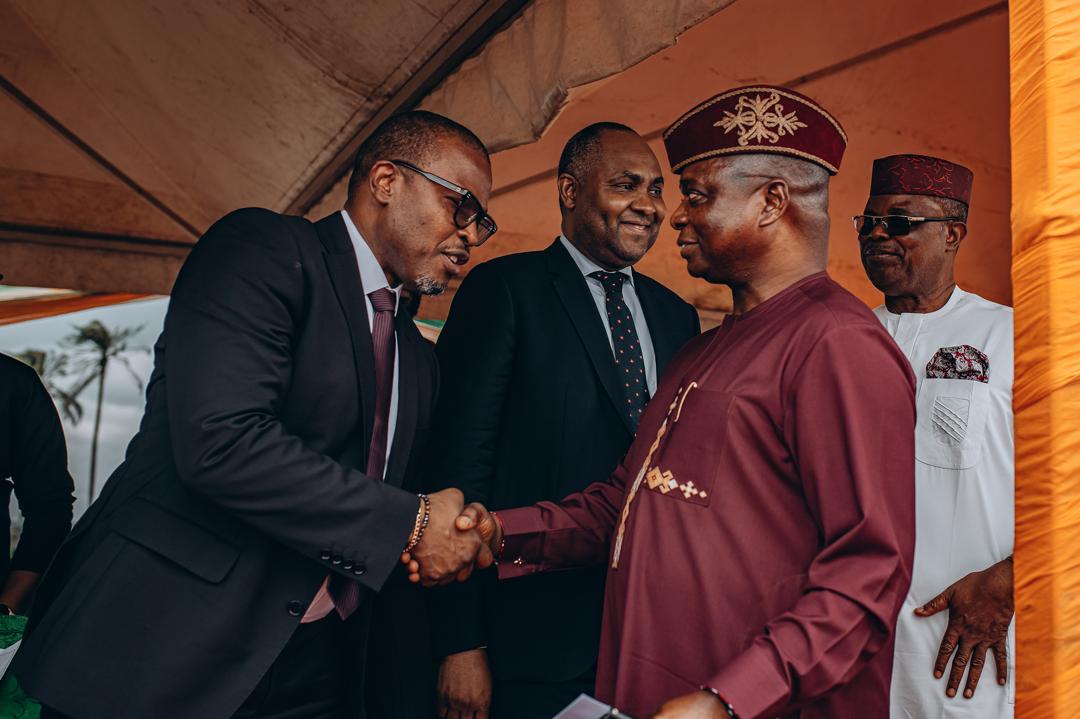
A road has two clocks. One counts down to the day the construction crews finish. The other starts when the traffic arrives, then keeps going through rain, repairs and all the small indignities that vehicles inflict on a surface. At the March 2025 launch of the Benin-Asaba Expressway redevelopment, Adeniran Ajakaiye spoke about long-term capital. The second clock helps explain why.
The project covers a 125-kilometre corridor. Ajakaiye, a co-founder of Africa Plus Partners, presented it as a way to connect economic activity as well as places. The road’s concession arrangement includes a continuing maintenance obligation. Its financial design therefore has to consider what happens well beyond the ceremony. A ribbon is wonderfully easy to maintain. A highway requires a rather larger budget.
That distance between an announcement and an asset that works is the territory of Ajakaiye’s career. He has worked in Nigerian banking, American financial institutions and management consulting. He now helps direct investment into infrastructure businesses. The work brings familiar financial questions into unusually tangible surroundings: a stretch of road, an accommodation block, the institutions responsible for keeping them useful.
An engineer learns the language of money
Ajakaiye’s first degree was in engineering at the University of Ilorin. He later earned an MBA in Finance and Strategy from Washington University in St. Louis. His LinkedIn education entry places his Olin Business School years between 2009 and 2011. The combination gives his biography an appealing symmetry: training in how things are designed, followed by training in how enterprises are financed.
His Nigerian career included GTBank, FirstBank, Stanbic IBTC and Access Bank. He held regional and zonal leadership roles and worked on debt instruments for infrastructure projects. In the United States, his employers included Citigroup and Wells Fargo, followed by PwC. There he consulted on mergers and acquisitions, compliance and business process changes. These are jobs in which the paperwork carries consequences.
There is no need to turn that record into a fable about an inevitable destiny. Banking and consulting were substantial occupations in their own right. What matters for the later story is the range: local banks and international institutions, investment transactions and the internal systems of businesses. Infrastructure finance needs both a proposal that attracts capital and an organisation capable of handling it.
In 2016, Ajakaiye and Anhad Narula founded Africa Plus Partners. Narula brought experience leading infrastructure projects across Africa and Asia. Ajakaiye brought banking, consulting and investment experience. Their partnership placed the financial and physical sides of a project inside the same firm. Ajakaiye’s current responsibilities include the Executive Managing Director role and the Chief Investment Officer position for the fund.
The missing middle gets a fund
Africa Plus Partners describes its area of interest as Africa’s “missing middle” infrastructure. The phrase is useful because infrastructure discussions can become so enormous that the individual business disappears. Ajakaiye’s firm works through investments in businesses that create, improve or expand infrastructure. Raising money is one part of the job. Choosing an investment, taking a governance position and supporting its operation are others.
The firm manages naira-denominated, equity-based infrastructure funds in Nigeria. That detail grounds an otherwise expansive ambition in a particular currency and capital market. It also brings local investors into the story. Africa Plus Partners’ model involves long-term capital and ownership interests, accompanied by a role in governance. The investor remains connected to what happens inside the business after the transaction.
On 24 January 2023, Africa Infra Plus Fund I reached a public milestone with its memorandum listing on the Nigerian Exchange. The listing announcement described a ₦20.5 billion closed-end infrastructure fund. It was co-managed with Capital Trust Investments & Asset Management. Its structure included equity and quasi-equity investments in infrastructure, with environmental and social considerations built into its stated investment approach.
At the listing, Ajakaiye emphasised governance and transparency alongside returns and the infrastructure gap. Those subjects can sound ceremonial until something goes wrong. Then everyone wants to know who made a decision, who checked it and who can explain it. His remarks placed accountability inside the investment proposition. A fund has to make its own workings credible before asking investors to trust the workings of a road.
- CapitalLong-term funding from investors
- OwnershipEquity interests in infrastructure businesses
- OversightGovernance and investment monitoring
- UseAssets serving their customers
Start small, then earn the next project
In October 2023, discussing alternatives for financing infrastructure, Ajakaiye offered governments a practical sequence. Begin with smaller projects. Demonstrate that they are viable. Give private investors a reason to participate. Alongside public-private partnerships, he discussed grants, financing alternatives and revenue collection. The advice had the modest appeal of something that could be attempted before an entire national problem was solved.
There is an investor’s logic in that sequence. A smaller project gives people something specific to examine. Its arrangements can be tested; its viability can be discussed without hiding behind the size of the ambition. In this reading of his advice, confidence develops through a transaction that can be understood. The next project benefits from the evidence produced by the previous one.
By March 2025, his public work included an undertaking on a different scale. The Benin-Asaba redevelopment was launched under Nigeria’s Highway Development and Management Initiative. The corridor was handed over through a public-private partnership process to the Benin-Asaba Expressway Concession Company. Ajakaiye’s investment career now had a long, measurable line on the map against which expectations would accumulate.
“This highway is a blueprint for how Nigeria should build roads - efficiently, sustainably, and with long-term capital.”
Adeniran Ajakaiye · March 2025 project launch
At the handover, he described a 25-year concession and a tolling arrangement intended to support maintenance without depending on annual government budgets. He also announced a 30-month delivery target. The two time spans explain the two clocks: construction has a deadline, while the concession extends the responsibility much further. They are commitments about a project’s future, with delivery still the test that matters.
In April 2025, Ajakaiye published a LinkedIn article titled “The Benin-Asaba Highway: Five (5) Ways Proactive Risk Management Guarantees Success on this Project.” The title places risk management near the centre of his public account of the road. It is a recognisable continuation of the banker’s occupation: identify the conditions that could interrupt a plan, then organise a response before those conditions become a crisis.
A room of one’s own, with a financing plan
A highway makes infrastructure visible at a large scale. Student accommodation brings it down to a room. On 15 May 2024, Africa Plus Partners joined Akwa Ibom State University, TETFund and Family Homes Fund at the groundbreaking of a planned 1,600-bed housing project. Ajakaiye spoke at the event, connecting the scheme to the shortage of accommodation in Nigerian tertiary education.
The wider programme was announced as an effort to support approximately 40,000 students across tertiary institutions. That figure described an ambition, while the Akwa Ibom project supplied a particular starting point. Keeping the two scales together is useful: a national programme needs an intelligible first site, and a first site needs an organisation capable of repeating the work elsewhere.
His stated purpose was to help students concentrate on studying rather than worrying about their living arrangements. The appeal of that idea needs little financial vocabulary. A room is a practical part of attending university. Treating accommodation as investable infrastructure puts the ordinary requirements of student life into a discussion usually dominated by roads, energy and the movement of goods.
Later that year, the firm’s Student Housing Company deal received the Infrastructure Deal of the Year award at the Private Equity Africa Awards. Narula accepted the company award at the November ceremony. Ajakaiye’s response credited the team and the trust of partners and investors. The recognition belonged to the transaction and its organisation; the eventual usefulness of the accommodation would be experienced one resident at a time.
Students appeared in his story before the hostels
The educational connection has an earlier chapter. In October 2019, Ajakaiye announced the Africa Plus Partners Student Venture Prize at a briefing in Calabar. It invited business ideas from Nigerian university undergraduates. Eligibility required a verifiable matriculation number. That small administrative detail made the intended audience clear: students with ideas, rather than a general field of established businesses.
He urged those students to take the potential of their ideas seriously. The planned competition included a shortlist, business training and a final pitch. Prize money rewarded the idea, he explained at the announcement. The structure made room for something still being developed, with a chance for students to present it and have it examined.
A venture competition and a housing programme are very different undertakings. Their connection in his public career is the student. One creates a setting in which an undergraduate can put forward a business proposal; the other addresses the physical setting in which an undergraduate studies. That is a more specific educational thread than a broad statement about supporting the next generation.
The unglamorous work that makes capital stay
In October 2025, Africa Plus Partners announced rating upgrades from Agusto & Co. and DataPro. The announcement described an A investment manager rating and an A+ credit rating respectively. It also discussed separate control and audit functions, independent board oversight and investment screening. These are institutional details, but they belong in a personal profile of the executive responsible for helping run the firm.
Ajakaiye connected the recognition to governance and discipline. Read alongside his earlier listing remarks, the emphasis is consistent. The organisation receiving investors’ money needs its own structure of checks and decisions. An infrastructure manager is managing relationships and obligations as well as assets. The quality of that work is less easy to photograph than a groundbreaking, and much harder to substitute with a speech.
Ajakaiye’s career now moves between those two kinds of visibility. There are public launches, a company award and projects whose scale can be counted in kilometres or beds. Behind them sit investment choices, agreements and oversight. The distance between money and a road is filled with those decisions. When the ceremony ends and the second clock keeps running, their consequences become part of everybody else’s day.