A park is an unusual place to explain a highway investor. In Denver, the Central 70 project lowered part of an interstate and put four acres of public space above it. The traffic could keep moving underneath. The neighborhood gained somewhere to gather overhead. For Nicolas Rubio, the Meridiam executive whose working life began in construction, the arrangement offers a useful introduction: one piece of infrastructure, several kinds of value, and a rather literal test of whether the numbers support the neighborhood.
At the project’s completion in late 2022, Rubio wanted Central 70 to become a model for community-focused highways. Kiewit Meridiam Partners would operate and maintain the roadway for another thirty years. That second fact changes the first. A park can make a fine opening-day picture; a maintenance commitment asks who will still be paying attention when the photograph has become an archive.
Rubio’s career runs through the gap between those moments. He is a civil engineer who became an operator and then an infrastructure investment executive. His work involves assets that people expect to use without consulting their ownership structures. Few commuters wake up eager to examine a concession agreement. They would quite like to arrive on time.
The builder goes into finance
Rubio studied civil engineering at the Polytechnic University of Madrid. He began at Ferrovial, spent a decade in construction and managed its business in Tunisia. At Cintra, his responsibilities moved through technical development, U.S. leadership and global operations. In early 2021, he joined Meridiam. Today, the firm lists him as partner and chief executive for North America, based in Washington, D.C.
Construction is a useful education in the limits of abstraction. Drawings must become structures. Sequences matter. Decisions made early turn into constraints later. Moving from that business into investment puts the same practical questions inside another set of calculations. What will it cost to keep a structure useful? Which obligations follow the capital? How much of the future can a contract sensibly anticipate?
A career that crosses those responsibilities offers a particular vantage point. The builder sees the schedule. The operator sees what happens after the schedule ends. The investor must consider both, along with the arrangements that make a project possible. Rubio’s progression joins those perspectives in one professional history. It gives his arguments about long-term ownership a physical setting: concrete, equipment, lanes and the people waiting to use them.
Tunisia→OPERATECintra
Global operations→INVESTMeridiam
Joined 2021
A partnership needs people who stay
Rubio was discussing the difficulties of these relationships years before joining Meridiam. In a 2015 infrastructure discussion, he emphasized the need for public owners to understand the partnership model and participate actively. He also stressed that both parties must accept the agreed allocation of risks and rewards. A long agreement needs an informed working relationship around it.
By Infrastructure Week in 2025, he had reduced the point to a memorable sentence about the third letter in P3. It is a tidy line for an untidy job. A public authority and a private consortium can agree on a destination while having different concerns about the route, the price and the speed.
“The third P is most important, most central to success: partnership.”
Nicolas Rubio · Infrastructure Week, 2025
The attraction of the argument is its insistence on behavior. Money may bring a project within reach. Technical skill may make it buildable. A relationship must then survive the unexpected. Over a period measured in decades, assumptions will be tested and people in the room will change. A partnership needs a way to keep working through those changes.
There is an unglamorous discipline here. Responsibilities have to be clear enough to enforce and practical enough to carry out. A local government has public obligations. A private investor has financial ones. Residents have mornings, evenings and limited patience. The elegance of the diagram matters less than whether these interests can coexist once the machinery starts.
Broadband enters the picture
A photograph from Bloomington, Indiana, catches Rubio beside Mayor John Hamilton at a podium. The subject was fiber broadband. In 2022, the city and Meridiam established a partnership to design, build, finance and manage a community-wide network. The project brought the language of infrastructure investment into something residents encounter through a screen, though the investment itself remained thoroughly physical.
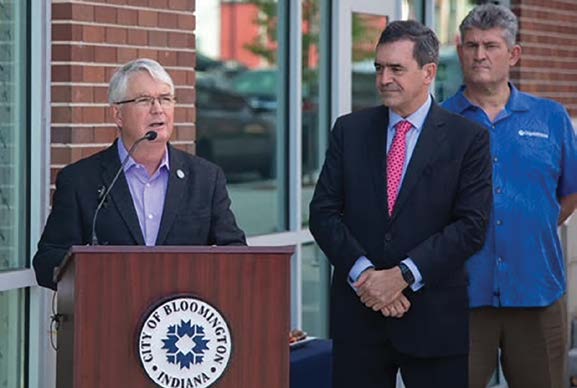
Fiber needs routes, construction, financing and maintenance. The same broad questions travel from roads into networks: who gets access, who operates the system, and how will it remain useful? The Bloomington partnership’s stated purpose was to extend access across income levels. That gives the investment a local test beyond the amount of cable installed.
In Memphis, Meridiam’s Blue Suede Networks broke ground in April 2024 on a network intended to reach at least 85 percent of the city. Rubio described fiber in utility terms and connected gaps in access with exclusion from digital life. The name supplies a little Memphis wit; the underlying obligation is sober. A connection becomes useful when somebody can actually use it.
Broadband adds another dimension to his professional story. Transportation infrastructure connects people to places. Digital infrastructure connects them to work, learning and services without requiring a trip. For the investor, both involve equipment and continuing responsibilities. For the household, each can change the range of things that an ordinary day permits.
The campus below the campus
At Fresno State, the infrastructure is less photogenic. Meridiam’s Bulldog Infrastructure Group and NORESCO reached substantial completion of a campus utility project in October 2024. It modernized the central plant and distribution network, alongside efficiency upgrades. Heating and cooling remained available during construction. The work happened around a university that still had to function.
The announced guarantees included energy savings above 33 percent and a 73 percent reduction in natural-gas use. Those figures describe project commitments, rather than a personal scorecard for Rubio. They also give the broad language of sustainability something measurable to answer to. The partnership extends across 33 years, with NORESCO responsible for maintenance over a thirty-year period.
FRESNO STATE · PROJECT GUARANTEES
Announced at substantial completion, October 2024. Different measures; bars share a percentage scale.
Such systems illustrate the peculiar dignity of infrastructure. When they work, most users have other things to think about. That is a reasonable outcome. Students attend classes; an operator attends to the systems supporting them. Reliability earns its place through repetition. It can be harder to photograph than a new building and more consequential than the photograph suggests.
The commute before the promise
The long view still has to accommodate this week’s journey. At the SR 400 groundbreaking in Georgia in April 2026, Rubio acknowledged the immediate cost of construction: “The coming years are not going to be easy in terms of the construction disruption.” The project adds sixteen miles of express lanes and bus infrastructure, with completion expected in early 2031.
That admission belongs beside any account of eventual benefits. A resident encounters cones before encountering a completed road. A project team must work through that interval with the people who use the corridor. Long-term investment earns credibility partly through how it handles the short term. Five years is a construction program; it is also a substantial number of school runs.
Rubio’s work also reaches a different mode of travel in Los Angeles. In January 2026, Meridiam and its partners Bechtel and American Triple I welcomed Metro’s selection of a modified underground-rail alternative for the Sepulveda Transit Corridor. The consortium was supporting its development. The distinction matters: a preferred alternative marks progress in planning, while a working railway remains a future undertaking.
The road and the rail proposal place him on both sides of a familiar urban question: how should people move through a growing region? Each requires coordination among institutions, investors, technical specialists and communities. Each must proceed through decisions that have consequences long before a passenger boards or a driver enters a new lane.
The investor’s clock meets the asset’s clock
The same question of duration appears inside the investment firm. On October 6, 2026, Meridiam announced the closing of an approximately $4.5 billion North America Core Fund containing fifteen infrastructure assets. The transaction extended the initial MINA II fund to a forty-five-year life. Existing investors received a liquidity option; continued investment remained possible. The announcement concerned the firm and the regional business Rubio leads.
The arrangement addresses a practical mismatch. A fund’s original timetable can run out while a public asset still has years of useful service ahead. Investment structures must accommodate the people supplying capital as well as the assets that capital supports. Keeping ownership workable over time is part of keeping the underlying project workable.
Rubio’s public agenda remains close to those delivery questions. A February 2026 podcast covered diversification in the P3 market, demand for contractors and permitting. In May, he joined a roundtable on permitting and project delivery. An October account placed him at a governors’ infrastructure workshop in New York. The topics trace the distance between an attractive proposal and a project that can proceed.
Return to the park above the Denver highway. It is an appealing place to begin because people can see what the project changes. The longer agreement underneath that achievement asks a less visible question: who keeps it working? Rubio’s career follows the responsibility from the building site into operations and investment. The ribbon gives the project an occasion. The years afterward give it a reputation.