The coffee cup was the problem. On Adam Passaglia's trading screen, it appeared when markets grew busy: a small waiting icon, with a rather leisurely attitude toward somebody else's money. He could click an order and then wait, unsure whether it had traded. Sometimes the uncertainty lasted seconds. Sometimes it lasted minutes. For someone placing orders on both sides of a market, this was an awkward moment to be offered a visual refreshment.
Passaglia's recollection of the experience is brief: “It drove me nuts.” In July 2001, he moved from Chicago to Frankfurt to get closer to the exchange servers. Geography had become part of his trading equipment. A faster connection was worth crossing an ocean.
That decision provides an early clue to the career that followed. Passaglia, now co-founder and CEO of ARB Trading Group, has spent years adjusting the arrangement around the trader: where the desk sits, who supplies its technology, how colleagues share resources, and what happens when an individual strategy grows into a business. His work has increasingly concerned the conditions that allow other people to trade.
The business section was next door
His first route into markets ran through the newspaper. As a child, he followed baseball statistics. Around thirteen, he noticed the commodities and futures prices in the neighboring business pages and started tracking their movement. He rehearsed trades in his head. The newspaper had acquired a second scoreboard.
At the University of Illinois, his interest was already occupational. A finance assignment gave students $25,000 of simulated capital. Passaglia recalls turning his account into $250,000 and submitting ten pages of trades, provoking an objection from his professor about what the exercise was supposed to teach. A successful simulated account, apparently, could still be an imperfect piece of homework.
The practical education continued between classes. In a 2026 recollection, he described hurrying through a statistics test so he could return to his apartment for a Federal Reserve announcement. He also recalled buying 100 Microsoft shares during college and still owning them. That surviving position is a pleasing exception in the memories of a trader otherwise occupied with much shorter decisions.
One desk, several job descriptions
Summer work in the CME's Eurodollar pit brought him close to professional trading. He graduated in May 2000 and began full-time work the following month. The Frankfurt move came a year later. By January 2003, he was back in Chicago, launching his own proprietary firm.
The Chicago operation demanded a fairly elastic definition of the word trader. Passaglia handled technology, accounting, training and trading himself. He installed an AT&T fiber connection in an office on Irving Park Road. The business depended on his preparation, but also on equipment that required its own attention. Every extra responsibility competed with the activity that was meant to pay for all the others.
Looking back in 2026, he acknowledged that his effort had kept increasing while his technology fell behind. He also described former Frankfurt trading acquaintances finding later roles with him in risk and other functions. Experience could retain its value even when the original job changed.
There is a useful distinction here between knowing how to trade and knowing how to sustain a trading operation. The first can be intensely individual. The second forces questions about staffing, systems and continuity. His later business would offer other traders support across precisely those less glamorous requirements. Somebody still has to deal with the connection.
- 2000Chicago
Full-time trading - 2001Frankfurt
Closer to the servers - 2003Chicago
His own firm - 2014ARB
A shared platform
Two traders step away from the screen
In 2012, Passaglia met Amnon Baazov, who ran a group of about fifteen traders in Montréal. Their relationship became the basis for combining their operations. Both stepped back from daily trading to build the firm. ARB dates its founding in Chicago to 2014.
The choice changed the unit of ambition. A trader can improve a book one decision at a time. A founder choosing infrastructure is making a longer commitment to other people's decisions. Passaglia and Baazov were building a place in which distinct trading approaches could operate together without requiring everyone to trade alike.
By March 2016, ARB was announcing a presence in the United States, Canada, the United Kingdom, Poland, Israel and India. Its early proposition paired market access and hosting with mentorship. Traders could visit and work from different locations across the network. The business was already describing collaboration as something practical, involving software, connectivity and development plans.
That early description matters because the firm now covers much more ground. The recognizable thread is an attempt to make resources available across individual desks. A trading idea may belong to one person. The systems around it can serve many.
The freedom requires some plumbing
Today, ARB Trading Group offers access to more than twenty-five exchanges across futures, options, fixed income, equities and digital assets. Its services include hosting near exchanges and in data centers, connections to market gateways, and tools for automated strategies. Risk oversight accompanies the capital and technology.
The firm's proposition leaves traders in control of their strategies while giving them shared operational support. For Passaglia, that arrangement makes an interesting successor to the office where he performed every function himself. Independence still has a place. The supporting jobs have acquired colleagues.
ARB's expansion into asset management adds another audience: investors looking for access to strategies. The asset management platform works with proprietary and external managers, with due diligence and operational support around them. Its offering includes a route for emerging portfolio managers to handle external money through the platform while retaining control of their strategies.
Fund management extends that logic into the mechanics of running a fund. Legal structuring, regulatory filings, administration oversight, investor operations and counterparty arrangements all sit within its remit. These are substantial obligations for an emerging manager to assemble separately. ARB offers to organize them through a common platform.
John Klimek leads that fund management business as CEO, with Jerry Happ as COO. Happ joined ARB in 2020 after years working with managed account platforms. Their roles give some definition to the distance Passaglia has traveled from doing his own accounting: the organization now contains businesses with their own specialist leadership.
The distinction between these services helps explain the company Passaglia has helped build. A trader seeking capital and execution support has one set of needs. A manager taking on outside investors acquires another. A fund launch introduces still more relationships and obligations. ARB has developed ways to support each stage. For the founder, the challenge becomes coordinating these different businesses while leaving room for the people making the investment decisions. The arrangements are more elaborate than the early Chicago desk, but the question of who does the supporting work remains familiar.
Choosing what deserves the capital
In a 2026 announcement, Dubai-based FoX-i disclosed an allocation from ARB following due diligence on its systematic foreign exchange strategy. Passaglia's comments emphasized the manager's investment framework, risk controls and institutional readiness. The announcement did not disclose the allocation's size.
The episode illustrates another part of his present work. Having built a business around traders, he must also evaluate which outside managers fit its requirements. A promising strategy needs an operating structure that can support institutional money. The inspection reaches beyond the trading idea itself.
FoX-i described the relationship in terms of transparency, governance and capital preservation. Those concerns are a considerable distance from a college simulation, where the paperwork arrived after the trades. In an allocation process, the paperwork and controls are part of the decision from the beginning.
Scale also brings a geographic change. ARB's current network lists Chicago, Montréal, several Indian centers, Dublin, Zagreb, Shanghai and Dubai, among other locations. Chicago remains the trading group's headquarters. The map has grown around access to people and markets, rather than around a requirement that every trader occupy the same room.
A faster screen, a larger bill
The economics of that network occupy Passaglia as much as its reach. In May 2025, he said ARB paid CME more than $1 million a year for data alone. He described a firm operating across the working week and preparing for markets that might run continuously. The screens may travel lightly; the supporting organization carries a bill.
He also imagined a device combining futures, equities, cryptocurrency and betting, while acknowledging uncertainty about how regulation would accommodate it. His forecast came with a demand for clear rules. Ease of access would leave questions of oversight to be answered.
By 2026, his advice to an aspiring trader included a warning against stubbornness. He acknowledged his own earlier failure to adapt technologically and described experimenting with AI as information tools developed. It is an unusually useful admission from somebody selling access to infrastructure: past competence does not settle the next problem.
“Don’t be stubborn.”
Adam Passaglia / 2026
The teenager reading prices in the newspaper could conduct an entire imaginary session in his head. The founder has had to make room for connections, colleagues, controls and costs. Across those changes, the practical question persists: what does the trader need to make the next decision? Once, Passaglia answered by moving to Frankfurt. Now, much of his job consists of arranging the answer for somebody else.
Continue the conversation
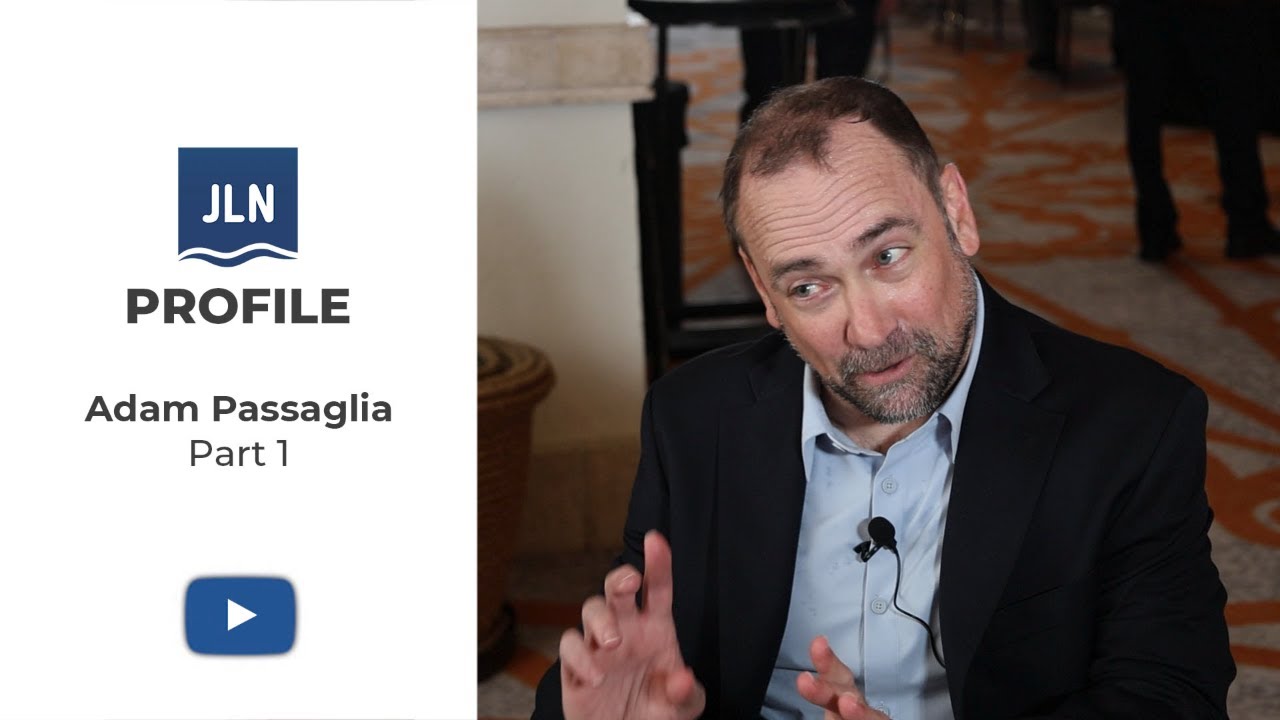
Explore the businesses and watch Passaglia tell the story.