The crowded toolbox is an old problem wearing an AI nametag. A system can have access to everything and still reach for the wrong thing. Achintya Ashok has encountered versions of that tension on a foreign-exchange desk, inside a global streaming service, across crypto infrastructure and in the middle of production operations. Today, as co-founder and CEO of OneGrep, he is applying those lessons to AI agents: how should software choose the right tool, carry the right context and complete useful work without losing the human judgment that made the workflow valuable?
The question sounds tidy. The working environment is not. Modern agents can connect to calendars, code hosts, ticketing systems, databases and a swelling catalog of Model Context Protocol servers. Each connection adds capability. It also adds names, schemas, instructions and chances for a model to select badly. Ashok and co-founder Brian Cripe describe the practical result as tool overload: more possible actions, more context consumed, and more room for an agent to become confidently busy with the wrong instrument.
Their answer is Toolprint, a product developed by OneGrep. Its central object, the toolprint, is a reusable blueprint written in human language that describes how tools can work together toward a goal. A developer might ask an agent to review recent changes in a GitHub repository and open the appropriate Linear tickets. The agent receives a focused set of tools and relevant guidance, without requiring its operator to draw a brittle workflow graph for every possible turn.
A career in useful answers
Ashok describes himself as a software engineer and entrepreneur drawn to large-scale services with direct, user-facing impact. The pairing matters. His public record is full of machinery, but it rarely treats machinery as the destination. At Goldman Sachs, where he first interned and later worked as an analyst and software engineer, the users were traders and salespeople in emerging-market foreign exchange. He built and improved systems for real-time position monitoring, interest-rate swaps and data ingestion. Code had to meet a live decision, made by someone with money and risk on the screen.
At Disney Streaming Services, the audience became dramatically larger. Ashok worked in content discovery and search, including the metadata APIs and pipelines behind personalized experiences. Y Combinator's profile says he became tech lead of the search team responsible for contextual experiences serving 70 million customers in real time. At AWS re:Invent in 2018, he spoke about the engineering required to deliver web applications at scale using edge computation. The stage image is refreshingly literal: Ashok beside a slide titled “The journey to scale nirvana,” discussing caching, origin traffic, global availability and response times.
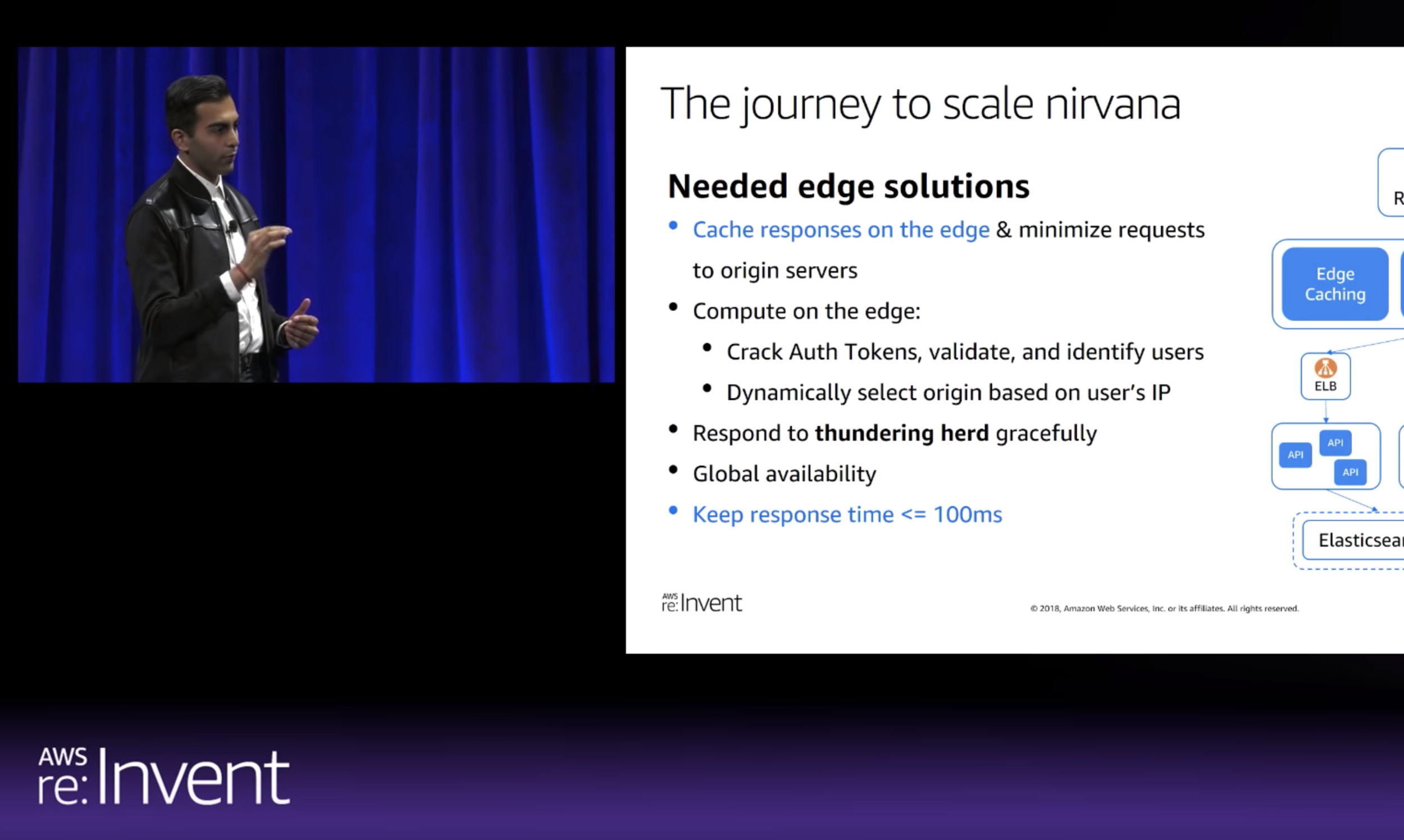
Those are not merely résumé stops. Together they form an education in finding signal under pressure. Streaming systems must return something relevant before impatience becomes a click. Trading systems must display risk while the risk is still actionable. Production systems must give an on-call engineer enough context to act before an incident grows. AI agents inherit the same demand with a comic twist: they may possess the right tool and still fail to recognize it.
The founder before the company
Long before OneGrep, Ashok was already turning ordinary friction into software. ReservEat began with a familiar social nuisance: making dinner plans with friends. He and Rohan Rayarikar built an iOS app that could invite people by text, gather availability, combine cuisine and neighborhood preferences, recommend places and pass a confirmed group to OpenTable. The product involved scrapers, APIs and messaging, but its real concern was coordination. Too many small decisions had been assigned to one patient friend.
XactSpot aimed at a different kind of coordination. Ashok and his collaborators designed a computer-vision system for parking operators. Networked cameras would read vehicles entering or leaving, compare license plates with customer records and report occupancy without installing a sensor in every individual space. His personal account dwells on unit economics and operating tradeoffs, evidence of an engineer learning to look beyond whether a system can be built toward whether it should survive contact with a budget.
An even earlier project offers a small preview of his current work. Ashok built a Connect Four opponent using minimax and alpha-beta pruning. The game tree asks a program to examine possible moves, reduce unnecessary search and choose an action with the best utility. AI agents powered by language models are far less bounded than a grid of colored discs, but the family resemblance is charming. Once again, the problem is not a lack of possible moves. It is selecting the useful one without wasting the board.
Different systems, the same useful moment
The repeating design instinct is selection: place the most useful capability near the next decision.
Following the bottleneck
OneGrep began in late 2023 with a more operationally specific pitch. Ashok and Cripe had both worked on distributed systems, and the company entered Y Combinator's Winter 2024 batch as an observability copilot. Its software sought to help engineers reduce noisy telemetry, control monitoring costs and resolve incidents by connecting real-time signals with the knowledge spread across a team. The company offered deployment in a customer's infrastructure as well as a hosted cloud service.
The original product was concerned with information that existed but was poorly connected: logs in one system, incident retrospectives in another, runbooks somewhere else, and practical know-how held by colleagues. Toolprint moves that concern into the agent stack. Now the fragmentation is among tools, servers and instructions. The shift changes the interface and market, while preserving a technical conviction: useful automation depends on presenting the right context and capability together.
HyperTool, an open-source project from Toolprint, makes the thesis concrete. It sits between an AI client and multiple MCP servers, then exposes focused toolsets instead of every available tool at once. Ashok wrote that some users were running 10 or 20 MCP servers with more than 100 tools while avoiding the context overflow and binding failures they had previously hit. Another project, GraphQL Forge, turns operations from a GraphQL schema into tools an agent can call. The products expand access and narrow attention at the same time.
GreenFeet appears in NYU's Spring Prototyping Showcase.
Goldman Sachs work and an AWS re:Invent talk on edge computation for streaming scale.
Senior software engineer and tech lead at Coinbase.
OneGrep begins with Brian Cripe.
OneGrep completes Y Combinator W24 with an observability product.
Toolprint and open-source MCP projects bring the company's focus to agent tool selection.
Humans remain in the loop
Ashok's public writing is notably skeptical of claims that AI agents can simply replace human labor and creativity. He has argued for systems that augment people: models can distill large bodies of information and handle discrete tasks, but they need guardrails, specific knowledge and guidance acquired through interaction. Toolprints encode that view in product form. They allow a person to describe a workflow in familiar language, refine it, and share the accumulated operating knowledge with other agents and teams.
That position also explains the appeal of a blueprint over a rigid automation graph. Real work develops exceptions. Requirements move. The person who understands the task may not be the person willing to debug a branching JSON configuration at two in the morning. Toolprint's promise is to preserve the intent and leave room for an agent to handle the messy path, while keeping the operator close enough to revise the guidance.
There is playfulness around the edges. Toolprint's site talks about giving an agent a “vibe,” and Ashok's older technical explanations detour through Roombas, happiness and the relief of surviving a lesson on minimax. His reading list wanders through shipping containers, empires, market history, mysteries and science fiction. During Y Combinator, his memories included late-night dumplings with a lesson in banking compliance and Saturday boxing sessions that became conversations about open-core strategy. The engineer's instinct to model a system coexists with an operator's awareness that the real system is usually a group of people improvising around lunch, fatigue and deadlines.
Judgment is the product
The next stage of OneGrep's story is still being written in public repositories, packages and product updates. What is already visible is a consistent arc. Ashok has moved from systems that help humans read a market, to systems that help viewers find a show, to systems that help engineers understand production, and finally to systems that help agents decide how to act. Each domain begins with abundance. Each becomes useful through selection.
For builders, the practical lesson is easy to borrow. When a platform makes capability cheap, pay attention to the new coordination cost. Streaming made content abundant and elevated discovery. Observability made telemetry abundant and elevated correlation. MCP makes integrations easier and elevates tool selection. The opportunity often appears one step after the breakthrough, where somebody must make the breakthrough manageable.
Ashok's aspiration is visible in that step: agents that can do meaningful work across software without pretending human expertise is obsolete. The ideal agent is neither an empty chat box nor an unsupervised oracle. It is a capable colleague with the right instruments laid out, the relevant notes nearby and enough instruction to understand why the work matters. Even software, it turns out, benefits from a well-organized desk.