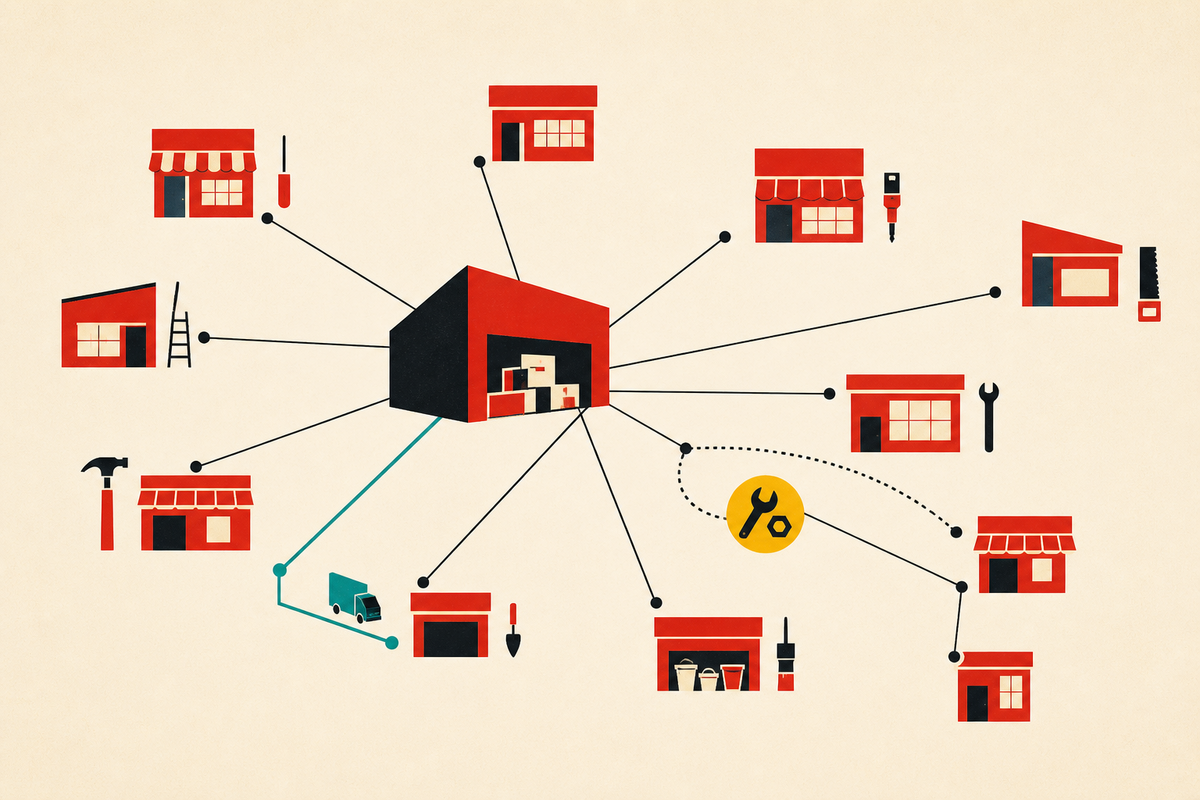
The most revealing item at Ace Hardware cannot be found between the paint chips and the plumbing fittings. It is the ownership structure. Walk into a typical Ace and the person deciding which snow shovel, grill or odd-size screw gets shelf space is a local entrepreneur. That retailer also owns a piece of the Oak Brook, Illinois, corporation buying and distributing much of the merchandise. The store is the customer; the customer is the shareholder; and the wholesaler works for both.
That circular arrangement has grown far beyond a quaint buying club. Ace finished fiscal 2025 with $10.043 billion in consolidated revenue, the first time it crossed the $10 billion line. It counted 5,823 branded stores worldwide, more than 5,200 in the United States, and reported $24.1 billion in system-wide retail sales. Corporate Ace is at once a wholesaler, logistics operator, consumer brand, digital platform, owner of retail chains and a growing home-services business. Yet its core pitch remains the one Richard Hesse and several Chicago hardware dealers devised in 1924: independents can bargain like a giant if they buy together.
The anti-chain chain
Home Depot and Lowe's made home improvement into a destination trip: a broad parking lot, towering racks and a store plan recognizable from one market to the next. Ace plays a different geographic game. Its stores can be compact urban shops, rural home centers or something in between. Owners tune stock and services to the blocks around them. A store may cut keys, repair screens, mix paint, sharpen blades or lean unusually hard into grills because that is what its neighborhood keeps asking for.
The difference is not nostalgia. It is an allocation of decisions. Ace centralizes jobs where scale matters - vendor negotiations, distribution centers, private-label development, national marketing, e-commerce infrastructure and data. It keeps many assortment and service choices near the customer. The corporation says its broader network serves more than 8,900 locally owned stores, including the Ace-branded locations and independent customers supplied by Emery Jensen Distribution.
The payoff is unusually literal. Member retailers buy shares and may receive patronage dividends based on eligible purchases and performance. In 2025, Ace returned a record $361.8 million to shareholders and reported a 40.2 percent pre-tax return on shareholder equity. Those shareholders are not a distant fund. They are operators with payrolls, inventory and customers of their own.
“Boring fundamentals, done consistently well, compound into extraordinary outcomes.”John Venhuizen, president and CEO, in the 2025 annual report
A business behind the business
The red sign is only the visible layer. The largest revenue engine is wholesale: Ace buys hardware, lawn and garden goods, paint, power tools, grilling equipment and thousands of routine repair products, then sells them through its network. Fiscal 2025 wholesale revenue was $9.2 billion. That scale lets a neighborhood operator order into a supply system a single store could never build.
Around that core sit four portfolios. Ace Retail Holdings includes company-owned operations such as Westlake Ace Hardware and Great Lakes Ace Hardware. Ace Wholesale Holdings includes Emery Jensen, which supplies hardline retailers beyond the Ace banner. Ace International Holdings supports licensed and franchised operations abroad. Ace Services Holdings extends the brand into Ace Handyman Services and residential trades such as heating, cooling, plumbing and electrical work. Together, they broaden the relationship from “buy the part” toward “help me finish the job.”
This structure also explains who Ace serves. Consumers range from first-time renters hunting for picture hooks to homeowners reviving a lawn and tradespeople replacing a failed part between calls. The second customer is the retailer who needs margin, inventory turns, dependable replenishment and a brand people recognize. Ace must make both people successful. Too much central control weakens the local operator; too little shared discipline wastes the cooperative's scale.
Digital, but still down the street
Ace's e-commerce strategy is less about building a parallel internet warehouse than making nearby inventory visible and movable. Customers can browse online, collect Ace Rewards benefits, pick up locally or request delivery. In 2025, omnichannel revenue reached $2.6 billion and the digital business grew 27 percent. Acehardware.com itself produced $485.4 million in revenue.
The recent delivery deals make the logic easy to see. DoorDash launched service from more than 4,000 local Ace locations in 2025. Uber Eats followed in April 2026, and Instacart added delivery in as fast as an hour in May. For a homeowner with a leaking fitting or a contractor missing a small tool, the useful advantage is not an infinite catalog. It is the right item already sitting a few streets away.
Ace is not asking digital to replace neighborhood retail. It is using search, fulfillment and delivery to make thousands of local shelves behave like a connected network.
Technology is also appearing on the sales floor. In 2026, Ace introduced Hey ARMA, an AI assistant operating on associates' existing handheld devices. It supplies product knowledge, project advice and recommendations in real time. This is a modest, practical use of AI: give the person in the red vest a faster route to the answer, then leave the human in the conversation.
Products that behave like advice
Ace has been concentrating its stores around categories where expertise and demonstration can matter. The ELEVATE3 Ace format turns Paint, Power, Backyard and Barbeque, and Home Preservation into more immersive departments. More than 130 stores had adopted the format by August 2025; Ace said those locations were growing sales 12 percent faster than non-implementing stores. For full-year 2025, ELEVATE stores posted 12.2 percent comparable-store growth.
YardRx takes the advisory idea outside the store. Launched in 2025, the subscription asks about region, grass type, yard size and preferences, then schedules product bundles for the relevant season. It converts a confusing shelf of fertilizers, controls and treatments into a plan. The launch on Groundhog Day included Punxsutawney Phil as a “seasonal employee,” a joke sturdy enough to carry a serious product premise: timing is part of lawn care.
Private labels and exclusives add another layer. Ace sells its own brands alongside names such as Milwaukee, Weber, EGO, Toro, Generac and Lutron. The cooperative recognized those vendors and others in its 2024 awards, underscoring a business that depends on supplier access as much as store execution. Its 2025 Major League Baseball partnership gave the brand a national stage without changing the local fulfillment model underneath.
Where helpfulness meets arithmetic
Ace's market position sits between two familiar retail forms. It offers more shared infrastructure and brand recognition than a fully independent hardware store, but more local ownership and variation than a centralized big-box chain. Direct cooperative and wholesale competitors such as Do it Best and Orgill court many of the same independent operators. Amazon and specialist retailers compete for convenient products. Home Depot, Lowe's and Menards compete for the whole project.
The vulnerabilities follow the model. Independent stores can deliver uneven experiences. Small formats cannot stock every bulky item. A cooperative must persuade thousands of owners to adopt new layouts, software and service standards rather than simply issue commands. Ace's answer has been to make adoption economically legible. In 2025 it opened 180 U.S. stores and completed 510 store projects. ELEVATE supplied evidence that remodeling could move sales. Record dividends showed members what scale returned.
Convenience, in this context, has a more specific meaning than sheer assortment. A big box can win a planned Saturday renovation; Ace is designed to win the interruption. The sink is dripping now. The grill is missing a regulator an hour before dinner. A painter needs one more gallon matched to yesterday's color. Proximity shortens the trip, local inventory narrows the search and an experienced associate can prevent a second visit. For professional customers, Ace's B2B programs and its agreement with ServiceMaster Brands apply the same logic to job sites: make supplies easier to source from a nearby independent business. For homeowners who would rather hand off the work, Ace Handyman Services and the wider home-services portfolio close the gap between diagnosis and completion. Each route starts with the same problem, but Ace can sell the object, the advice, the delivery or the labor.
The community work is part of that same compact. The Ace Hardware Foundation and its partners support children's hospitals, disaster relief and local causes; company fundraising exceeded $24.2 million in 2025. The mission printed in the annual report is only five words: “We exist to help others.” In retail, mission statements are easy to laminate. Ace's more interesting test is whether the structure makes helpful behavior pay - for the customer who needs one correct washer and for the owner who keeps it in stock.
After 102 years, the original insight has not become complicated. Pool the parts of retail that reward bigness. Protect the parts that reward closeness. Ace Hardware's achievement is holding both ideas in the same red sign - a global machine whose owners still stand behind local counters.