Twitter is an eccentric place to look for reliable information. Abed Benaichouche helped build a system to do precisely that. Before his work involved GPU infrastructure and sovereign AI, he designed and developed Suricate-Nat, a platform that collected social-media accounts of natural disasters and used natural-language processing to analyze them. Somewhere inside the public chatter was information that could be useful. The task was to find it.
There is a pleasing continuity between that project and the company he now leads in Abu Dhabi. As co-founder and chief executive of Open Innovation AI, Benaichouche works on the systems that allow governments and enterprises to operate artificial intelligence. The vocabulary has grown considerably more expensive. The underlying question remains recognizable: what has to happen before a technical possibility becomes something an organization can actually use?
Read his career through that question and the sequence becomes easier to follow. Research in France. Applied AI in the UAE. Industrial systems at AIQ. Then a company concerned with the infrastructure beneath AI and the controls around it. The setting changes; the practical difficulties keep earning a return invitation.
A useful signal in a very noisy place
Benaichouche’s academic training included a master’s in computer vision and virtual reality at Université d’Évry-Val-d’Essonne and doctoral study at MINES ParisTech. He subsequently worked in French research, including at BRGM, the French Geological Survey. These were settings in which computation had to describe things outside the computer: landscapes, hazards and the uncertain behavior of physical systems.
Suricate-Nat belonged to that world. It treated citizens’ social-media posts as material for analysis, collecting reports about natural disasters and applying language-processing techniques. He also managed work on an interoperable platform for analyzing multiple risks. Both projects placed software between complicated information and people trying to make sense of it.
The useful detail is the direction of travel. A problem existed first. The technology had to earn its place by helping with that problem. A system that can sort language still needs relevant inputs, an intelligible output and a reason for someone to consult it. Even a clever algorithm has to survive the indignity of being useful.
The researcher enters the engine room
By 2018, Benaichouche was a senior research engineer and team leader at the Inception Institute of Artificial Intelligence in the UAE. His work included computer vision, from detecting objects to interpreting satellite and aerial imagery. He appeared on the program of the United Nations World Data Forum in Dubai that October, in a session asking a straightforward question: what are data scientists?
It was an apt question for someone moving between research and its applications. His later career within G42 brought larger technology programs and infrastructure into the picture. He held senior technology leadership positions there and co-founded AIQ, the joint venture between G42 and ADNOC, serving as its chief technology officer.
The industrial setting matters to this story. An energy company brings data, equipment and operational responsibilities into the same conversation. AI has to meet the conditions of a working organization. Accuracy is one concern; deployment, integration and the ability to maintain a system are others. That is the professional territory Benaichouche occupied before taking the chief executive’s chair at Open Innovation AI.
Two names on the paper
His partnership with Rachid Belmeskine, Open Innovation AI’s co-founder and CTO, has a research record as well as a business record. In January 2023, the two posted a paper on filling gaps in borehole images using generative adversarial networks. The application was firmly underground: helping reconstruct incomplete images used in geological interpretation.
The proposed system used a generator and two discriminators to complete missing regions. In the authors’ experiments, it produced realistic completions on a borehole-image dataset. The claim was about a particular method and a particular task. Generative AI, in this instance, was being put to work on an awkward industrial image rather than asked to compose a dinner-party anecdote.
Another paper that month examined food-security scenarios. It combined a statistical forecasting model with Monte Carlo simulation, using time-series information assembled from international data providers. Here again, the objective was to help reason through a concrete problem: how a defined scenario might affect conditions such as food prices and availability.
Placed side by side, these papers suggest a useful way to read the partnership. This is an interpretation of the work: the pair repeatedly approach AI through an application and its constraints. Their eventual company extends the question to the environment in which many such applications must run.
The $100 million announcement, unpacked
Open Innovation AI became more visible internationally at the end of 2023. World Wide Technology announced a $100 million partnership with the Abu Dhabi startup. The arrangement included equity and adoption of Open Innovation AI’s AI operating-system platform at WWT’s Advanced Technology Center. WWT president Omar Mir was also announced as an executive board member.
The number catches the eye. The laboratory helps explain the business. Access to a testing environment and a global technology integrator’s customers offered a route for the software into enterprise use. For Benaichouche, the arrangement connected an AI platform developed in Abu Dhabi with an organization equipped to test and bring technology to customers elsewhere.
WWT agreement covering equity and AI platform adoption.
In January 2024, he joined Carrington Malin for a discussion of the company’s global launch. The enterprise problem was familiar enough: organizations wanted to build AI, while the required computing, expertise and time could make the undertaking difficult. Open Innovation AI’s proposition addressed that surrounding work.
It is worth reading the agreement at its stated scope. The announced value covered a partnership involving investment and technology adoption. That structure gives a clearer picture of the company’s route to market than a large number left to fend for itself.
Sovereignty comes with an operating manual
Benaichouche’s present agenda places control alongside deployment. Open Innovation AI describes a platform spanning computing orchestration, model operations and generative AI applications, with customers retaining control over data, models and compute. Its intended users include governments and enterprises whose operating requirements extend beyond obtaining access to a model.
At the Digital Readiness Retreat in 2026, his keynote addressed a “sovereign agentic workforce.” The phrase concerns organizations operating with AI assistants and agents at scale. The presentation considered governance, validation and the infrastructure required to move toward that kind of deployment.
It is a larger ambition than producing a useful answer in a chat window. Once software can take actions within an organization, permissions and oversight become part of the product’s everyday logic. Who may reach which system? What should be checked before an agent is deployed? Who remains accountable? These are practical questions through which to understand the agenda he is describing.
At the same retreat, Open Innovation AI introduced its AI security offering and announced collaborations involving du and Core42. The surrounding activity makes his position easier to understand. A company proposing AI at organizational scale must work with the people supplying infrastructure, setting rules and helping customers adopt it.
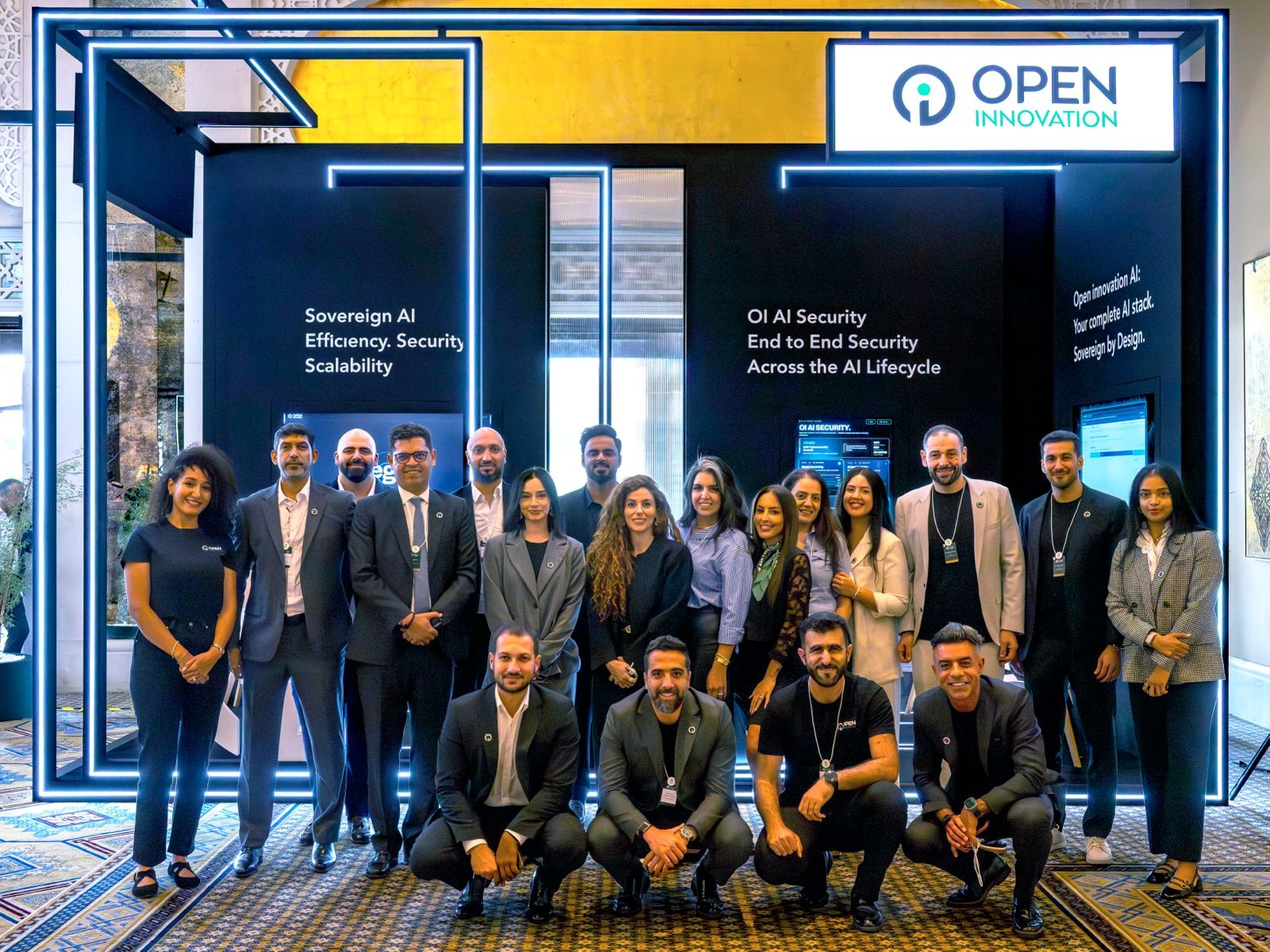
The people around the platform
Education has entered that work, too. In June 2026, Sorbonne University Abu Dhabi and Open Innovation AI signed a memorandum of understanding at VivaTech in Paris. Benaichouche represented the company alongside Belmeskine. The proposed collaboration covered executive education, research, student learning opportunities and engagement between academics and industry.
The agreement adds a human requirement to the infrastructure story. Machines need people who can build, govern and apply them. For a chief executive with a research background, collaboration with a university also connects two parts of his own professional life. The planned activities concern the skills around AI as much as the technology itself.
By September, he was participating in a U.S.-U.A.E. Business Council discussion on trusted AI and cybersecurity in Dubai. The panel brought him together with technology and security executives, including CPX chief executive Hadi Anwar and Microsoft UAE general manager Amr Kamel. The subject was AI becoming embedded in organizations and digital infrastructure.
October brought further announcements. Open Innovation AI and NetApp set out an exploratory collaboration on combining AI orchestration with data infrastructure. Separately, the UAE Cyber Security Council, Core42, Microsoft and Open Innovation AI described a next phase of MDASH adoption, including pilots, workshops and implementation support for participating government entities.
“Trustworthy AI depends on security at every layer, from the infrastructure it runs on to the way its agents behave.”
Abed Benaichouche · October 2026
The MDASH work includes assessing software risk through the National AI Test and Validation Lab. Benaichouche’s contribution to the announcement emphasized checking systems before deployment. That is a concrete expression of the operating concerns running through his current work: a capability has to be examined in the environment where people intend to rely on it.
Looking back to Suricate-Nat, the scale has changed enormously. The earlier task was to draw useful information from a disorderly stream of public messages. Today, he leads a company building the environment around AI for institutions. Both leave plenty of room for difficult, unglamorous work. Benaichouche’s career is interesting because he keeps turning up where that work begins.