Ahmad Ali Alwan has a surprisingly precise allowance for disorder. Asked about leading his team, the Hub71 chief executive said he leaves “10 to 20 percent room for healthy chaos.” It is a pleasingly financial way to describe a very unfinancial ingredient. Somewhere inside the operating plan, apparently, there is permission for an idea to misbehave.
He also talks about listening, resilience, accepting failure and staying grounded in one’s own strengths. Yet the small allocation to chaos is the detail that sticks. Alwan’s professional life has involved investment portfolios, corporate strategy and an institutional merger. He knows what structure is for. His current job asks him to make that structure useful to people whose businesses may still be changing shape.
At Hub71, Abu Dhabi’s technology ecosystem, he works between founders and the institutions that can help them grow. The work brings together investment, customers, regulations and international relationships. An entrepreneur may arrive with a product. Alwan’s organization tries to help assemble the circumstances in which that product can become a lasting company.
Before the founders, the portfolios
Alwan studied international studies at the University of Sharjah and earned a master’s in international business and emerging markets at the University of Edinburgh. Those subjects belong comfortably together in his later career: how countries connect, how businesses expand, and what happens when the ambitions of one meet the institutions of another. His education provided an international frame for a career built around Abu Dhabi.
He began at Mubadala in Mubadala Capital’s private-equity fund investment team. Later, in portfolio strategy, he worked on corporate planning and special projects. During the Mubadala-IPIC merger in 2016 and 2017, he served as working committee secretary and participated in the project management office. This was experience in the machinery behind a major institutional combination, where coordination has consequences far beyond an untidy meeting.
His subsequent responsibilities in Mubadala’s UAE Clusters asset-management team included aerospace and technology businesses such as Strata, Sanad and G42, as well as Hub71. The range matters. A portfolio spanning industrial production and computing exposes an investment professional to businesses with different customers, operating rhythms and routes to growth. The young software company down the corridor does not have the same needs as an aerospace manufacturer.
Building the place where companies begin
In 2019, Alwan helped launch Abu Dhabi Catalyst Partners. Looking back in 2020, he described the experience of setting up an initiative from scratch and developing the strategy behind it. What particularly interested him was combining business objectives with benefits for Abu Dhabi and the UAE. Financial performance and economic development were becoming connected questions in his work.
He was also a founding team member of Hub71 in 2019. By November 2020, he was its head of strategy and corporate development, describing a community of almost 60 startups and more than 30 partners. He spoke of listening to founders and turning their difficulties into changes to the offering. For someone arriving from investment and institutional strategy, it was a shift toward the daily problems of building businesses.
The title changed in October 2022, when he became deputy CEO. His responsibilities had already ranged across strategy, stakeholder relationships, finance, investor engagement and operations. In January 2024, he became CEO. The promotion put someone who had helped construct the organization in charge of its next phase, with the institutional memory that comes from having worked on several parts of the machine.
He took over alongside other leadership appointments covering value creation, operations, marketing and growth. His public message acknowledged Badr Al-Olama’s mentorship. The progression gives his career a particular shape: investment work, institution building, then responsibility for a place where other people build. His entrepreneurial connection is through creating and operating the supporting organization, alongside the founders running its member companies.
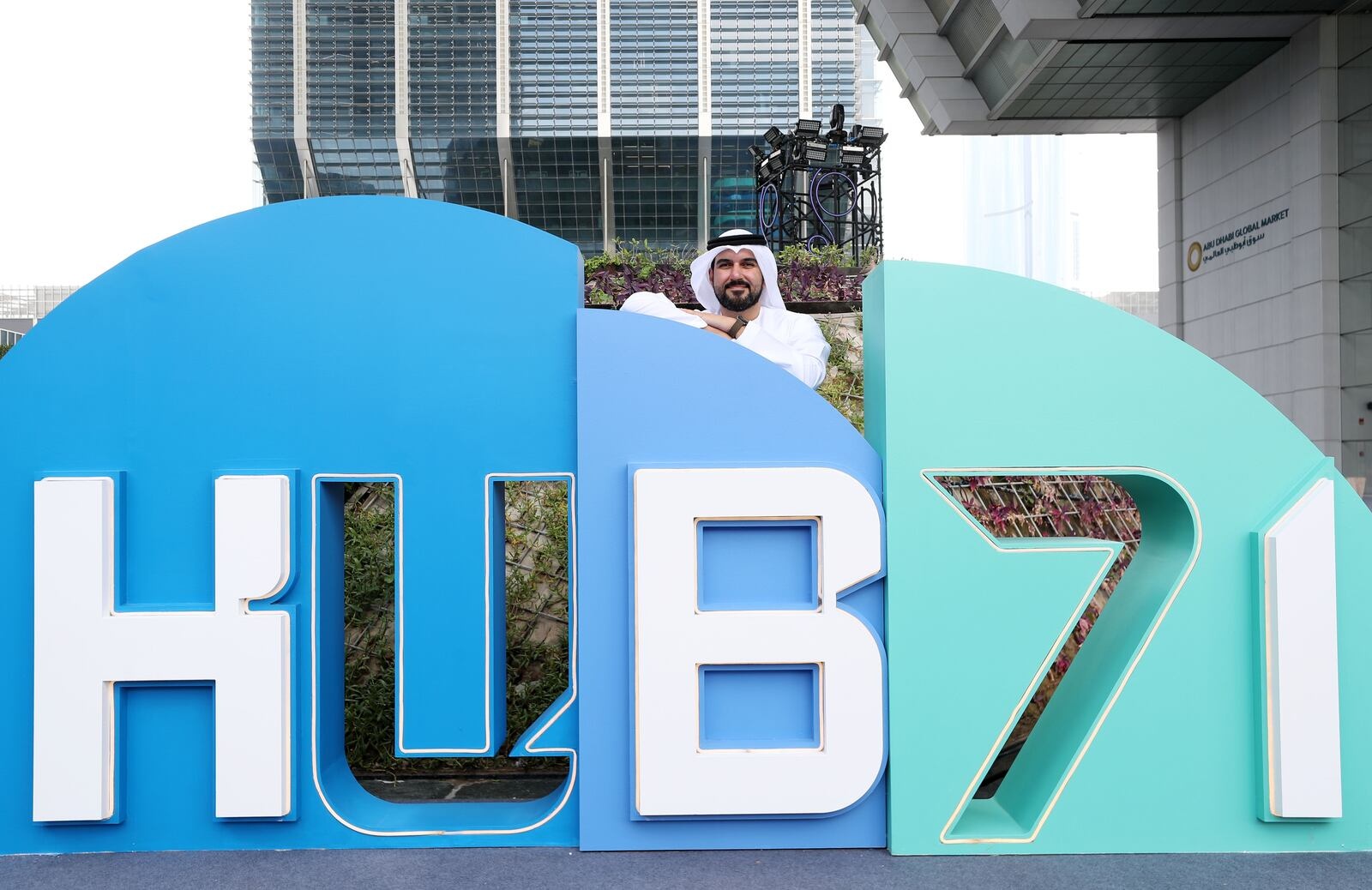
Abu Dhabi is the starting point
Once in the CEO role, Alwan made international expansion a recurring subject. In February 2024, he described plans for more cross-border partnerships, including relationships involving South Korea, Pakistan and Singapore. His ambition was for companies to grow outward from Abu Dhabi. A local base could become the beginning of a much wider commercial map.
This is an important distinction in the job itself. Persuading a founder to relocate creates a relationship with a city. Helping that founder reach a buyer in another country makes the relationship useful to the business. For Alwan, the second task follows the first. A startup’s address can change in a day; the work of establishing customers and trust takes longer.
The Hong Kong Startup Immersion Programme, announced in 2025, made that international work more tangible. It combined virtual onboarding with time in Abu Dhabi and a Demo Day, alongside relationships involving Cyberport, Hong Kong-Shenzhen Innovation and Technology Park and MTR Lab. The format gave companies a way to investigate a market before treating expansion as an accomplished fact. An itinerary is a sensible beginning; it still has to lead somewhere.
An AI strategy with working parts
In May 2025, Hub71 and Google launched an accelerator for 28 startups from the Hub71 community. The three-month curriculum offered mentors, engineers, product expertise and cloud credits, with eligible top performers able to receive up to $300,000 in credits. Those are specific resources for companies facing technical and commercial decisions. They also show what Alwan’s partnership work can put within a founder’s reach.
The distinction between a partnership announcement and usable support is especially relevant in artificial intelligence. A name on a slide has limited value when a team needs help with infrastructure or a product decision. The accelerator brought identifiable people and tools into the offer. Its usefulness would depend on how founders applied them, a rather more demanding test than the ceremony surrounding a launch.
By June 2026, Alwan was describing an AI-first ambition for Hub71’s own operations as well as its startup recruitment. He wanted the organization to use the technology internally while attracting companies working at its frontier. In the same conversation, he returned to community and the value of founders from different sectors working alongside one another. Even when the subject was advanced technology, people sharing a place remained central to his explanation.
“We want to be AI first”Ahmad Ali Alwan, June 2026
The queue outside, the network inside
Hub71’s June 2026 intake gives that community argument a measurable detail. For Cohort 18, it selected 27 startups from 2,453 applications across 112 countries. All selected companies were headquartered outside the UAE. Equally revealing, 31 percent of applications came through partner and founder referrals. Some of the invitation was now being carried by the network itself.
Those figures describe selection and interest. They cannot tell us what happened to every business afterward. Still, for an executive whose work includes bringing people into a new market, the referral share is a useful sign of how introductions circulate. A founder already inside a community can become someone else’s reason to investigate it. Reputation travels through people with something at stake.
There is a domestic counterpart to that international recruitment. In May 2026, Khalifa Fund and Hub71 announced the first MZN Hub71 cohort in Al Ain, welcoming 17 Emirati founders selected from more than 370 applications. More than three-quarters were starting their first ventures. The three-month program took participants through developing products, testing ideas and preparing for launch, followed by an investor-facing Demo Day.
Alwan’s responsibilities therefore stretch across very different starting lines. One team may arrive from abroad with capital already raised. Another may be working through its first business idea. Both need help, but the useful introduction, the relevant advice and the right moment for investment will differ. Building a community at this scale requires attention to those differences, even when everyone shares the same coffee machine.
27startups selected
31%of applications referred by founders and partners
The listener gets the microphone
An October 2025 conversation with FUBU founder Daymond John offered a different view of Alwan at work. He was the interviewer, asking about the brand’s origins, its audience and the lessons founders could take from John’s books. The discussion moved from an early marketing episode involving LL Cool J to learning from customers. Alwan’s questions followed the practical decisions behind a familiar entrepreneurial success story.
It is a useful companion to his institutional biography. Here was the investment professional and ecosystem executive asking someone who had built a consumer brand how the thing actually happened. Their businesses and backgrounds differed, but the conversation had recognizable concerns: belief in a product, understanding its audience and finding people who can help. The scale of the ambition did not remove the need for those ordinary questions.
A pilot is where the introductions get serious
By August 2026, Hub71’s Initiate program had attracted roughly 5,500 applications and brought 500 attendees into seven workshops during July and August. One venture, Prism56, had progressed from concept to a minimum viable product. Its next steps were validation and pilot deployment. For Alwan’s organization, this placed the work of supporting founders earlier in the company-building process, before the polished expansion pitch.
A September agreement with the Abu Dhabi Real Estate Centre addressed the other end of that process: finding a setting in which technology could be tested. The framework covered identifying sector challenges, matching relevant startups, exploring pilots and sharing expertise. Alwan emphasized testing against practical use cases and understanding a sector’s priorities. It was a concrete expression of the relationship between a startup community and the economy around it.
This is where his career’s two worlds meet. Institutional experience helps him understand the organizations with resources and responsibilities. Working with founders keeps the question of usefulness close. A workshop needs to improve a decision. A mentor needs something relevant to say. A pilot needs a problem worth solving. There is room for disorder along the way, provided someone has done enough organizing to let an uncertain idea get a fair trial.