The least glamorous moment in software arrives just after everyone agrees the demo was impressive. A customer clicks twice. Traffic rises. A dependency stalls. The system discovers geography, permissions, old assumptions and the little manual shortcut that only one engineer remembers. Abdullah Shah has built his career in that moment - the interval between software that works and software that keeps working.
His résumé reads like a compressed history of modern infrastructure. There is early research into software-defined networking, then distributed network software at PLUMgrid, a passage through VMware after its acquisition of the company, cloud security engineering at Salesforce, and eventually the leadership of Xgrid. The company now describes Shah as CEO and CTO, while its team page uses GM and CTO. Titles vary. The work does not: scale, availability, security, automation and the behavior of systems under stress.
This is not the familiar founder story of a revelation scribbled on a napkin. It is more like a long debugging session in which the problem keeps revealing a larger boundary. First, a controller. Then a network. Then several clouds. Then an organization. Now, long-running AI workflows whose failures can be stranger than any neat architecture diagram admits.
Before the cloud was a metaphor
At the National University of Sciences and Technology in Pakistan, Shah studied electrical and electronics engineering from 2008 to 2012. His earliest listed professional role began before graduation, as a network software engineering intern at xFlow Research in 2011. That timing matters. He entered the field when software-defined networking was moving the control of networks out of specialized boxes and into programmable software.
In 2013, Shah and four co-authors published “An Architectural Evaluation of SDN Controllers” at the IEEE International Conference on Communications. They compared NOX, Beacon, Maestro and Floodlight, four open-source controllers, looking at thread scalability, switch scalability and latency. The question was wonderfully concrete: which architectural choices actually make a controller perform?
The team did more than rank existing software. It used the results to design a controller that improved on the best performers they tested. The percentages were modest enough to be believable and useful enough to matter. Infrastructure work rarely rewards theatrical gestures. It rewards identifying the bottleneck, changing the architecture and measuring again.
That habit followed Shah into PLUMgrid from 2012 to 2016. His work there centered on distributed software for networking, including scale, high availability, automated infrastructure, fault tolerance and failure recovery. When VMware acquired PLUMgrid in 2016, Shah continued in VMware’s network and security R&D organization as a Member of Technical Staff III. The employer changed. The class of problem grew.
xFlow Research internship, NUST degree and published SDN controller research.
Distributed networking work at PLUMgrid, followed by VMware’s network and security R&D group.
Senior, then lead, software engineering work at Salesforce.
Leadership at Xgrid, spanning cloud, DevOps, security and durable workflow engineering.
A system that remembers
At Salesforce, Shah joined the Cloud Security Engineering team as a senior software engineer in 2018 and became a lead software engineer in 2020. One outcome of that chapter is unusually legible: he is among the named inventors on a Salesforce patent for network security orchestration and management across different clouds, granted in the United States in December 2024.
The patent addresses an awkward fact of multi-cloud life. Each provider has its own security controls, yet an enterprise wants one consistent policy. Its proposed system converts security information into a cloud-independent representation, generates provider-specific policy sets and sends each set to the appropriate cloud. In plain English, write the intent once, then translate it without losing the plot.
One policy, several dialects
in a shared form
representation
policy sets
The same preference appears in Shah’s public conversation about infrastructure as code. Manual configuration produces drift: environments gradually become different, procedures escape documentation and recovery depends on memory. Code makes infrastructure versionable, testable and repeatable. It does not remove judgment. It records judgment in a form that the next deployment can reuse.
“If you anticipate failure, you can prepare for it and then mitigate it.”Abdullah Shah, on infrastructure as code
His advice to startup founders was to build that foundation early, before scaling beyond the first two or three servers turns improvisation into policy. He favors declarative infrastructure for maintaining a desired state, recommends involving developers, reliability engineers and stakeholders in tool selection, and insists that testing and monitoring cannot be skipped. There is also a streak of pragmatism. Asked to choose between mutable and immutable infrastructure, his answer was not a hymn to purity: when in doubt, go mutable.
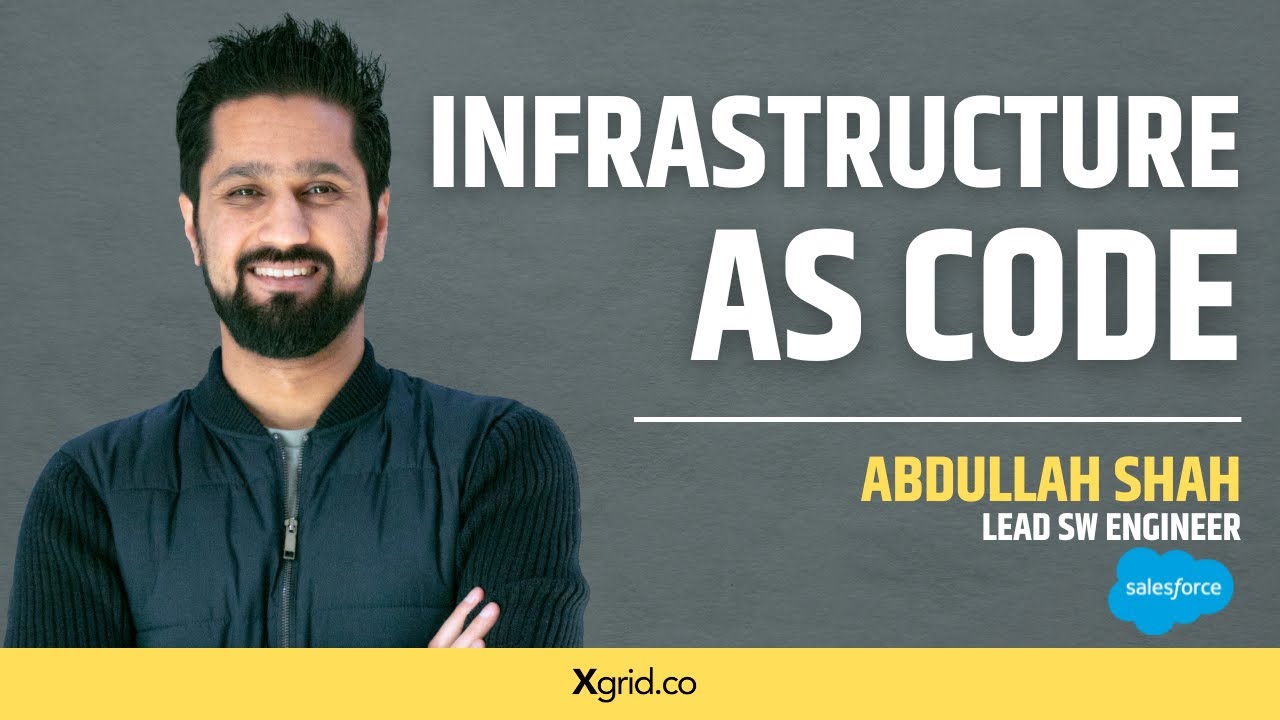
This is where the technical language becomes personal. Infrastructure as code is institutional memory. Automated tests are skepticism with a schedule. A feedback loop is the admission that the first answer will not remain the final one. Shah’s engineering outlook is less about eliminating failure than refusing to be surprised by the obvious versions of it.
When architecture becomes management
Moving from lead engineer to company leader changes the unit of reliability. A service can have graceful recovery while a team has none. A platform can expose perfect metrics while nobody owns the alert. Shah’s current work at Xgrid stretches across cloud and DevOps, security, application development and, more recently, Temporal consulting. The company itself began in 2012 and lists operations in California, Dubai, Islamabad and Lahore.
Shah’s public notes from KubeCon 2025 show what he watches in a crowded field. He highlighted OpenTelemetry’s rise, the practical embedding of AI and machine learning into cloud-native tools, internal platforms built as products, and security moving into pipelines rather than waiting at the gate. He also appreciated a tool that made Kubernetes upgrades safer. Anyone who has shepherded a cluster through an upgrade will recognize the affection: pain is an excellent product-discovery engine.
His tone is that of an engineer who has acquired a wider map without misplacing the wrench. He can discuss platform governance and developer experience, then return quickly to retries, signals, heartbeats and blind spots. The glamorous noun may be AI. The verbs are still fail, recover, monitor and scale.
“What matters now is not just what’s new. It’s what breaks, what scales, and what makes durable execution possible.”Abdullah Shah, Replay 2026 agenda
That sentence anchors his 2026 writing about Replay, Temporal’s conference for durable systems. Shah selected sessions on long-running agents, common Temporal mistakes, large Kubernetes migrations, organization-wide adoption and workflow-as-a-service. The topics sound separate until one notices the connective tissue: state must survive, migrations must not interrupt work, and expertise must become a path other teams can safely follow.
This is particularly relevant to agentic AI. A model can choose a sensible next action and still live inside a brittle execution layer. A tool call hangs. Approval arrives tomorrow. A deployment changes code halfway through a process. A retry duplicates something expensive. Intelligence at the center does not make the surrounding distributed system less distributed.
Shah’s recent emphasis on durable execution therefore feels less like a pivot than a return. The 2013 researcher asked which controller architecture scaled. The Salesforce inventor helped create a shared policy model across clouds. The Xgrid executive now asks how long-running workflows remain correct amid retries, crashes and organizational change. Technology keeps changing the costume. Reliability keeps the same appointment.
Build for the second success
There is a stealable idea in Shah’s career for anyone building a company or a system: the first success proves possibility; the second proves a method. A prototype can succeed through attention, favorable timing and the presence of its creator. A repeatable system has to carry intent after the creator leaves the room.
That means writing down the desired state, distributing ownership, testing the failure paths and watching what the system actually does. It also means resisting architecture as theater. Shah’s record favors benchmarks, control loops and production constraints over grand declarations. Even the patent he celebrated was described as a “nice little year-end update,” followed by thanks to the team that built it.
The modest phrasing is fitting. Infrastructure engineers learn that certainty has a half-life. Today’s robust design becomes tomorrow’s legacy dependency. The useful confidence is procedural: observe, test, revise. Build a system capable of admitting that reality has changed.
Abdullah Shah’s story is still being written across a field that now includes cloud-native platforms, durable workflows and AI agents. Its spine is already clear. He began by measuring how network controllers behaved under load. He moved into software designed to recover from failure, then helped encode security intent across multiple clouds. At Xgrid, he is extending those concerns from components to platforms and from platforms to the teams that operate them.
The demo, in other words, is merely the opening scene. Shah’s preferred drama begins when a system meets Tuesday morning: users arriving, jobs still running, clouds disagreeing, humans changing their minds. That is when architecture stops being a picture and becomes a promise.