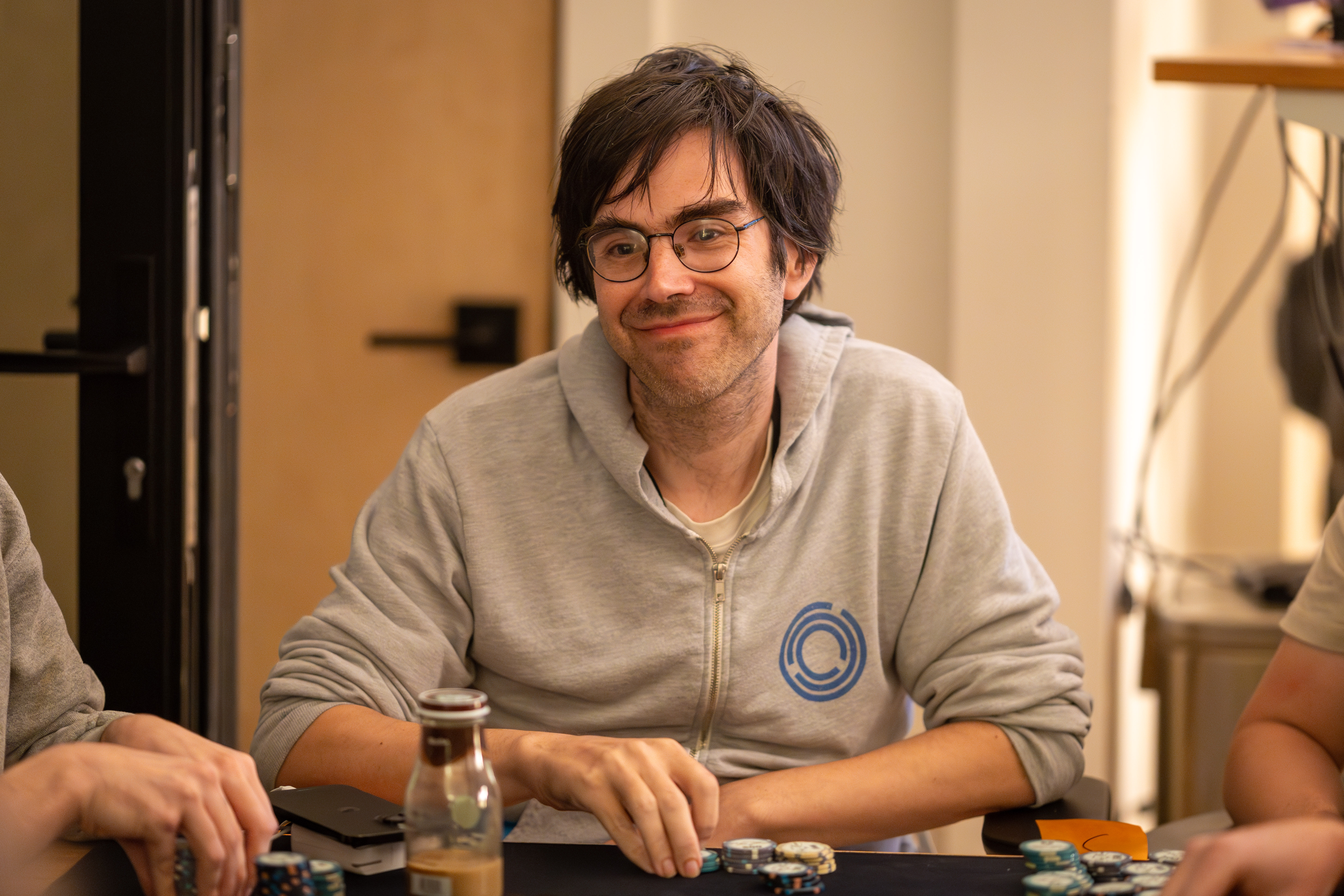
He built world-beating card game strategies before most people had heard of optimization theory. Now he builds world models to understand whether artificial intelligence kills us - and publishes every step of the reasoning.
Zvi Mowshowitz is a writer and analyst who has spent his adult life doing one thing unusually well: taking complex, chaotic systems and finding the patterns others miss. In card games, that made him a Hall of Famer. In AI safety, it makes him one of the most closely read independent voices on the internet.
His Substack newsletter, "Don't Worry About the Vase," has become required reading for anyone trying to keep up with AI development. Each week, Zvi publishes thousands of words on what the frontier models are doing, what the labs are saying, what the policy environment looks like, and - crucially - what it all means. He does not summarize the news. He interrogates it.
Born in New York City on January 8, 1979, Zvi grew up with professors for parents - his mother Deborah Mowshowitz a biology professor at Columbia University. He went on to study mathematics at Columbia College. Whatever analytical instincts his upbringing cultivated, they have been running at full capacity ever since.
His career before writing reads like a highlight reel of interesting choices: quantitative trading at Jane Street, running a personalized medicine startup backed by Peter Thiel, co-founding a policy think tank to repeal a century-old maritime law nobody else seemed to care about. He moves between domains as if domain boundaries were suggestions rather than walls.
"One of the biggest barriers to coordination is people assuming they can't coordinate and therefore not trying."
- Zvi Mowshowitz
A Life Measured
The Card Breaker
Before anyone worried about Zvi Mowshowitz's views on machine intelligence, they worried about his views on their next Magic: The Gathering deck. In the late 1990s and 2000s, he was one of the most feared players in the world - not because he played the best decks, but because he built decks nobody else had thought of.
Commentator Ben Bleiweiss put it plainly: Zvi "has broken more engine cards than any other player in Magic history." Cards like Yawgmoth's Bargain and Dream Halls - powerful artifacts waiting to be exploited - had their potential fully realized only after Zvi got to them. He built "TurboLand," "My Fires," and "The Solution," decks that became part of the permanent canon of the game's history.
His tournament record reflects the consistency of someone who understands not just how to play, but how to think. He won Pro Tour Tokyo in 2001. He was part of the U.S. team that won the 1999 World Championships. He accumulated 236 lifetime Pro Points - a top 20 all-time figure - and more than $141,000 in prize winnings. He had four Pro Tour Top 8 finishes.
In 2004, the community voted him into the Magic Invitational, a tournament populated only by fan favorites. In 2005, he worked inside Wizards of the Coast's R&D division, on the team that designs the game itself. In 2007, he was inducted into the Pro Tour Hall of Fame.
Writing was a constant alongside competition. For over a decade, he wrote for The Dojo, Brainburst, StarCityGames, and the official Magicthegathering.com. He popularized systematic set reviews - the practice of going card by card and evaluating each one before a set releases, which is now a standard format across every major card game outlet.
What he learned playing card games translates directly to what he does now. Both demand the same skill: building a model of a complex system, identifying the leverage points most people miss, and acting on your analysis before the crowd catches up.
The Long Game
Born January 8 to academic parents - his mother Deborah Mowshowitz would become a Columbia University biology professor.
Steps onto the professional Magic circuit with no expectations - and immediately becomes a player to watch.
Part of the U.S. National Team that wins the Magic: The Gathering World Championships.
Studies mathematics at Columbia College, the same institution where his mother teaches biology.
Wins Pro Tour Tokyo with "The Solution" - cementing himself as one of the best in the world.
Wins Grand Prix New Orleans and Grand Prix Pittsburgh (team event: "Illuminati") in the same year.
Works inside the team that designs Magic: The Gathering - making games rather than just winning them.
Inducted into the Magic: The Gathering Pro Tour Hall of Fame - one of the sport's highest honors.
Applies quantitative analysis to financial markets at one of the world's leading trading firms.
Launches a personalized medical research company with Peter Thiel backing and a roster of rationalist co-founders including Jaan Tallinn (co-founder of Skype).
Starts a nonprofit policy think tank focused on the Jones Act, housing supply, and NEPA reform - policy issues he believes are significantly underserved.
Begins his newsletter career covering COVID-19 with analysis many readers found more accurate and faster than mainstream coverage.
As AI becomes the defining story of the decade, Zvi shifts to weekly deep-dives on AI development, safety, and policy.
Publishes over 163 weekly AI issues. Plans to write fewer, deeper posts. Sets goal to do more coding. Newsletter continues as primary professional focus.
The Doom Calculus
Estimated probability of catastrophic AI outcomes
Note: These are reported estimates. All figures are approximate and have shifted over time.
Straight Talk
"One of the biggest barriers to coordination is people assuming they can't coordinate and therefore not trying."
"The moment you say 'most' on top of anything... you get effectively power-seeking behaviors."
"If you figure out how to align a system, suddenly everything is aligned and everything is fine... people fool themselves."
"I say 50% when I have to make a guess. But I understand that my numbers should be shifting around constantly."
"In their present state, they are almost entirely positive."
"It brings us one step closer to the goal of Garfield, of games standing on the same platform as baseball."
When Zvi puts a number on AI catastrophe risk, he is not being dramatic. He is being precise. His estimate of 60-70% reflects years of careful attention to how AI development is actually proceeding, what the safety community is actually doing, and how those two things relate.
His view is more nuanced than a single number suggests. He does not believe current AI systems are dangerous - "In their present state, they are almost entirely positive." The danger he tracks is what comes next: the potential for systems that pursue objectives in ways their designers did not intend, at a scale and speed that leaves no room to correct course.
He identifies multiple independent failure modes, each with double-digit probability. There is no single doomsday path. There are several. And he does not think coordination to prevent them is impossible - just that people have convinced themselves too quickly that it is.
His landmark observation: the entire U.S. AI safety ecosystem - 11 major organizations - spends roughly $133 million per year. That is less than frontier AI labs spend in a single day. The asymmetry bothers him.
By 2026, he had lengthened his AGI timeline estimates after capability jumps failed to materialize on the schedule many feared. He calls 2026 "an age of wonders" in terms of available tools - while remaining cautious that wonder and wisdom tend not to arrive on the same schedule.