A treadmill presents an advertiser with a peculiar opportunity. The person on it is moving, but going nowhere. There is time to fill, a screen to look at and, if the gym has done its job, a reason to return. Zoom Media built GymTV around this arrangement. A familiar piece of fitness furniture becomes a meeting place between a member, a gym operator and a brand. Each wants something different from the same television.
- GymTV combines entertainment, gym communications and paid advertising.
- Its advantage is a recurring audience in a specific physical setting.
- Programmatic buying expands access; proving sales impact remains the harder job.
The company’s current website reports 13,600 gyms and 100,600 screens across the United States, Canada and United Kingdom. Those are Zoom’s figures. The interesting number, however, is smaller: 80 minutes, the average visit duration cited in its August 2025 VIOOH partnership announcement. A roadside billboard gets a passing glance. A gym screen has the possibility of repeated encounters during a single visit. Possibility is the operative word. A screen cannot compel attention merely by being overhead.
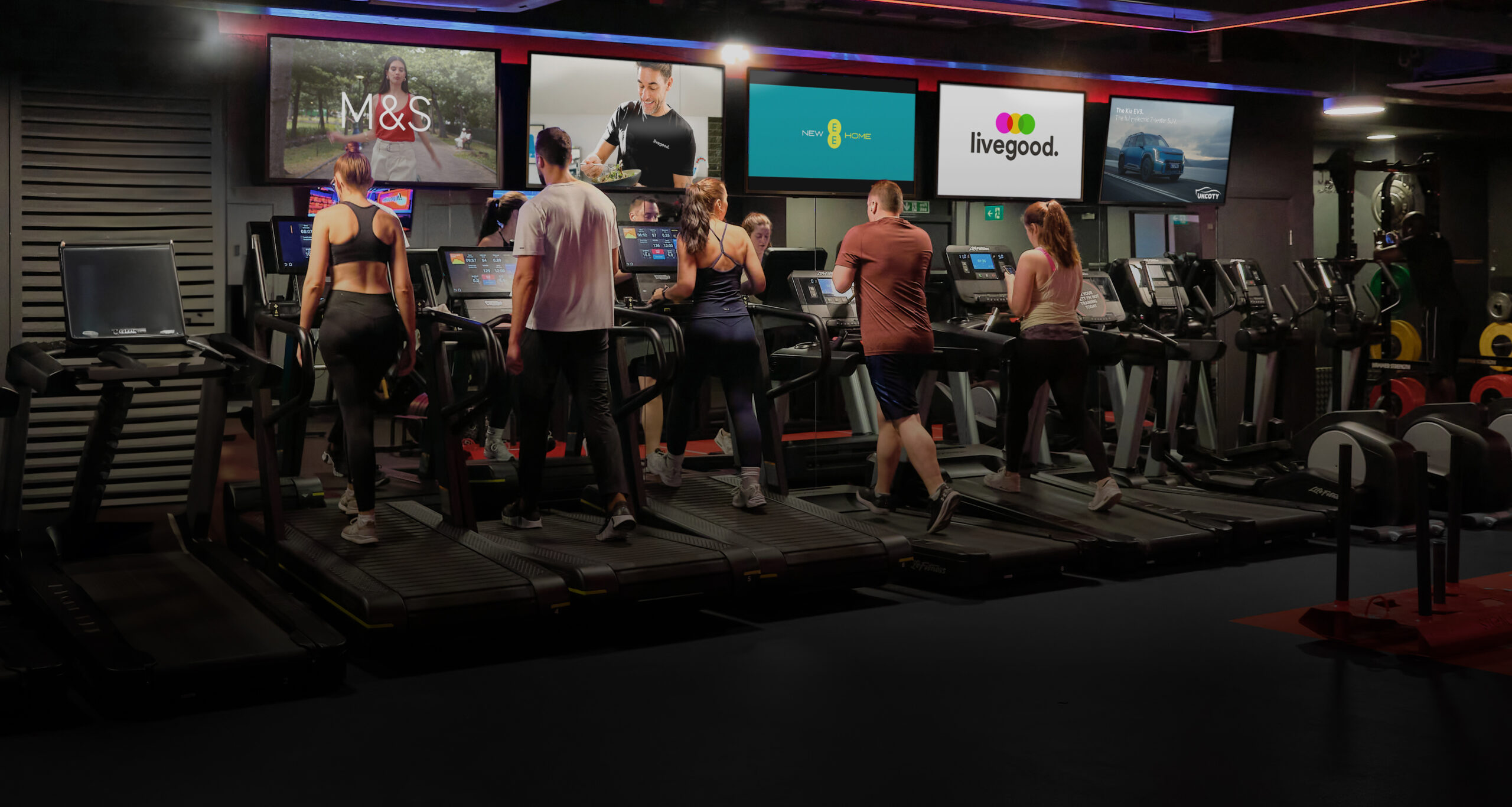
The membership is the media plan
Zoom calls this audience Generation Active. The name sounds like an age bracket, but the defining characteristic is a habit. People show up to exercise. That gives the company a particular place in the advertising market: a fitness-focused media owner selling access to consumers through their surroundings. Its alternatives include other place-based screens, conventional video advertising and direct deals with individual gyms. Zoom’s proposition gathers the gym relationship, content and advertising delivery into one operation.
For the operator, the screen must earn its keep. GymTV supplies music, fitness tips and lifestyle programming; club communications can help promote services. Advertising offers another revenue opportunity. ClubCom, a club entertainment network that identifies Zoom as its advertising partner, also describes class schedules, events and trainers as uses for the screens. This is a practical bargain. Members receive something to watch; the gym receives a communications channel; advertisers receive a setting with an identifiable purpose.
Brands can buy video with sound, silent video, static advertisements or content sponsorship. Beyond overhead television, Zoom offers personal cardio screens, large-format displays, billboards, sampling and digital extensions. A local business can use its creative services to reach people nearby. A national brand can combine broader coverage with an on-site trial. The business model is advertising and gym media services, with direct selling alongside programmatic routes. The gym is both a distribution partner and a customer whose member experience matters.
Thirty million dollars, and a change of surface
The history makes more sense when you begin with the wall. According to his family foundation, François de Gaspé Beaubien had invested in Zoom since 1994 and acquired the company in 2003. It was an indoor advertising business. Digital screens allowed that physical presence to carry changing content rather than a single printed message. In March 2009, ABS Capital Partners bought a minority stake for US$30 million, with digital expansion and acquisitions the stated uses of the money.
“Digital trumps everything”
François de Gaspé Beaubien · 2009
That is a useful answer to what the expansion cost, rather than a price for buying an advertisement today. The more revealing detail is the direction of investment: improve and extend the network already inside venues. The strategy depended on those venues remaining open. Grenier’s reporting describes how pandemic gym closures interrupted GymTV after a strong 2019. The audience could disappear without a television breaking. Physical attendance was the vulnerable link.
The less glamorous revolution backstage
By 2025, the UK business was changing how its channel was delivered. GymTV+ introduced programmatic-enabled connected television, with Places Leisure as the first major operator announced for the service. The companies had worked together for more than 14 years. Zoom also brought back-end management and music curation under its own control. Its announcement linked the redevelopment to operator needs and music licensing cost pressures. This gave Zoom greater control over subsequent changes to the service.
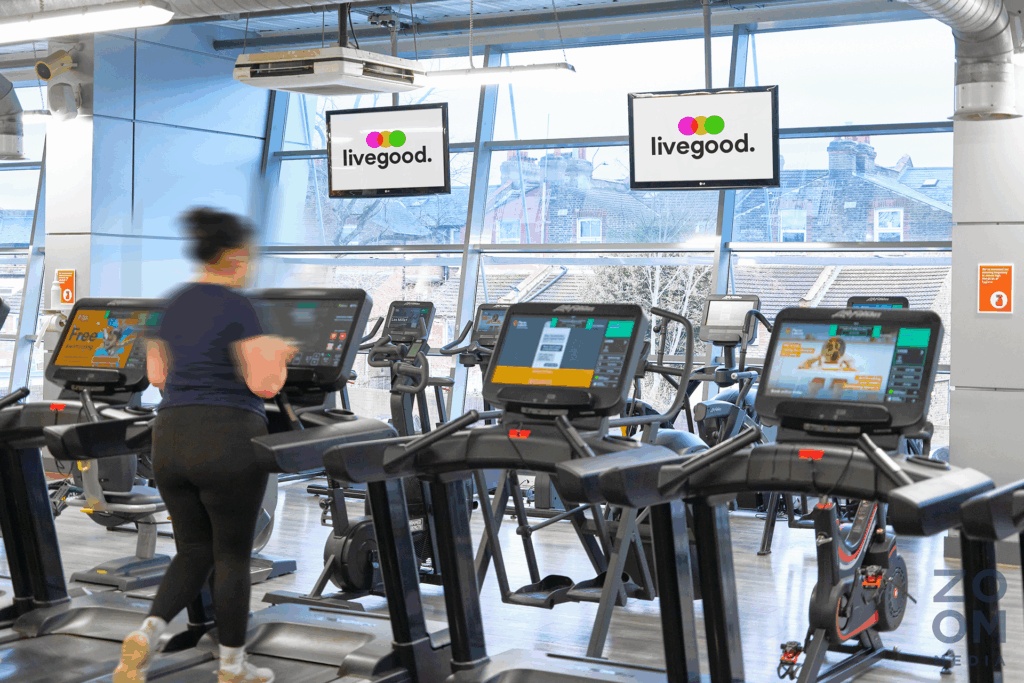
The purchasing machinery changed too. The August 2025 VIOOH agreement opened another programmatic route into North American GymTV inventory, with targeting by location, time of day or audience segment. Earlier UK work with Hivestack described using gym swipe-card entry data to optimize delivery. That can help match advertising to attendance patterns. It does not mean the system knows that every person in the building watched an advertisement. Counting entries and measuring attention answer different questions.
A happy audience still needs a receipt
Zoom’s May 2026 Afterburn Effect research with Differentology examined the hours following a workout. The study included 2,000 UK adults, of whom 1,500 were gym-goers. It reported that 80% of gym-goers felt better after exercising and 90% were more or equally likely to buy afterward. That last phrase deserves care. Combining “more” with “equally” describes openness, not a demonstrated increase in purchases. The study offers a hypothesis about timing; it cannot substitute for a campaign’s sales results.
reported a better mood after a workoutAfterburn Effect · UK gym-goer survey · May 2026
Zoom advertises brand lift, sales lift, foot traffic and consumer insights studies. A buyer should choose the measure that fits the objective. A deodorant trial, a local restaurant advertisement and a financial services campaign need different evidence. In 2026, the UK case-study catalogue included Danone GetPro, LinkedIn Ads and Disney+. The variety suggests the audience is being sold beyond sports products. Relevance still has to be earned by the individual message.
There is a lesson here for businesses that own no screens: start with a routine people already keep, make your presence useful within it, then test the result. GymTV’s approach depends on attendance, appropriate creative and an audience that overlaps with the buyer’s customers. Empty venues, a poor geographic fit or a message nobody can absorb between sets weaken the proposition. The treadmill supplies time. The advertiser must supply a reason to look.