The first attempt was a mess. Mason Malone gave Zoo’s AI agent a drawing of a keyboard instrument and its original French description. The drawing dated from 1636. The resulting model was incoherent. Eventually, after consulting further research and rebuilding the instrument piece by piece, Malone produced the clavichord that won Zoo’s first Design Studio Makeathon. Its 49 keys and 70 strings make a useful introduction to the company. Zoo sells software that turns ideas into editable geometry. The word “editable” carries considerable weight.
- One model, several entrances: sketch visually, write code, or ask Zookeeper.
- Two businesses: a CAD application for designers and APIs for developers.
- A practical test: can you inspect and correct the generated part?
A company that discovered two customers
Zoo began in 2021 as KittyCAD, incubated by Embedded Ventures and founded by Jessie Frazelle, Jordan Noone, and Jenna Bryant. The founding complaint was familiar to software developers: why couldn’t mechanical design enjoy the same programmable tools, automated checks, and shared extensions? A public GitHub call for people who recognized the problem helped turn that complaint into a company.
The original plan centered on infrastructure. Developers would use APIs to build their own hardware design tools. Then an example application attracted people who simply wanted to design things. They had no interest in implementing an API call. By December 2023, the company described two distinct audiences, with different documentation and tutorials to match. It adopted Zoo as the umbrella name and retained KittyCAD for its Design API.
That is an instructive product decision. A demonstration can become the thing customers want to buy. Zoo had to make room for that discovery. Its visual application also forced an interesting engineering question: could clicking and programming remain connected?
“We’re building a flippin’ Graphical-User-Interface (GUI).”Kurt Hutten · Zoo engineering blog, 2023
A reported $5 million seed round in October 2023 included Venrex and investors such as Liquid 2 and Gaingels. The work also needed an unusual mix of specialists. Zoo describes a globally distributed team and advertises roles spanning CAD graphics, cloud infrastructure, interoperability, and manufacturing. Its published values emphasize curiosity, transparency, and individual ownership. Those are the company’s account of its culture; the public application code offers a more concrete way to examine what the team builds.
The drawing has working parts
Zoo Design Studio, released as v1 in May 2025, combines familiar modeling operations with KCL, the company’s CAD language. A designer can work through the visual interface without writing code. Someone comfortable with programming can express dimensions and repeated features directly. The application is open source; the geometry engine beneath it is proprietary.
The distinction matters because CAD is more than a picture. A boundary representation, or B-rep, describes an object through its surfaces and boundaries. A parametric model also preserves dimensions and relationships that can drive changes. Imagine widening a bracket while keeping its holes in the intended positions. A convincing image cannot tell you whether those relationships survived.
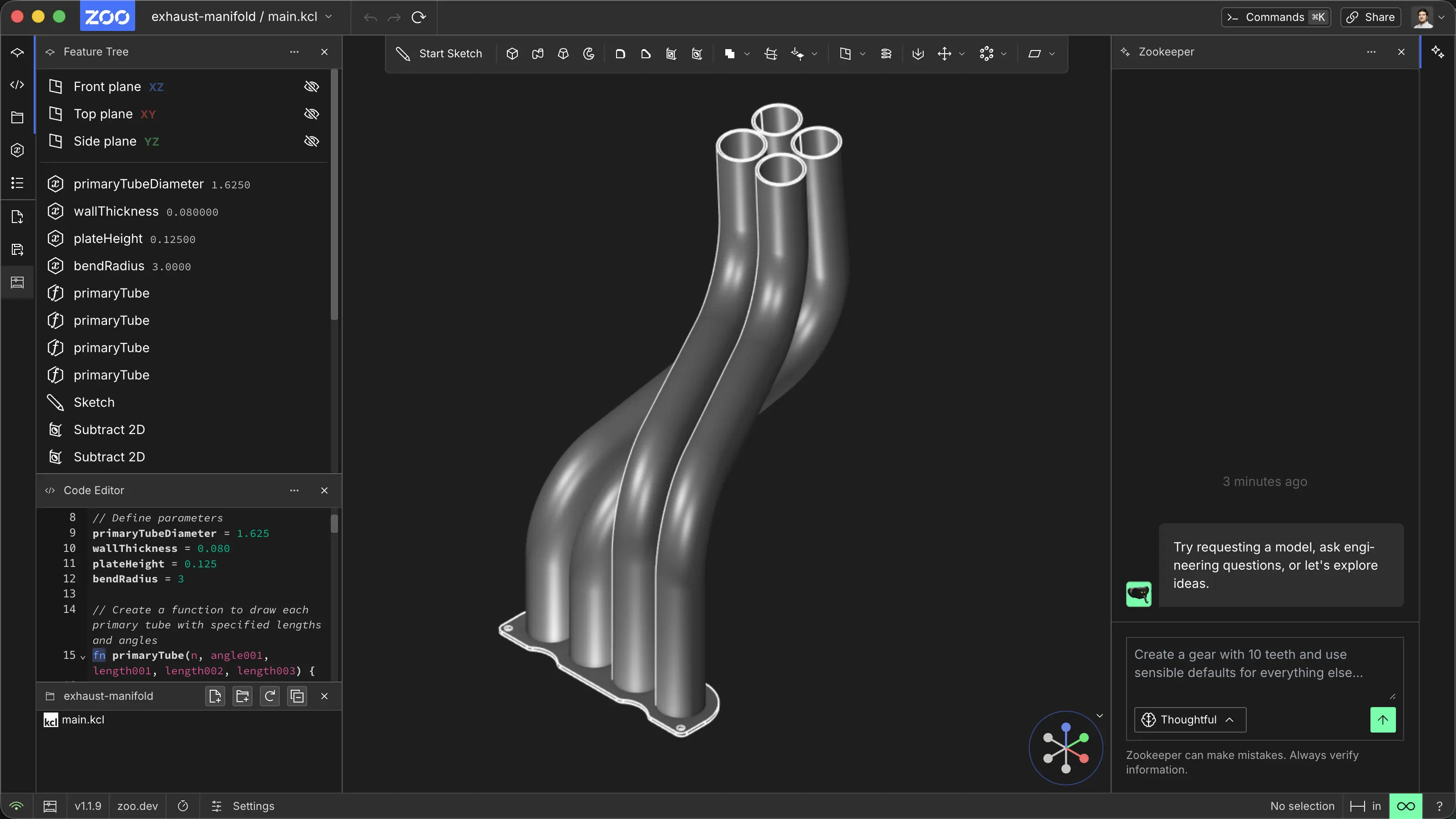
Zoo’s wager is that owning the underlying engine and language makes these transitions easier to control. Its expertise sits below the chat window: computational geometry, graphics infrastructure, and the translation between readable instructions and solids. SolidWorks, Onshape, Fusion, NX, and Creo remain alternatives that teams will judge against their established work. Zoo offers a different architecture; engineers still have to test the features their jobs require.
The second instruction is the interesting one
Announced in February 2026, Zookeeper adds a conversational agent inside Design Studio. It can create and modify models, use highlighted faces or edges as context, inspect snapshots, and search for technical references. Selecting a particular face gives a short request a location. The conversation can continue around the actual model.
Malone’s instrument illustrates why that continuation matters. After the failed first attempt, he brought in scholarship and a physical reconstruction, separated the instrument into components, and established shared parameters. He inspected results and corrected geometry. The lesson a reader can copy is straightforward: supply evidence, divide the job, and check each relationship. Sparse, ambiguous source material is a poor foundation for a one-shot request.
The factory needed a converter
For another Zoo customer, the useful feature was less theatrical. Fort Worth manufacturer RMFG needed people uploading CAD files to see their parts in a browser. Founder Kenneth Cassel considered building a conversion system internally. That would consume engineering time the company wanted to spend automating its factory.
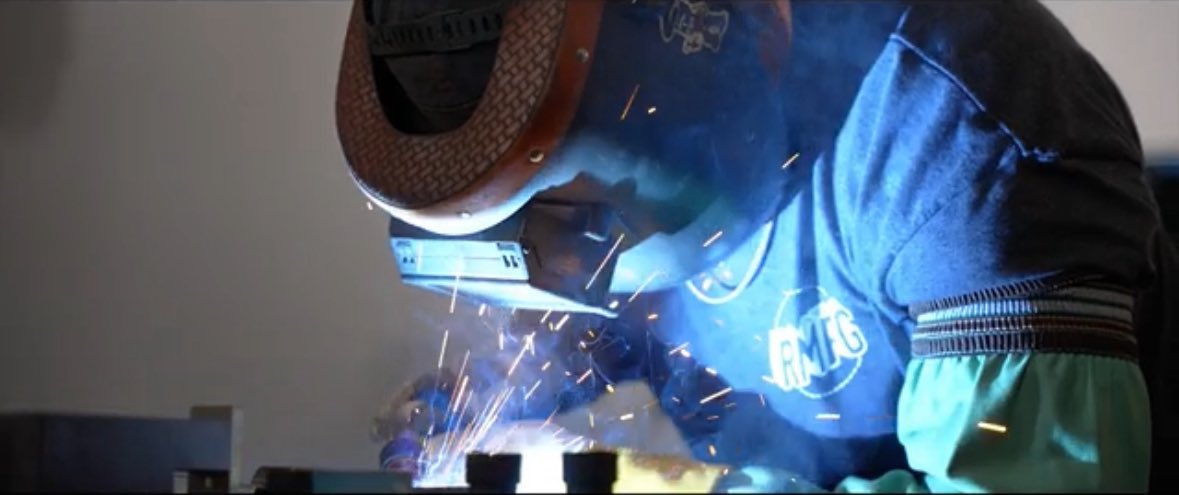
Zoo’s API converted STEP files into glTF, a format suitable for browser visualization. Customers could upload a part, inspect it, and configure manufacturing details. In Zoo’s July 2025 case study, RMFG reported avoiding months of development and saving tens of thousands of dollars. Those are the customer’s reported savings. The integration described there used file conversion; prompt-based ordering was a possible future extension.
The example explains Zoo’s position in the market. It can sell a complete design environment, or supply one unglamorous operation inside someone else’s product. For a developer, the question becomes whether maintaining that operation internally deserves the time.
The bill, the connection, the next revision
Zoo combines a Free plan, paid subscriptions, metered AI and API usage, and tailored enterprise work. Its current pricing distinguishes unlimited CAD modeling from billable reasoning and API activity. Historical launch offers require care: February 2026’s Zookeeper announcement listed Plus at $20 monthly and Pro at $99, but now directs readers to updated allowances. Buyers should price the actual workflow.
There are practical boundaries. Modeling and rendering require an internet connection, even with locally stored files. Zoo’s enterprise guidance recommends starting with a focused part family and representative native CAD files. Evaluate editability, accuracy, compliance with internal rules, and time saved. A polished rendering alone settles none of those questions.
October 2026’s KCL 3 release addresses another everyday concern: improving geometry algorithms without unexpectedly changing old designs. Older files can keep their earlier format; migration is optional. For all the appeal of asking a machine to draw, the more revealing promise may be quieter: tomorrow, the model should still make sense.
Open the workshop
Try the tools, explore editable work, or watch the workflow.