A computer can give you the right answer and still be too late. Before Zhenwu Shi became a blockchain founder, he spent his doctoral years examining that awkward fact. His 2014 Georgia Tech dissertation concerned response times in real-time systems: the interval between asking a machine to do something and getting the result. It is an excellent subject for anyone who has ever watched a loading wheel and reconsidered a life choice.
The research dealt with computing, communication networks, and energy management. InfStones, the company Shi founded in 2018, deals with blockchain nodes, staking, and access to data. The settings are different. Read his career through the question of dependable service, though, and a connection emerges. How much complicated work must happen underneath before an ordinary person can rely on the thing on top?
A deadline before a company
Shi’s doctorate was in electrical and computer engineering. His dissertation examined an alternative to designing exclusively around worst-case response times, an approach that can make systems unnecessarily conservative. Working with adviser Fumin Zhang, he studied mathematical models and ways to improve system design. Timing was something to analyze precisely, rather than a vague promise that the computer would get round to it.
There is a useful distinction here for understanding his later business. A successful calculation and a satisfactory service are different achievements. A developer building on a blockchain needs access that fits the application’s demands. Customers experience the result of technical decisions they may never see. The relationship between those decisions and the person waiting at the other end gives Shi’s engineering history its relevance.
A small team, a very long shift
Bitcoin entered Shi’s research life in 2013. He tested its mining algorithm, became interested in decentralization, and continued learning about blockchain after joining Oracle. When he launched InfStones, two early founders left during the downturn. Sili Zhao joined him. For two years, the pair handled business development and infrastructure, working from a bedroom and a dormitory. Shi put his phone under his back while sleeping so he would feel incident alerts.
That detail gives the early business a human scale. Somewhere behind the promise of a decentralized network was a customer who needed an answer, and a founder determined to notice the call.
The customer buys fewer chores
By February 2022, Shi could describe a business serving Binance, Dune Analytics, Polygon, Circle, and Compound. InfStones supported more than 50 blockchain networks at that point. He said the company had been profitable since its beginning. Those are dated milestones, but they help explain why an infrastructure service could attract attention alongside the more conspicuous products built on blockchains.
A customer choosing such a service is making a practical decision about work. Someone must deploy nodes, maintain access, and accommodate the particular network involved. Doing those jobs internally requires people and expertise. Buying a managed service changes who carries them out. The developer can spend more time on the application, while the provider takes responsibility for an agreed part of the machinery.
“Our goal is to bring the AWS experience to Web3.”
Zhenwu Shi · February 2022
The comparison with Amazon Web Services made Shi’s intention easy to understand. In February 2022, InfStones paired its financing announcement with a self-service portal for node management and public and dedicated API gateways. The customer-facing ambition was deployment within minutes. A complicated operating job would have a shorter entrance, allowing a developer to get started without assembling every component independently.
The financing was substantial: a $33 million Series B, followed by a $66 million round announced in June. SoftBank Vision Fund 2 and GGV Capital led the latter. Shi’s company outlined plans for more people, product development, new markets, and partnerships. Funding could help turn an operating practice into a larger organization. It could also multiply the number of customers expecting that practice to hold up.
Round amounts, shown to scale. Company financing is distinct from a founder’s personal wealth.
Shi’s stated ambition that June was broader adoption of decentralized applications around the world. He described an environment that would be easier to use and support a more transparent, intelligent world. Read as a business strategy, that puts an unusual burden on an infrastructure founder: the tools must be approachable enough to attract new builders while dependable enough to serve existing customers. Expansion brings both groups through the same door. Each has reasons to care about what happens after the welcome screen.
Oracle comes round again
In August 2022, Oracle became part of the story again. Shi had worked there as a senior software engineer. Now InfStones and Oracle were collaborating on blockchain development for enterprise customers, using Oracle Cloud Infrastructure. The former employee had returned in the role of a partner-company CEO. It is a satisfying career turn, with a business purpose more specific than the symmetry.
The collaboration aimed to make blockchain infrastructure easier for shared customers to use. It also placed InfStones within an enterprise environment where cloud services and existing software matter. A decentralized application still has to run somewhere. Its builders still make choices about storage, access, operating costs, and which chores to entrust to another company.
By September 2022, that work had a concrete expression. InfStones had used Oracle’s Autonomous JSON Database to build a query service over billions of blockchain records. The engineering requirements included low latency, flexible development, scalability, and less database administration. The company that sold customers relief from infrastructure chores was itself selecting services that reduced those chores for its engineers.
The example included an initial BNB Chain collection of roughly two billion JSON documents. Engineers described reorganizing records around the attributes used in queries to reduce physical reads. That is a useful glimpse behind the convenient endpoint. Arranging information carefully can matter as much as buying more capacity. The practical question remained familiar: how do you return useful results quickly without making the system unnecessarily expensive?
Reliability acquires a paper trail
A founder’s willingness to answer alerts can help a young company. As it grows, customers need evidence that the organization can handle problems consistently. In November 2023, InfStones published an account of a vulnerability identified and resolved that July, involving an open-source library called Tailon. The company said it blocked affected external access, removed the library, and rotated credentials and keys.
InfStones reported that its investigation found no exploitation. Those statements describe the company’s account of its response. They also put concrete operating actions on the record. For a business built around dependable infrastructure, the ability to explain remediation belongs alongside the ability to explain a product.
In January 2025, InfStones announced SOC 2 Type II attestation, following its earlier Type I attestation. The distinction concerns whether controls have operated effectively over a period, rather than their design at a single point. It cannot turn a service into a guarantee against failure. It does help move the conversation toward repeatable processes. Eventually, the organization needs an answer that goes beyond calling the founder.
A wider front door
Shi’s interest in access also appears in the audiences InfStones has pursued. An imToken partnership announced in 2021 brought Ethereum staking services into a mobile wallet. Infrastructure could reach people through a product they already used. The user did not have to begin with a blank server and an instruction manual.
In July 2024, InfStones extended its Node-as-a-Service offering to users of decentralized physical infrastructure networks, commonly called DePIN. Shi described bringing institutional tools to individual participants through a simpler interface. Projects including Aethir, CARV, and Lumoz featured in the announcement. The business opportunity involved helping people take part in networks whose technical requirements could otherwise be a barrier.
Aethir supplied a concrete example. Its node sale involved Checker Node licenses, and InfStones helped turn license holders into operators. The distinction is easy to overlook: acquiring permission to participate still leaves the work of participation. A managed service sits in that gap. For Shi, the broader audience changed the customer relationship while preserving a familiar job underneath.
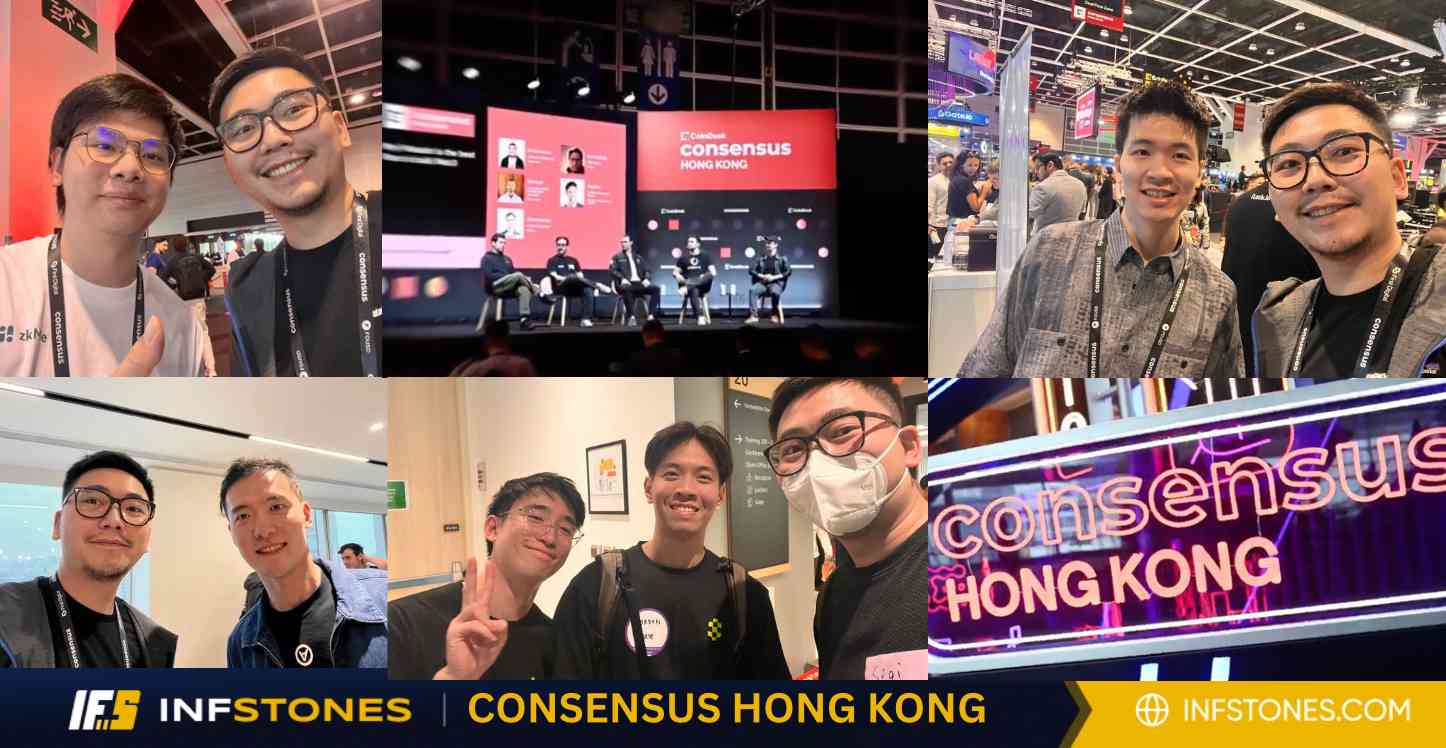
Shi was among the InfStones team attending Consensus Hong Kong in February 2025. That public appearance offers another view of the role: meeting clients and partners in an industry whose products are connected to one another. Infrastructure has to fit those relationships as well as the software. Supporting a network means understanding the people building on it.
The question becomes the interface
The company’s 2026 products show that concern with usability continuing in smaller, specific ways. An April multi-wallet dashboard brought Ethereum staking balances, validators, and rewards together across wallet addresses. Its scope was defined: validators and rewards for ETH staked through InfStones. Sometimes making a product easier means sparing someone a tour of several browser tabs.
In July, InfStones introduced Blockchain Intelligence for Claude. Fourteen read-only tools connected questions in plain language to public data on Ethereum and BNB Chain. Tasks included investigating failed transactions and tracing transfers. The connector did not sign transactions or move funds. It offered another way into the company’s infrastructure, this time through a conversation.
That progression gives Shi’s stated ambition a current expression without requiring a prediction about where blockchain will go. A researcher studied how long a system takes to respond. An engineer became a founder selling tools that make complicated networks easier to use. Now some of those tools can begin with a question. The user still waits for an answer. Shi’s business lives in the work between the two.