Zhao Jiehui has a rather inconvenient habit for someone selling enterprise technology: he asks what the words mean. A fashionable term arrives, the industry dresses for the occasion, and Zhao wants to know what the customer will be able to do on Monday morning. He has been asking versions of that question since before artificial intelligence became the guest of honour at every software presentation.
Consider the phrase zhongtai, usually rendered as “middle platform”: shared technical and business capabilities intended to support a company’s applications. Zhao had helped develop enterprise architecture work at Alibaba Cloud. Deepexi, the company he co-founded in 2018, was readily associated with the idea. By November 2019, he was onstage arguing for “more than 中台”. A useful reputation can become a room with the door locked from outside.
Eleven years before the startup
His route into that room began with engineering. Zhao graduated from Tianjin University in June 2001, majoring in electrical engineering and automation. He received a master’s degree in power system and automation from the same university in June 2004. His professional career began at Huawei that March, in work related to core routers.
He stayed until May 2015, serving as a core technology expert and team leader. Eleven years is enough time to watch an engineering organization acquire habits, capabilities and a history of its own. Zhao has described the satisfaction of growing alongside a product team, and of seeing technical work become something useful to customers. That experience would later inform his reasons for starting a company.
Alibaba followed. Between May 2015 and September 2018, his roles included senior technology expert and general manager of Alibaba Cloud’s enterprise business department. The sequence matters: infrastructure, then enterprise cloud services, then his own enterprise-software business. His career had already supplied a fairly demanding audience for a product pitch.
A useful idea acquires a fashionable wardrobe
Zhao and Yang Lei co-founded Deepexi in May 2018. In the market around them, the middle-platform concept offered a convenient way to discuss enterprise modernization. Convenient language, however, can become an excuse to stop asking precise questions. Zhao’s objections became increasingly explicit.
In a 2021 conversation, he argued for attention to concrete technologies and specific business situations. He wanted data intelligence understood through the work of turning raw data into usable information and knowledge, then applying models to decisions. That explanation has verbs in it. Much enterprise vocabulary would benefit from the same treatment.
The skepticism extended to the enthusiasm surrounding a market. Zhao has repeatedly spoken against opportunism and following fashionable opportunities. His public position allows for changing products and strategies while demanding a reason beyond the popularity of a label. For a founder, that is a discipline with consequences: yesterday’s persuasive introduction may need rewriting tomorrow.
The shopkeeper’s clock
At WISE2021, he gave the argument a useful setting: retail. Shops close late. Sales information sits across regions, brands and systems. The next morning, managers need to decide what to replenish, move or sell. A handsome report delivered after those decisions has rather missed its appointment.
Zhao described a retail example in which older arrangements left operating analysis available only the following afternoon. With Deepexi’s real-time data platform, he said, analysis could be ready by six the next morning. The point was the relationship between information and the hour at which somebody could act on it.
He also described demand moving beyond management reports toward the needs of staff closer to daily operations. His examples give a practical shape to his interests: data earns its place when it helps someone make a decision while that decision still matters.
A construction crew with its own tools
By 2023, his explanation of Deepexi had acquired a refreshingly unceremonious image. “We are like a construction crew,” he said, in translation. The company brought its own tools to build customers’ data warehouses and data lakes, then helped make the information useful. There are more glamorous comparisons. Few are as serviceable.
“We are like a construction crew.”
Zhao Jiehui, 2023 · translated from Chinese
At that year’s China International Fair for Trade in Services, he discussed FastData alongside the Deepexi enterprise model. The ambition was to connect business knowledge and models with the underlying data platform, allowing people in different roles to work with information through business logic. The data foundations remained in the picture as the interface to them changed.
The continuity is useful when reading his career. Routers, cloud services, data infrastructure and AI applications are different things. Each raises a question about what must work underneath the visible experience. Zhao keeps returning to the foundations, even as the industry changes the furniture upstairs.
The organization gets inspected, too
His interest in foundations also reaches management. In a 2020 interview, Zhao described quarterly meetings where partners examined their own shortcomings. Colleagues offered criticism; records were shared with employees; the previous account returned at the next meeting. The paperwork, at least, was not permitted to enjoy a quiet retirement.
He spoke about culture, incentives and the responsibility created when employees and customers commit themselves to a young business. The ambition he described was to build a company that customers respected and to make technical capability more accessible. These are his stated standards, rather than an independent verdict on how consistently the company meets them.
There is a related editorial detail. In a 2025 retrospective, Zhao said he had told his PR team to avoid adjectives and sensationalist headlines. A technology founder declaring hostilities against adjectives is a pleasing reversal of custom. It also fits the argument he keeps making: the work should carry the description.
The bell rings; the work resumes
Deepexi listed on the Hong Kong Stock Exchange on October 28, 2025, under stock code 1384. The listing supplied a public milestone seven years after the company’s founding. By the following spring, Zhao remained chairman, executive director and chief executive officer.
His account of the days around the listing gives the milestone an unusually short holiday. He was reported to have enjoyed the occasion for a day; soon afterwards, management was discussing where the company should go next. His concern was the need for greater investment in its own models, without which he believed Deepexi would face constraints.
The decision connects ambition to a resource commitment. A stock-market ceremony can commemorate what has happened. It cannot do the next piece of engineering. Zhao’s attention had returned to a familiar problem: which capabilities the company needed to build for itself.
An AI employee needs a job description
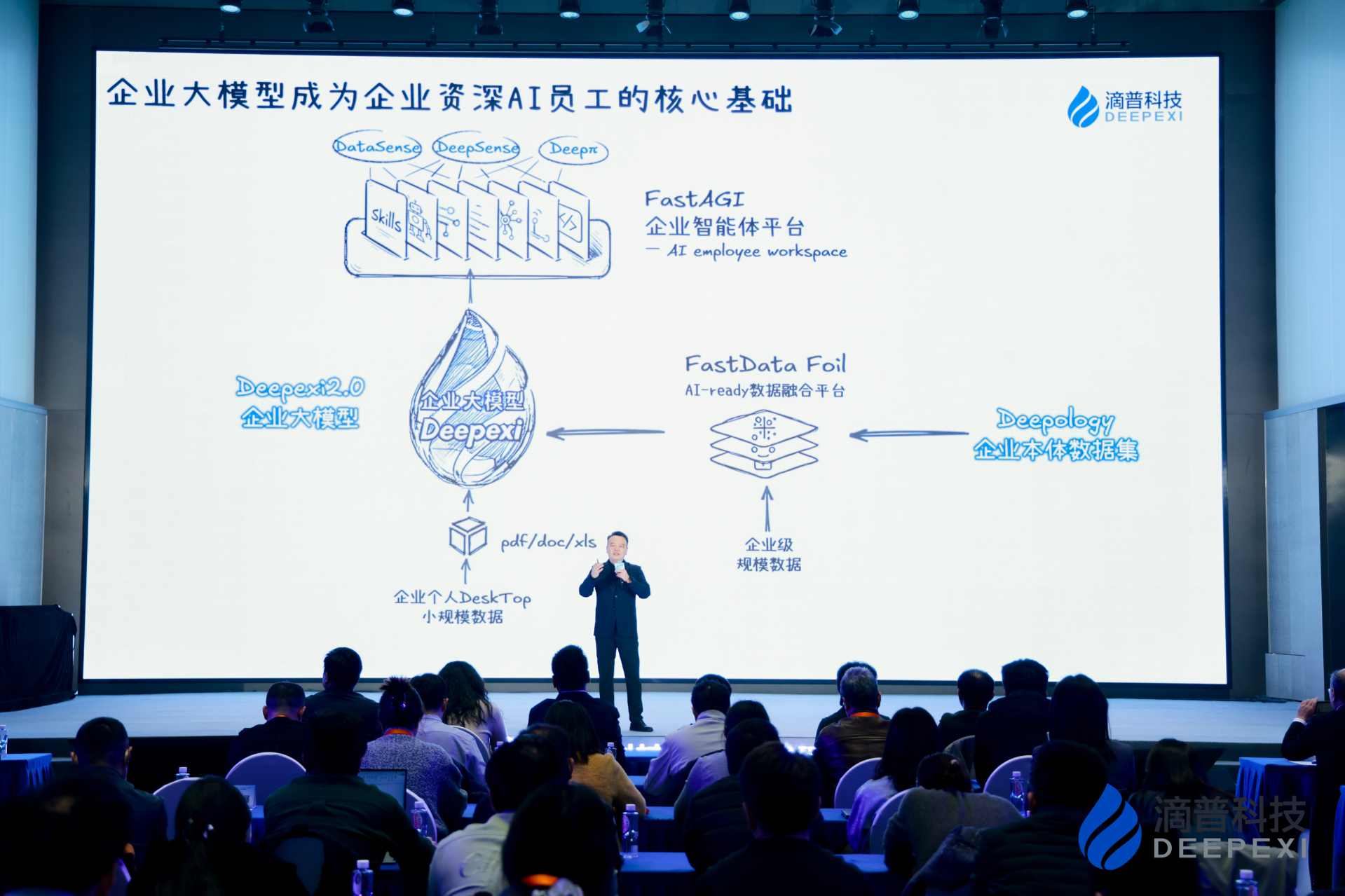
By March 2026, Zhao was talking about AI employees as a way to explain enterprise adoption. His emphasis fell on the company knowledge and authority assigned to a role. A business has its own relationships, procedures and definitions; an agent drawing on general internet knowledge can misunderstand that setting.
He described a path from enterprise knowledge to a structured model of the business, then skills and role-specific agents. Engineering drawings and complex tables belong in that problem alongside ordinary documents. The phrase “AI employee” sounds friendly. The work behind it includes deciding what the system may know and what it may do.
- 01Company knowledge
- 02Business relationships
- 03Role + permissions
- 04Work inside the business
A separate analogy concerned an employee changing companies: specific data must stay behind, while the ability to understand data can travel. Zhao used it to explain the distinction between a customer’s information and transferable capability. The analogy makes the ambition legible without making the implementation simple.
Memory gets a place on the bill
In May 2026, Zhao examined agent memory as an economic question. Productive value, he argued, must justify the computing, human effort and operating resources consumed. Memory matters because repeating the work of understanding an organization adds cost, while remembering useful context may improve the result.
His emphasis was on continuity: a role has a history, a company has rules, and a task belongs to a larger operation. An intelligent answer can still be expensive if the system must reconstruct that setting every time. His argument asks buyers to examine what their spending produces, rather than treating a cheaper unit of computation as a complete business case.
The corrections are part of the knowledge
By September, his public discussion had turned to the traces left when people adjust and correct systems. At the ITValue Summit, he argued that this accumulated experience could help automate more of the work of expressing a company’s knowledge and business logic. The correction itself becomes material to learn from.
The summer had supplied other evidence of his direction: DeepWorks public testing in July and a Deepexi collaboration with Huawei Cloud announced in August. Zhao continued to emphasize the constraints around industrial adoption, including data preparation and computing capacity. The story had arrived back at infrastructure, now beneath an agent platform.
Respect, earned at the customer’s desk
Zhao’s stated aspiration to build a company respected by customers offers a useful way to read these changes. His products and vocabulary have evolved. The test he sets for them remains grounded in another organization’s work.
That makes the next chapter interesting. Enterprise AI promises to act, which gives the customer more reason to insist on context, permissions and dependable execution. Zhao has spent years asking fashionable software to explain itself. Now his own AI employees must turn up prepared for the job.
Continue the conversation
- Deepexi · company website
- Zhao’s 2019 “more than 中台” talk
- WISE2021 · data intelligence in practice
- Enterprise AI employees · March 2026 interview
- Zhao on agent memory · May 2026
- ITValue Summit · September 2026
- Company filings · 2025 annual report
Quotations are translated from Chinese.