Wouter Janssen was defending his thesis when a customer called. Universities have procedures for assessing a student’s command of a subject. Customers have procedures of their own, generally involving a telephone and an inconvenient moment. Janssen picked up. He later described the decision without much apparent suspense: he knew he had made the right choice.
It is a small incident with unusually good explanatory powers. Here was a student being examined on what he knew, interrupted by someone who needed him to do something. He chose the live problem. Years later, as chief executive and co-founder of Tekst, he would be selling companies a way to understand precisely that territory: the requests, interruptions and decisions that make work happen between the formal systems.
The thesis story is funny because the priorities are so gloriously impolite. It also gives a better introduction to Janssen than a funding announcement could. Before there were investors to persuade and an international market to pursue, there was already a customer whose call he felt obliged to answer. The business had acquired a claim on his attention.
Two friends, one overflowing inbox
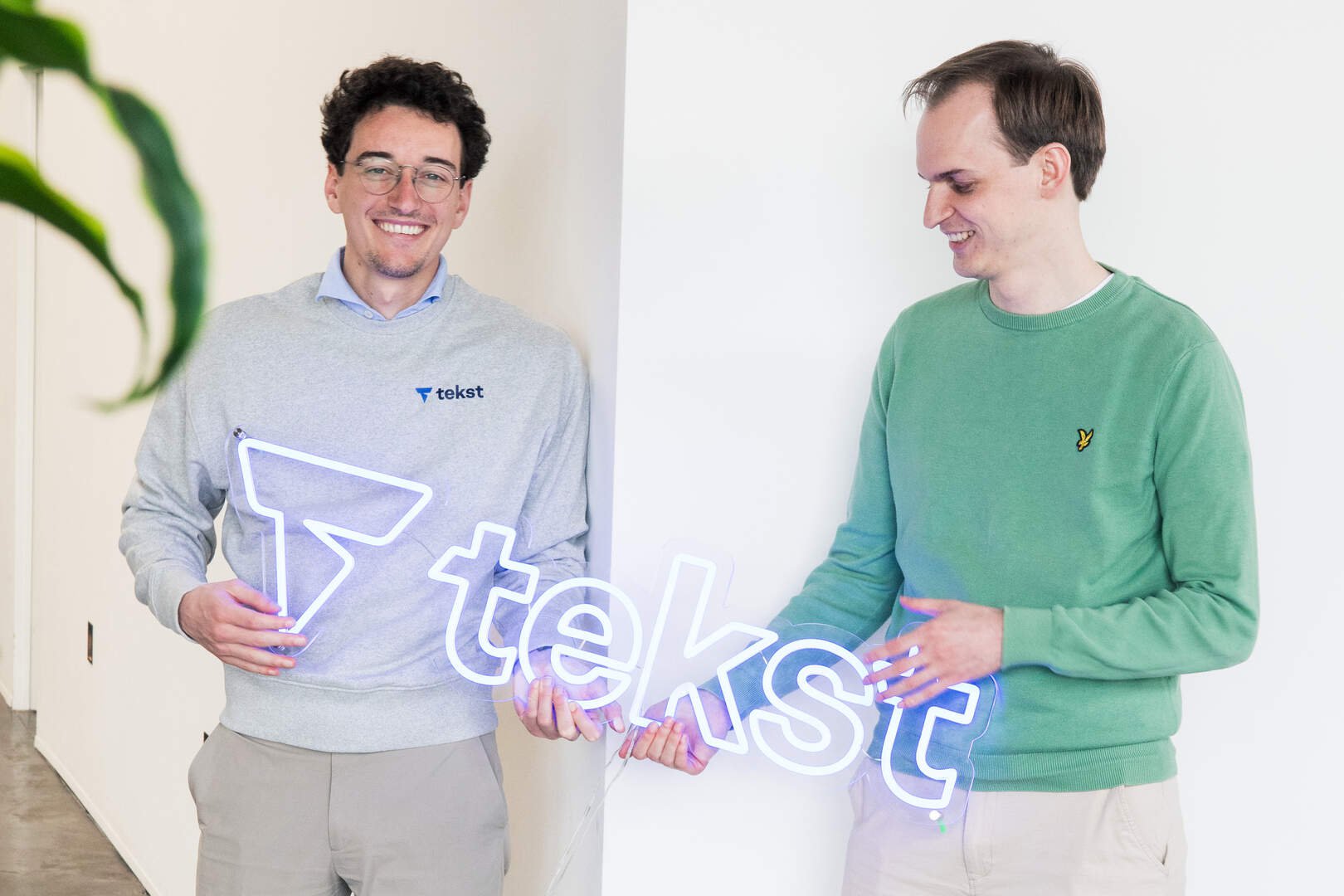
Janssen and his co-founder, Tiebe Parmentier, were childhood friends from Ostend. Their first code dates to 2021. The immediate problem was an overactive student mailbox: too many messages, too many notifications, too little distinction between something important and something merely arriving. They combined their business-engineering and engineering backgrounds to build a filter that could tell different kinds of messages apart.
They wanted useful interruptions. That is a pleasingly modest ambition for the beginning of an AI company. Nobody needed to announce the future of intelligence before deciding which email deserved a look. A working integration with their own mailboxes offered a more immediate test: did the thing help?
The project grew beyond its first users. Janssen remembers getting into a car to solve a customer’s problem in Antwerp instead of going to class. There is a point at which student entrepreneurship begins to look suspiciously like entrepreneurship with unfinished homework. For these two, the timetable was already being rewritten by people outside the university.
The student who studied value
At Ghent University, Janssen studied business engineering, completing a bachelor’s degree before a master’s with a data-analytics focus. His listed electives put deep learning beside investment analysis. His master’s dissertation considered discounted cash-flow models and their application to S&P 500 companies, including the differences between technology businesses and consumer staples.
It is an interesting pairing of interests. One concerns what machines can learn; the other concerns what a business is worth. A model that performs an impressive trick and a business that earns a durable place in a customer’s budget are related achievements, but they require different examinations. Janssen had academic reasons to think about both.
His public profile lists Dutch, English and French. For a founder building software around human communication, that is an apt detail. Business language comes with local habits, specialised vocabulary and context. The product’s early commitment to multiple languages fits a company whose first market was never a world conducted exclusively in English.
Sell first. Then build.
Tekst was founded in Ghent in 2022, with Janssen as CEO and Parmentier as CTO. Looking back, Janssen describes an early discipline of selling before building. The first three customers helped determine what the product became. That sequence places an awkward but useful constraint on ambition: someone has to want the result enough to buy it.
Mentorship changed the pace. Pieterjan Bouten, the Showpad co-founder behind Entourage, helped the founders put decisions in order. Janssen credits him with bringing structure and a clearer destination. Working from Bouten’s office created a short feedback loop. One lesson concerned pricing: early arguments over small differences in a contract could distract from the more important task of becoming indispensable to customers.
It is advice with a certain comic cruelty for anyone who enjoys a spreadsheet. A price can be debated indefinitely. A customer either keeps finding a reason to use the product or starts looking elsewhere. Janssen’s account of those early years keeps returning to the second question.
“You need more than a feature. You need to become part of the customer’s future architecture.”
Wouter Janssen, June 2026
€700,000 for the unglamorous bits
In May 2024, Tekst announced €700,000 from Entourage Capital to develop its platform and expand commercially in Europe. By then, its work involved turning unstructured text into data that other business software could use. Milcobel was among the named customers. The gap between a message arriving and a useful action being completed had become a commercial proposition.
Janssen described the importance of operating in the background. Employees already had systems to use; asking them to adopt yet another tool could introduce a fresh burden while promising to remove an old one. Tekst connected with software such as SAP and Salesforce, drawing on information already present inside the organisation.
That detail makes his choice of problem more revealing. Much of software’s public appeal rests on what a person can see on a screen. Here the desired result might be an employee having less to do with a screen at all. The achievement is a request arriving in the right place, with the relevant information, without another round of copying and forwarding.
The office between the boxes
By 2026, Janssen’s explanation of the opportunity had broadened into process intelligence: reconstructing how work actually moves through an organisation before assigning more of it to AI agents. Tekst’s proposition follows digital traces across messages, documents and business systems. The aim is to recover the context that employees use when deciding what happens next.
“The processes that actually run a business aren’t written down anywhere,” he said in the May funding announcement. “They live in emails, in PDFs, in people’s heads.”
A formal workflow can make an office look wonderfully composed. A real request may require someone to remember a previous exchange, notice an exception or ask a colleague. That is where Janssen has chosen to build. The difficulty gives his pitch its practical character: automation has to cope with the working day as people conduct it, including its untidy dependencies.
His vocabulary can be technical, but the underlying frustration is familiar. Somebody becomes the bridge between two systems, moving information across by hand. Tekst’s ambition is to make that bridge part of the software. For Janssen, the inbox has become a place to study the organisation around it.
A larger cheque, a shorter horizon
On 7 May 2026, Tekst announced an €11.5 million Series A led by American venture firm Elephant, with Entourage investing again. The company reported 35 employees and a plan to double that number by year-end. The hiring plan concentrated on engineering and go-to-market roles, putting more people behind the product and the effort to bring it to new customers.
The funding supported product development and international expansion. Janssen identified the United States as the next logical market for a product addressing a worldwide problem. For a business started by two students in Ghent, an American investor also offered a connection to the market they wanted to enter.
Expansion gives the founder another version of his original challenge. More opportunity means more possible demands on attention. A company has to choose which requests to pursue, which capabilities to build and which promises it can keep. The sums have changed considerably since the student mailbox. The need to distinguish the important signal remains.
Janssen’s June 2026 discussion of AI economics offers a useful counterweight to the excitement of a large round. He urged caution about three-year plans and favoured horizons of 12 to 18 months. He also pointed to expansion revenue as evidence that a product was becoming more relevant to existing customers. His concern was commercial durability as capabilities became cheaper and alternatives easier to build.
There is a demanding standard hidden in that view. An early sale earns a chance to solve a problem. Continued spending asks whether the solution still matters. For Janssen, deeper integration and additional value are ways to keep earning that place. The founder who once answered a customer during an examination now describes a business that must keep passing examinations set by customers.
Answering the next question
His public appearances increasingly put him in conversations about what AI requires from company leaders. In June 2025, he joined a discussion with Rika Coppens of House of HR, Hans De Cuyper of Ageas and PwC Belgium’s Patrick Boone. The question reached beyond buying technology to the role of the chief executive when work across the organisation begins to change.
He was also listed to speak on the economics of AI transformation at the September 2026 AI Summer School in Ostend. It is a fitting subject for someone whose studies combined data analytics and business valuation. The technical possibility is one question. Who pays, who benefits and what remains valuable are questions that follow immediately behind it.
Janssen’s story keeps bringing those worlds into the same room: university and customer, engineering and commerce, a childhood friendship and an international enterprise. The thesis-defence call remains its most economical scene. A request arrived. He decided it mattered. Then he answered. His company has grown around the much harder task of helping other organisations do that reliably, millions of ordinary decisions at a time.