At about three in the morning on May 1, 2021, Zeshan Ali’s phone rang. The caller was Kerem Atalay, his friend and fellow programmer on a new project called Bored Ape Yacht Club. Ali thought something had gone terribly wrong. They had just released a collection of cartoon apes, and all the moving parts of the launch had to hold together: a website, Ethereum smart contracts, and spaces reserved for people who owned a token. Instead, Atalay had news that sent them both to their screens. The apes were selling out. The two watched the remaining supply disappear in real time.
It is a tidy anecdote now, almost suspiciously good as a beginning. A late call. A worried engineer. A surprise ending. But its charm lies in the worry. Ali’s first thought was of a fault because his part of the operation was a system that could fail. The pictures had to appear, ownership had to register, and the promise of a club had to lead somewhere once a buyer arrived. On that morning, it did.
The friend who knew the code
Ali did not enter the story through an ad agency or an art studio. He and Atalay had met studying computer science at the University of Maryland. Atalay knew Greg Solano from the University of Virginia, where Solano had been working on a creative writing degree. When Solano and Wylie Aronow began turning a joke about newly rich, chronically bored crypto people into an NFT club, Solano reached out to the pair who could make the thing function.
The first programming question was about JavaScript. That language could help with a website, but the blockchain portion required Solidity, the language used for Ethereum smart contracts. Ali and Atalay learned it. They had a public token standard, ERC-721, to work from, which made the contract itself relatively approachable. The trouble was in the stitching: connecting a sale to a site, the contract to ownership, and ownership to the places members had been promised. Ali later called the job “a big lift.”
The division of labor among the four founders was unusually plain. Solano and Aronow developed the concept and its voice. Ali and Atalay handled the technical side. None of these jobs could substitute for the others. A funny image without a working mint would have remained an image. A flawless contract without a reason to care would have been a quiet little program. BAYC’s original appeal depended on both: the prospect of belonging to a strange club and the proof that its door opened.
That door included a digital graffiti wall called the Bathroom, an early example of the founders’ taste for giving token ownership somewhere to go. The name was knowingly low rent for an enterprise later discussed in billions. It also captured the original pitch better than a sober technical diagram. A yacht club for people who had no intention of behaving like yacht club members should probably have a bathroom wall to write on.
Four pseudonyms, four real people
At the beginning, the founders used names that sounded less like a boardroom than a group chat. Aronow was Gordon Goner; Solano was Gargamel; Atalay was Emperor Tomato Ketchup. Ali was No Sass, later shortened to Sass. Yuga Labs has described the project as beginning with a message between four friends: “Let’s make an NFT.” The line is almost comically spare, considering how much work followed it.
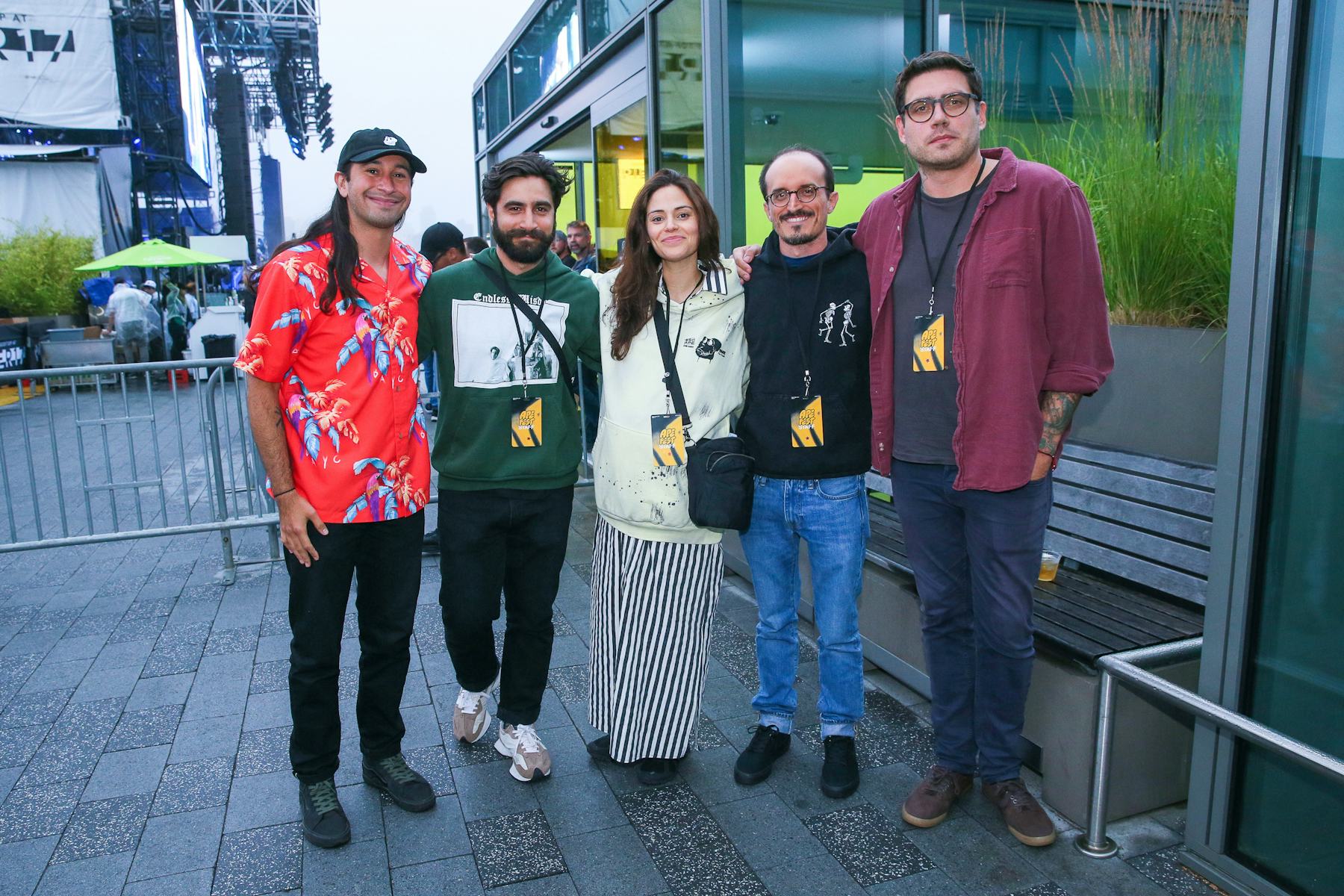
For Ali, the disguise had a practical social effect. At the first ApeFest, he could spend time among other members without anyone knowing he was one of the founders. He remembered savoring that freedom. It let him experience the community as a participant, with no introductory speech required and no conversation bent by the knowledge of who wrote the code.
“I remember being at ApeFest last year and savoring the fact that I can hang out with anybody, and no one knows who I am.”Zeshan Ali, reflecting in 2022
That anonymity did not last. In February 2022, the identities of Solano and Aronow became public. Four days later, Ali and Atalay posted photographs and their first names themselves. Atalay said they wanted some control over how that introduction happened and a chance to make it a celebration. Ali’s message was simple: “Hey, I’m Zeshan. Nice to meet y’all (:” He placed his real-world photograph beside his online ape. His caption called them his Web2 and Web3 selves.
The side-by-side images were neat shorthand for a moment that must have felt less neat to live through. A pseudonym had let the builders stand behind the club and talk to its members as familiar usernames. Once the names were public, their work acquired ordinary human faces. Ali knew the unrecognized ApeFest visit could not be repeated.
The work behind the spectacle
The apes sold originally for about $200 each. Their subsequent rise made them visible well beyond crypto circles, and Yuga Labs expanded the project into companion collections, live gatherings and plans for a virtual world called Otherside. Each new chapter drew more attention to the brand. Ali’s early contribution is easiest to understand by returning to the less glamorous launch checklist: a token that can be minted, a holder who can prove ownership, a place for that holder to enter. Remove any one of those and the first version of the club loses part of its meaning.
The technical challenge also grew from a peculiarity of NFTs. A token is a record of ownership, but a record alone does not create an experience. For BAYC, the social layer mattered: the chat, the jokes, the member spaces, the ability to recognize someone else’s ape. Ali and Atalay’s work joined that social ambition to the mechanics of Ethereum. It made membership readable by a machine and usable by a person.
A 2022 Yuga account of its first year says the four founders had become a team of more than 40 by the time it was written. The same account frames the original idea with playful modesty, but rapid growth changes what a founder’s work looks like. Processes, colleagues and specialist teams arrive. The original night of four people waiting for a mint to work becomes company history. Ali’s later public profile has remained far quieter than the brand he helped start; his memorable comments still return to the launch and to the odd privilege of being anonymous at a party for a club he built.
The way the founding team talked about the launch also reveals how new the terrain was. Solano’s first question to his developer friends was about JavaScript, a perfectly ordinary question for someone imagining a website. The project needed more: a smart contract written in Solidity, the web experience around it, and checks that distinguished a member from a visitor. Atalay later described learning the token language as the easy part. Ali pointed to the job of making all those components cooperate. It is the difference between learning to build a lock and making sure the lock, the key, the door and the guest list all agree.
The club’s playful presentation could make those details disappear. Members saw a swampy clubhouse and apes with improbable expressions. Behind the scenes, a team of four had divided the labor according to what each person could do. There is a small comic justice in the fact that an enterprise named for boredom demanded such a busy launch. Ali and Atalay had enough to do before anybody could claim the luxury of being bored.
What the call still tells us
There is a reason the 3 a.m. call survives the bigger figures. It contains a useful distinction between an outcome and the people waiting to see if their work holds. From outside, the sale looks like a smooth upward line. From Ali’s side, it began as a ring in the middle of the night and a fear that something had broken. By dawn, he and Atalay had watched the collection sell out.
His biography also complicates the usual shorthand for a crypto founder. Ali grew up on the West Coast with immigrant parents from Guatemala and Pakistan who met in English classes. He studied computer science in Maryland and joined a project through an old academic friendship. Those details offer no grand prophecy about NFTs. They explain a route by which one particular person reached one particular job: an introduction, a question about code, a language learned, and a deadline.
The story of BAYC is often told through its market price or its celebrity owners. Neither explains why Ali thought a call from Atalay could be bad news. He was close enough to the machinery to imagine its failures. That is the useful angle on his place in the founding four. The club became a spectacle, and the spectacle was possible because a couple of programmers made its invitation work.