The useful player is not always the one holding the ball. Sometimes he is the one running away from it, taking a defender with him and leaving a teammate a little more room. The box score records the basket. It has less to say about the small act of persuasion that made the basket possible. Zelus Analytics made that gap between visible performance and underlying contribution part of its business.
- Predictive models help teams evaluate players, build rosters and prepare for games.
- An early exclusive network shared the cost of specialist research.
- Acquired in 2024, Zelus now powers Teamworks Intelligence.
The run nobody counted
Luke Bornn came to sports through statistics. His research had involved movement across time and space, including animals and climate systems. Basketball tracking data offered another unusually rich setting. Eventually he led analytics at AS Roma and the Sacramento Kings. Doug Fearing brought experience running research and development for the Los Angeles Dodgers and Tampa Bay Rays. Dan Cervone’s background included academic work with Bornn and a postdoctoral fellowship at NYU.
They were interested in questions that ordinary totals leave unanswered. Who creates space? What happens before the assist? How much should a team pay for what a player might do next, rather than what he did last season? The founders combined research experience with the practical inconvenience of having to answer those questions inside actual sports organizations.



The first bottleneck was capacity. In 2021, Bornn described raw basketball tracking data as too demanding even for his nine-person Kings staff. Collecting information and extracting useful player evaluations were separate jobs. A team could have the feed without having the specialists, time or systems to turn it into a decision.
Six seats at the table
Zelus’s early answer was a shared research department with restrictions on admission. In baseball, its reported limit was one club per division: six potential customers. In basketball, three teams per conference. That policy sounds peculiar if the point of software is to sell another copy at minimal cost. It makes more sense if the customer is buying an advantage over people who might buy the same copy.
“There is this really nice trade-off between cost sharing and competitive advantage.”Doug Fearing, 2021
The company sold access to expertise that could be expensive to assemble inside one organization. Its customers included teams building their analytics capabilities and teams with established departments seeking another perspective. Zelus documented its models and supplied granular outputs through APIs, allowing internal analysts to examine the work and incorporate it into their own systems.
Money still mattered. May 2021 reporting put the NBA offering in the low six figures annually; one unnamed baseball general manager estimated $500,000-$600,000. Those were historical estimates, not today’s price list. The same account reported that six MLB partners had become four amid the pandemic, while the remaining four renewed at higher rates. Exclusivity could protect the proposition; it could not make sports budgets immune to a crisis.
One club per division
Shared research. Limited access.
The plumbing beneath the prediction
By the time Teamworks acquired Zelus, the architecture had two named pieces. Data Engine gathered league, team and vendor information into a central warehouse, cleaning and transforming it for analysis. Titan Intelligence supplied sport-specific metrics, predictive models and visualizations. The connection matters: an elegant prediction built on inconsistent inputs is an elegant way to be wrong.
The work addressed roster construction, player development, game preparation and in-match strategy. For Toulouse FC, a publicly discussed relationship, the questions extended to recruitment, contracts, opposition analysis and set plays. The club had a local data lead connecting Zelus with its decision-makers. The software belonged in a conversation about choices, rather than in a separate room where numbers admired themselves.
This positions Zelus alongside a team’s internal research staff and downstream of data collection. Tracking and event-data suppliers, including businesses such as Second Spectrum and StatsBomb, occupy overlapping parts of that market. Buying a data feed, hiring researchers and buying a supported modeling platform solve different portions of the same problem.
A research department for one golfer
In October 2023, Zelus announced the first tranche of its Series A. NYU’s account reported $3.6 million. Participants included Teamworthy Ventures, Gametime Capital, Kevin Durant and Rich Kleiman’s 35V, and Billy Beane, joining existing investor RedBird Capital. The money supported product investment and expansion into additional markets.
The following month, Zelus bought TourIQ, founded by Cory Jez in 2021. TourIQ used historical ShotLink data to help PGA Tour professionals assess performance and plan course strategy, with direct support available alongside the product. An individual golfer could draw on analytical resources resembling those behind a franchise. Buying TourIQ also brought existing golf relationships and a working product, rather than merely a promising spreadsheet.
From a private club to the operating system
On September 5, 2024, Teamworks acquired Zelus. The announcement counted more than 70 incoming sports data scientists and engineers, with experience across more than 30 professional organizations. Fearing’s stated rationale was expansion into more sports and markets, including college athletic departments. The exclusive-network origin was giving way to a larger distribution opportunity.
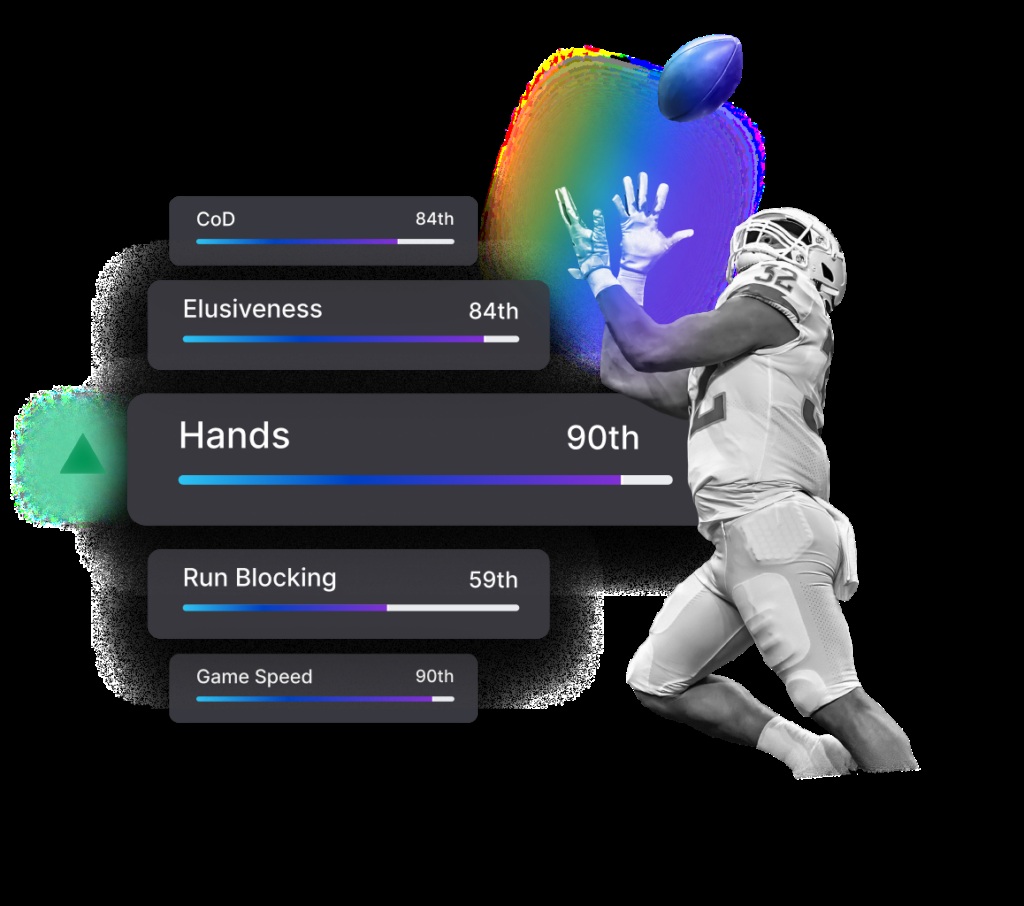
In February 2025, Teamworks announced a PFF partnership to bring contextual, position-specific predictions into college football recruiting and roster planning. In March 2026, it acquired PFF’s enterprise business. Data and models were moving closer together. Current Player Scouting documentation describes searches combining traits, advanced statistics and biographical information to identify FBS candidates.
The lesson readers can copy is procedural: name the decision, organize the inputs, question the assumptions and put the result where someone acts. The conditions matter. Missing data, an unsuitable model or a staff unwilling to use the analysis can undo the benefit. A probability is useful precisely because it leaves room for uncertainty. Even an excellent research department cannot promise what happens after the whistle.