Dispatch · Where they stand in 2026
It's a Tuesday morning, and a kid is getting all of it in one place.
A six-year-old walks into a Zarminali clinic for a sore throat. Before she leaves, the speech therapist down the hall has confirmed a follow-up, the behavioral health note is already in her chart, and her mother has booked next month's wellness visit without making a single second phone call. No fax. No "we don't have those records." No three-week wait to see someone in a different building across town. This is the ordinary thing Zarminali Pediatrics is trying to make ordinary.
That scene is the whole pitch. Zarminali (say it: zar-mee-naah-lee) is a venture-backed, multi-specialty pediatric practice group that puts primary care, urgent care, specialty services, behavioral health, and telehealth under one coordinated roof. As of 2026 it runs roughly 28 clinics across 8 states, employs around 120 people on the corporate side plus clinical teams in the field, and has raised about $150 million total - including a $110 million Series A that closed in January.
"Our pediatric healthcare system is broken, and Zarminali's model is the necessary solution."
Danish Qureshi, Founder & CEO
It is a bold thing to say about an industry that mostly works fine for healthy children. The catch - and Zarminali's entire reason to exist - is what happens to the families for whom it does not.
The Problem · Why a clinic group, really
Roughly one in four families becomes an unpaid care coordinator.
American pediatric care is generous with pediatricians and stingy with coordination. A child with a developmental delay, an autoimmune condition, or a behavioral health need does not get one care plan. The family gets a scavenger hunt: a referral here, a specialist with a four-month waitlist there, a therapist who never sees the pediatrician's notes, and an after-hours system that funnels everyone to the emergency room by default.
By Zarminali's own framing, about one in four families needs that kind of specialty coordination - and most of them end up doing the coordinating themselves, between school pickups and work. The market is enormous and weirdly under-served at once. The company pegs the addressable opportunity at roughly $78 billion by 2033. That is not a niche. That is a system-sized gap that everyone had politely agreed to call "normal."
The quiet math
Plenty of companies fix one slice of pediatric care - a telehealth app here, a behavioral health startup there. Zarminali's wager is that the slices are the problem. Coordination, it turns out, is the product.
"There is no other group addressing the overarching challenges across the entirety of pediatric care nationwide."
Danish Qureshi
The Bet · Why this founder, this problem
He had already scaled a healthcare company. Then it got personal.
Danish Qureshi is not a first-timer with a slide deck. He spent 15-plus years in healthcare, built a wound-care company that was acquired, and co-founded LifeStance Health - which he helped scale to roughly 7,000 clinicians across 33 states as president and COO. He knew, in operational detail, how to grow a multi-state clinical network. What he did not have, until his own family did, was a reason to point all of that at children.
Then his daughter was diagnosed with an autoimmune disorder. Qureshi and his wife - both healthcare insiders - found themselves drowning in the same fragmented system everyone else does. If the people who build these companies struggle to navigate pediatric care, the reasoning went, what chance does anyone else have. He launched Zarminali in July 2024 and opened the first practice in Michigan that November.
The name is the thesis
"Zarminali" means something more precious to you than gold. It is a sentimental choice for a company that otherwise talks in clinic counts and addressable markets. It is also, conveniently, hard to forget.
"Zarminali is being painstakingly designed by parents who have struggled against the flaws of our healthcare system - because every child deserves amazing care, from birth to adulthood."
Danish Qureshi, Founder & CEO
The Product · What's actually under the roof
Five services, one care team, no membership fee.
The model is a hybrid: real, purpose-built clinics combined with telemedicine and asynchronous messaging. Crucially, it bills through major insurers and skips the concierge-style membership fee that puts so many "better" healthcare brands out of reach. The idea is not to build a premium tier. It is to make the coordinated version the default version.
Primary Care
Newborn through adolescence: wellness visits, immunizations, developmental screenings, chronic condition management, same-day sick visits.
Urgent Care
Walk-in and extended-hours pediatric urgent care designed to keep families out of the ER for things the ER shouldn't handle.
Specialty Care
On-site specialists at select locations - behavioral health, occupational therapy, and speech therapy, sharing one chart.
Virtual & Telehealth
After-hours virtual support and async messaging, with 24/7 telehealth in expansion. The 2 a.m. fever has a destination now.
Exhibit A: the menu most pediatric "experiences" make you visit four buildings to assemble.
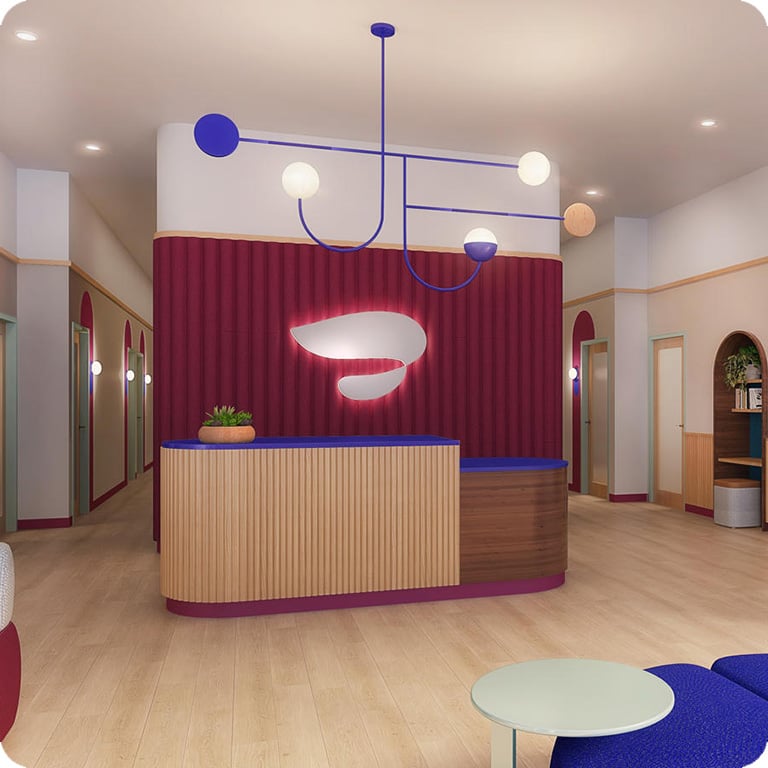
There is also a less visible design choice that families notice immediately: the buildings themselves. Clinics use natural materials and sensory-conscious spaces, built on the unglamorous evidence that a calmer room makes for a calmer exam. When the architecture is part of the medicine, the waiting room stops being a place you endure.
"Every child deserves amazing care, from birth to adulthood."
The mission, stated plainly
How a clinic group grew up fast
Jul 2024
Founded. Danish Qureshi launches Zarminali after his daughter's diagnosis exposes the cracks.
2024
$40M seed led by General Catalyst - raised pre-revenue, on conviction.
Nov 2024
First clinics open in Michigan; three locations stand up within months.
2025
Multi-state expansion into Minnesota and beyond; footprint climbs toward 28 clinics.
Jan 2026
$110M Series A led by Healthier Capital; Amir Dan Rubin (ex-One Medical CEO) joins the board.
Mar 2026
Washington, DC. Trusted local practice McKnight Pediatrics joins and rebrands under Zarminali.
2026 →
Next: 15 de novo clinics planned, including Chicago, Milwaukee, and Dallas.
The Proof · Numbers, money, and a notable board seat
Investors don't usually fund a vibe. They funded the spread.
The $110 million Series A was led by Healthier Capital, with existing backer General Catalyst returning and K2 HealthVentures joining. The capital is earmarked for the unglamorous work of growth: 15 additional de novo clinics in 2026, deeper specialty services, and a push toward 24/7 telehealth. The board addition is its own signal - Amir Dan Rubin, who ran Amazon's One Medical, does not lend his name to ideas he expects to fizzle.
From zero to a network, fast
CLINIC COUNT BY YEAR (APPROXIMATE)
The Washington, DC move shows the second growth lever: acquisition. Rather than parachute a new brand into a city, Zarminali absorbed McKnight Pediatrics, a practice DC-area families had trusted for generations, and put its name on the door. New sign, same people who already know your kid. It is a quieter strategy than ribbon-cuttings, and probably a smarter one.
"Zarminali represents a fundamentally better way to care for children."
Amir Dan Rubin, Board Member · former CEO, Amazon One Medical
The Mission · What it's really for
Make the coordinated version the normal version.
Strip away the funding rounds and the clinic counts and the mission is almost stubbornly simple: stop making parents the glue. Keep the same clinicians and families together over years rather than rotating strangers through. Put the specialists where the pediatrician already is. Share the chart. Answer the phone after hours. None of these are breakthroughs. They are just hard to do at once, across states, at a price insurance will cover.
Who it's for
Any family with a kid from newborn through adolescence - but especially the quarter of them juggling specialty needs. If you've ever held a referral slip wondering who actually calls whom, you are the customer.
There is healthy skepticism to keep on hand. Roll-ups in healthcare have a mixed record, and growing from 3 to 28 clinics in under two years is exactly the speed at which quality can wobble. The model's promise - coordinated, personal, unhurried care - is also the hardest thing to preserve while scaling. Zarminali's bet is that technology absorbs the administrative load so clinicians can keep the human part. Whether that holds at 100 clinics is the open question.
Tomorrow · Why it matters
Back to that Tuesday morning.
The six-year-old with the sore throat doesn't know what a "multi-specialty practice group" is. She knows the room was calm, the person who saw her last time saw her again, and her mom didn't spend the afternoon on hold. That is the entire revolution Zarminali is selling - not a gadget, not an app, just a day that went the way it should have gone all along.
If the company hits its targets - the top 30 states within a few years, 24/7 virtual care, specialty services in more buildings - that ordinary Tuesday becomes ordinary for a lot more families. If it stumbles, it will be a familiar story about scaling care faster than it can be felt. Either way, the question Zarminali forces the rest of pediatrics to answer is the uncomfortable one: why was the scavenger hunt ever the default?
"Something more precious to you than gold."
What the name means · and the standard it sets