ZapScale Wants Your Customer Success Team Live Before Lunch
A bootstrapped B2B SaaS startup, run by a founding trio that already built and sold one company, is betting the whole category on a single idea - be the easiest tool to switch to and get you set up in a day. Here is how it stacks up against Gainsight and Chameleon.
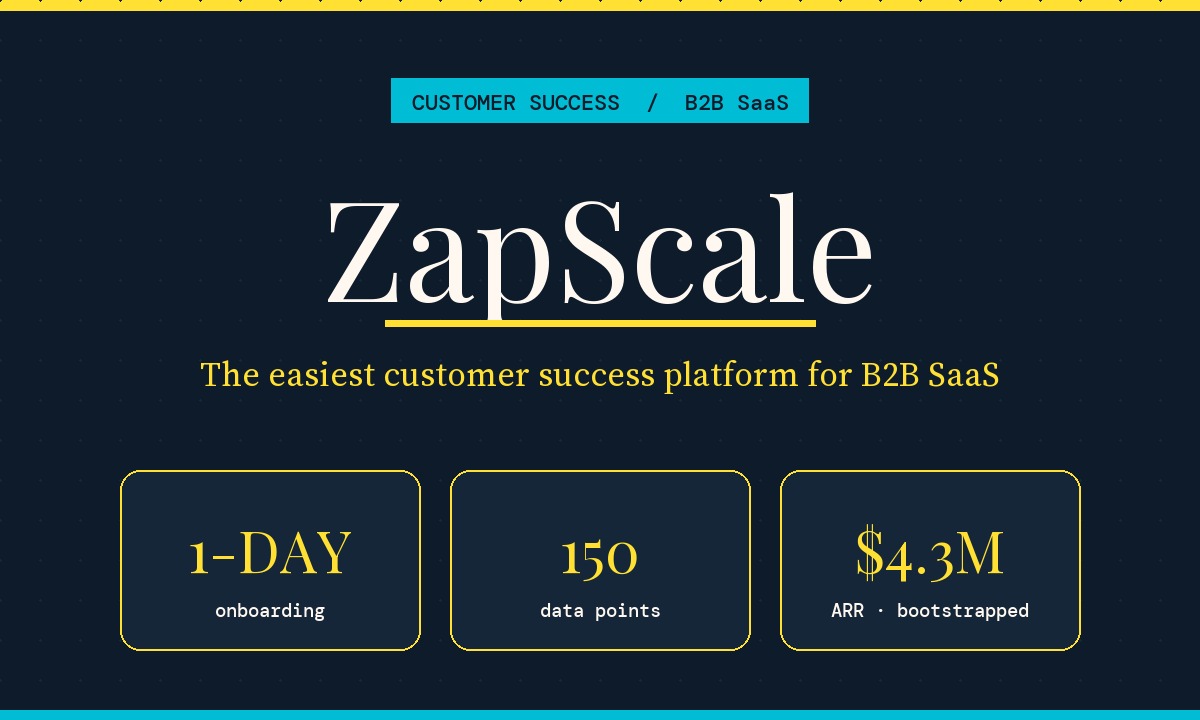
Most software companies try to win by adding. More dashboards, more configuration, more knobs for the power user who wants them. ZapScale is trying to win by removing. Its pitch to a growing SaaS company is almost rude in its simplicity: your customer success platform should be running before you finish your coffee, not after a quarter of implementation calls.
That is a strange thing to build a company around. Customer success software is a mature, crowded market with a clear king in Gainsight. Going after it in 2021 was not the obvious move for three founders who had just sold their last company. But the bet ZapScale is making is worth understanding, because it is a template a lot of founders could copy - find the market where the leader's greatest strength is also the thing customers quietly complain about, then build the opposite on purpose.
01The founders had done this before - in a different industry
ZapScale was founded in 2021 by Manasij Ganguli, Mausmi Ambastha and Bratish Goswami. The three had already built a company together: ThreadSol, a manufacturing and apparel-tech business started back in 2012. In 2019 ThreadSol was acquired by Coats, the industrial thread group, and Ganguli spent time in a technology innovation role there before starting up again.
Second-time founders tend to have a superpower - they know which problems are worth their next decade. The interesting choice here is that they did not build ThreadSol 2.0. They left manufacturing entirely and picked customer success, a category that had nothing to do with their prior domain expertise. What carried over was not the subject matter. It was the discipline of having sold enterprise software into slow-moving buyers and watching how painful adoption really is.
ZapScale was born out of my passion to empower B2B SaaS start-ups with an efficient and effective CS platform.Manasij Ganguli, co-founder and CEO
02What the product actually does
Strip away the positioning and ZapScale is a customer health engine. It connects to the tools a SaaS company already runs - product usage, support tickets, billing, CRM - and pulls them into a single 360-degree view of each account. The company says it tracks around 150 data points per customer, which is less about surveillance and more about a specific outcome: a customer success manager opens one screen and knows, without having to ask anyone, which accounts are about to churn and which are ready to buy more.
Everything else is downstream of that health score. The platform ships with 40 pre-built, KPI-based health frameworks and roughly 60 playbooks - the automated sequences a CS team runs when an account goes red, or when a renewal is 90 days out. On top sits a layer of AI features that are refreshingly boring in the good way: classify the shared inbox, summarize an account, flag sentiment, so a human spends their day on the three accounts that matter instead of triaging fifty.
03Why "one-day onboarding" is the whole strategy
It is easy to read one-day onboarding as a marketing line. Look closer and you notice that nearly every product decision exists to make that claim true. The 40 prebuilt frameworks mean you are not designing a health score from scratch. The 60 playbooks mean you are not writing automation from a blank page. ZapScale even makes a point of integrating apps without requiring a unique key - a small, unglamorous detail that removes one of the classic reasons a data integration stalls for two weeks.
The reason this matters strategically is switching cost. In B2B software, the deepest moat is rarely features - it is the pain of ripping out the tool you already have and standing up a new one. Incumbents love that moat. A challenger's only move is to attack it, which is exactly what ZapScale is doing: it makes the act of switching cheap, because that is the only way a smaller company gets a foot in a market an incumbent already owns.
04ZapScale vs Gainsight vs Chameleon
These three come up together, but they are not really the same product - and the comparison tells you who ZapScale is for. Gainsight is the deep, highly configurable category leader, usually run by larger organizations with a dedicated CS operations team. Chameleon lives more in the product-adoption and in-app guidance world - tooltips, tours, onboarding flows inside your app. ZapScale sits in the middle, aimed at the growing SaaS team that wants a health-and-revenue command center without an enterprise deployment.
| ZapScale | Gainsight | Chameleon | |
|---|---|---|---|
| Core job | Customer health & revenue signals | Full CS operations suite | In-app guidance & product adoption |
| Built for | Growing B2B SaaS CS teams | Mid-market to enterprise | Product & growth teams |
| Setup | Pitched as one day | Weeks, often with services | Fast, but a different scope |
| Sweet spot | Ease + fast time to value | Depth & configurability | Onboarding tours inside the app |
ZapScale does not hide from this comparison. It publishes pages that name Gainsight and Chameleon directly, then argues that "easiest to implement" beats "most configurable" for the companies it wants to win. That is a confident move, and it only works because the argument is honest: if you are a 300-person enterprise with a five-person CS ops team, you may genuinely want the configurable thing. ZapScale is not chasing that buyer.
05The unglamorous metric it is really chasing
Underneath all of it is one number that keeps SaaS executives up at night: Net Revenue Retention. NRR measures whether your existing customers are worth more or less to you a year from now, after churn and after expansion. It is the metric that decides whether growth is real or just a leaky bucket you keep refilling with new logos. Customer success is where a company finds out the answer, and ZapScale is a bet that thousands of teams currently flying blind will pay for a clear view before they will pay for a powerful one.
06Bootstrapped is the more interesting story
ZapScale is described in public sources as bootstrapped, with a reported figure of around $4.3M ARR as of 2023 and no disclosed venture round. That constraint shapes the product more than any mission statement. When there is no growth-at-all-costs cover, the unit economics have to work from early on, which pushes you toward exactly the kind of self-serve, fast-to-deploy motion ZapScale sells. Pricing follows the same logic - entry tiers cited publicly have sat in the low hundreds of dollars a month, which quietly tells you the buyer is the startup CS lead who was told the enterprise option needs a six-figure budget and a quarter to install.
None of this guarantees ZapScale wins. Incumbents move down-market, and "easy" is a claim every competitor eventually copies. But the company has picked a real seam in the market and built consistently toward it. For founders watching, the lesson to steal is not the product - it is the shape of the bet. Ease of use is not a feature you bolt on at the end. Done right, it is a strategy you organize the entire company around.
Go deeper
- Sitezapscale.com
- LinkedInZapScale company page
- FounderManasij Ganguli, co-founder & CEO
- LaunchOne-day onboarding announcement (PR Newswire)
- ProfileZapScale on Crunchbase
Frequently asked
What is ZapScale?
A customer success platform for B2B SaaS companies. It pulls product usage, support and account data into a 360-degree view of customer health, predicts churn risk, and surfaces renewal and upsell opportunities.
Who founded ZapScale and when?
It was founded in 2021 by Manasij Ganguli, Mausmi Ambastha and Bratish Goswami - the same trio behind ThreadSol, which Coats acquired in 2019. Manasij Ganguli is co-founder and CEO.
How is it different from Gainsight?
Gainsight is the deep, highly configurable enterprise leader, often deployed over weeks. ZapScale positions itself as the easiest to use and fastest to implement, pitching one-day onboarding and prebuilt frameworks for growing teams.
How much does ZapScale cost?
It uses a subscription model with a free trial. Publicly cited entry pricing has ranged from around $249/month at launch to roughly $599/month depending on plan and source. Check the vendor for current pricing.
Is it funded or bootstrapped?
Public sources describe ZapScale as bootstrapped, with a reported ~$4.3M ARR as of 2023. No major venture round has been publicly disclosed.