Everyone liked Yvan Miron’s idea for a mobile stage. A construction company thought it could be done. The people who put on concerts could see the attraction. The bank manager was harder to persuade. This was 1982, and Miron wanted to replace a familiar outdoor ritual: arrive with a heap of materials, assemble a stage, dismantle it, then repeat the exercise somewhere else. He wanted the stage to travel as equipment. The distinction sounds small until you are the person waiting for the roof.
By 1984, he had a prototype. He used his own money to develop the technology and put it to work at shows. Stageline followed in 1987. Nearly four decades later, its equipment would be working at more than 30,000 events a year. But the beginning had none of that numerical reassurance. There was an awkward machine, a practical complaint and a promoter who had decided that the preparation for a concert ought to be less of a performance.
A guitarist with a backstage problem
Miron was born in Quebec and traces his family’s craftsmanship back to the mid-1600s. He began playing guitar when he went to college, then travelled extensively after finishing his studies. He has credited those travels with helping him understand the stage experiences his business would later create. His route into manufacturing passed through music and through the work of getting people together to hear it.
In the 1970s, he promoted shows and managed bands. By the early 1980s, he was organizing outdoor events with a friend. There is an education available in that job which no audience member needs to acquire: how many separate things must happen before somebody can strike a chord. Quebec’s weather made the lesson particularly emphatic.
A promoter can agree a running order. The wind has other arrangements. Miron wanted a covered stage that could move quickly between sites and reduce the repeated labour of building from loose components. His explanation was wonderfully unadorned: “I had to make life a little easier.” A considerable amount of machinery would eventually follow from that modest wish.
“I had to make life a little easier.”
Yvan Miron, recalling the problem that started Stageline
The roof had to travel, too
Early prototypes gave Miron something more useful than an approving conversation: equipment he could try at actual events. The first machines were built on flatbed structures. Hydraulics offered a way to raise and lower the platform. The challenge was making the whole arrangement dependable in the circumstances that had made outdoor production such a demanding business in the first place.
He turned to the Canadian Building Code for structural calculations, including wind resistance. A temporary stage was still a structure exposed to weather. Its short stay in a field did not make that fact disappear. Miron’s approach brought the expectations associated with permanent buildings into a product intended to leave town.
The change also moved work from the event site into the design of the equipment. A stage assembled afresh carries a fresh assembly job wherever it goes. An integrated mobile system arrives with more of that work already resolved. The audience sees a platform and a roof; the organizer sees fewer things that must be made to agree before the gates open.
Years later, Miron described the starting point this way: “Before Stageline, a stage was a construction.” His company treated it as a machine. That decision shaped both the product and the business built around it. The trailer was carrying a method as well as a stage.
There are three people called SAM
The story has a second central figure in Marius Chouinard, Miron’s longtime technical collaborator. Product development depended on that partnership and the engineers, technicians and craftspeople around it. An idea about faster staging still had to become a roof that could be manufactured, transported and deployed.
The company’s product names preserve some of the people and ambitions behind that work. SL simply stands for Stageline. SAM has a more sociable history. When the business looked toward the American outdoor festival market in the early 1990s, the name winked at Uncle Sam. Inside the company, it also became Scène à Miron: Miron’s stage.
Then came Scène à Marius, acknowledging Chouinard’s part in the equipment’s technical development. Most industrial model names have the charm of a filing cabinet. This one found room for an export plan and two colleagues. The joke is small, but it puts people back into a story that can otherwise vanish beneath specifications.
The larger lesson lies in the shared credit. Miron supplied the original dissatisfaction and kept pursuing it. Chouinard and the wider team helped turn that dissatisfaction into a family of products. The name on a stage can conceal a remarkably crowded workshop.
A passport for the stage
The company’s history records a European-market model in 1993, followed by the SAM550’s North American introduction in 1994-95. An SL250 worked on the Atlanta Olympic Torch Relay in 1996. The stages were finding uses beyond the events that had first prompted Miron to build them.
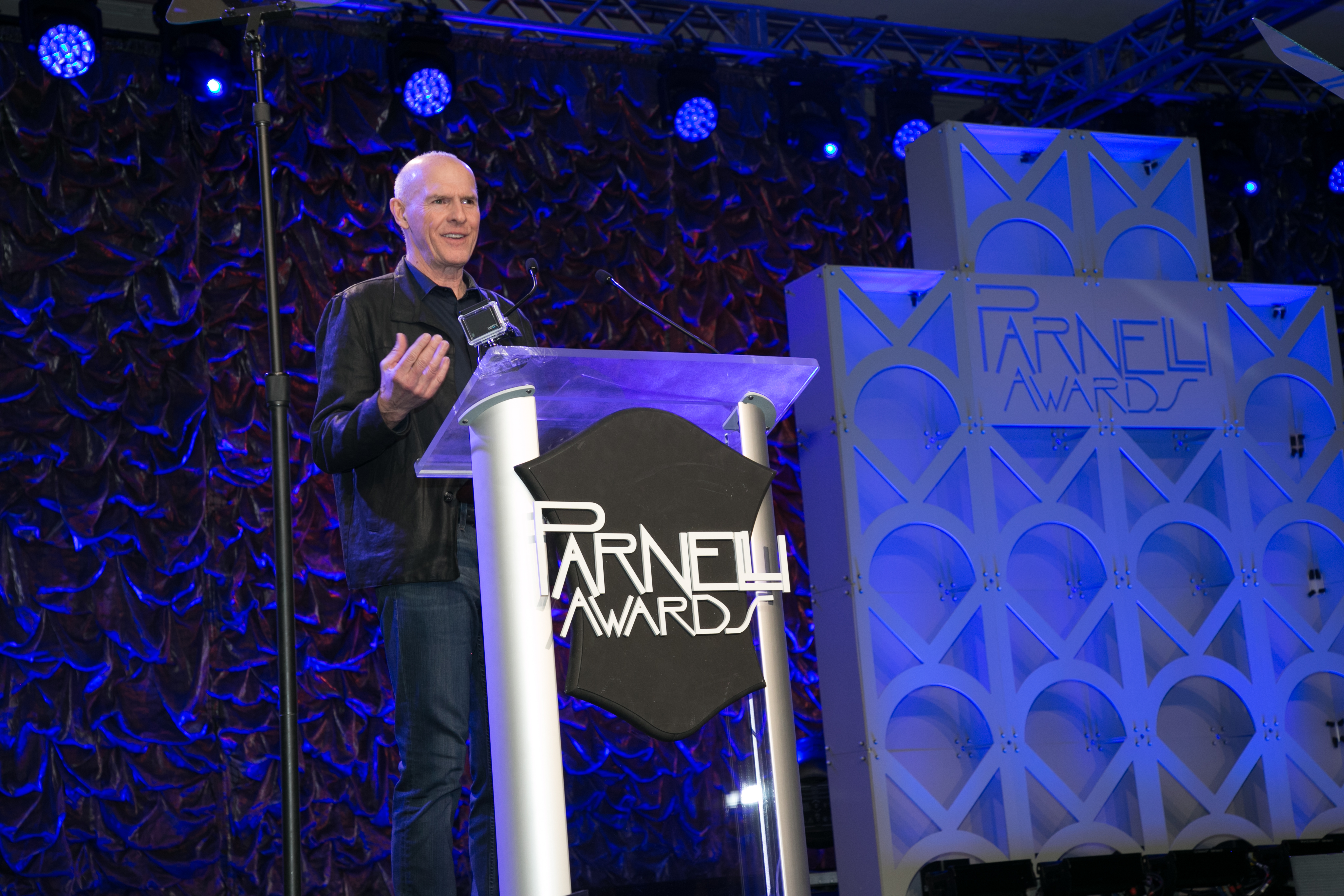
Touring makes the appeal easy to understand. Every additional city brings another arrival, another setup and another departure. Repeating those operations gives a small improvement many opportunities to matter. Warped Tour founder Kevin Lyman became an important connection in Miron’s career and later presented his Parnelli Visionary Award. A tour’s public identity belongs to its performers; the equipment underneath it has a demanding itinerary of its own.
Miron’s ambition also extended beyond the stage itself. In a 2019 podcast conversation, he discussed temporary buildings as a further market. It was a recognizably related question: what else could be designed to arrive, unfold and serve its purpose? Once he had spent years persuading a building to behave like equipment, other structures were bound to look interesting.
The invention stays in Quebec
By 2018, another design problem was taking shape: how the company would continue beyond its founder. Roynat and the Fonds de solidarité FTQ invested alongside an internal succession plan. Seven members of management and Miron’s daughter Marianne, who worked in sales, joined the shareholding group.
American buyers had been interested. Miron wanted the company to remain in Quebec, where the expertise had been accumulated. He helped finance his managers’ participation over five years. Keeping a business local required a way for the people already running it to become owners. Affection for a place had to survive the arithmetic.
He also wanted more time for technological development while the other shareholders took on more of the daily operation. It is an appealingly specific answer to the founder’s succession question: make room for colleagues, and make room for the work that first interested you.
His priorities had a geographical consistency. The stages could go abroad while the accumulated knowledge stayed close to the people who had developed it. Exporting a piece of equipment and selling the organization that makes it are different decisions. Miron was willing to pursue the first without treating the second as inevitable. The management investment gave that preference a practical form.
In 2022, he acknowledged an earlier mistake: he had shown the equipment before seeking a broad patent for the concept. He also said money had never been his determining motivation. Those recollections give the business story some texture. The founder could describe an error without treating it as a catastrophe, and could value the enterprise without reducing its purpose to a sale price.
A handover, years in the making
A further ownership transaction, described in September 2024, involved BDG & Partners, the Fonds de solidarité FTQ, management and Miron himself. Continuity was part of the stated search for a partner. Ownership and leadership were being arranged through a sequence of decisions, rather than left for one dramatic final announcement.
At the end of 2024, Miron formally handed over company leadership after 37 years. That date matters. The career now belongs to Stageline’s founder and former CEO, whose succession planning had been publicly visible for years. The work of stepping aside had its own long development period.
The sequence lends a different shape to his story. Early on, he was paying to develop a machine that would let a crew repeat a difficult task more reliably. Later, he was helping colleagues buy into a business so its work could continue with different people in charge. In each case, the arrangement had to function after the initial act of persuasion was over.
- 1984First prototype
- 1987Stageline founded
- 2018Management joins ownership
- 2024Leadership handed over
In October 2025, Event Safety Alliance Canada recognized him with its Excellence in Safety Award. The honour followed his 2019 Parnelli Visionary Award, bringing attention again to the concern that had accompanied the original equipment. “Safety is non-negotiable,” he said. By then, Stageline reported more than 30,000 annual events using its stages, with equipment in over 50 countries.
There is something quietly funny about a former guitarist devoting so much of his working life to what goes beneath the guitarist. Miron stayed close to the music while changing the conditions in which it could happen. His early wish was to make the job easier. The roof, the road and eventually the handover all received the same sustained attention. Then the performers could get on with it.
More from Miron’s world
Hear him talk, see the equipment, and follow the company he founded.
Watch: the NAMM oral history ↗Watch: the 2019 Parnelli tribute ↗Listen: Geezers of Gear, episode 50 ↗Explore Stageline ↗Stageline on YouTube ↗Stageline on LinkedIn ↗The 2025 award announcement ↗Read: the Quebec succession decision ↗