At 2 a.m. before an outdoor concert, nobody is asking whether the stage has a compelling origin story. They want to know if the roof is secure, whether the lighting load matches the engineer's drawing and how fast the crew can get out if the wind turns rude. Stageline built a company around that unromantic hour. Its product is the thing underneath the thing people paid to see.
Founded in 1987 in L'Assomption, Quebec, Stageline designs and manufactures hydraulic mobile stages: road trailers that unfold into covered performance structures with integrated decks, roofs and rigging. It sells units, rents them, trains technicians, supplies engineering documents and parts, and supports projects in the field. The range now stretches from compact community stages to the SAM750, a 70-by-56-foot platform rated for 152,000 pounds of rigging. The company specifies a 12-person, 16-hour assembly for that giant. In the strange arithmetic of major events, that counts as fast.
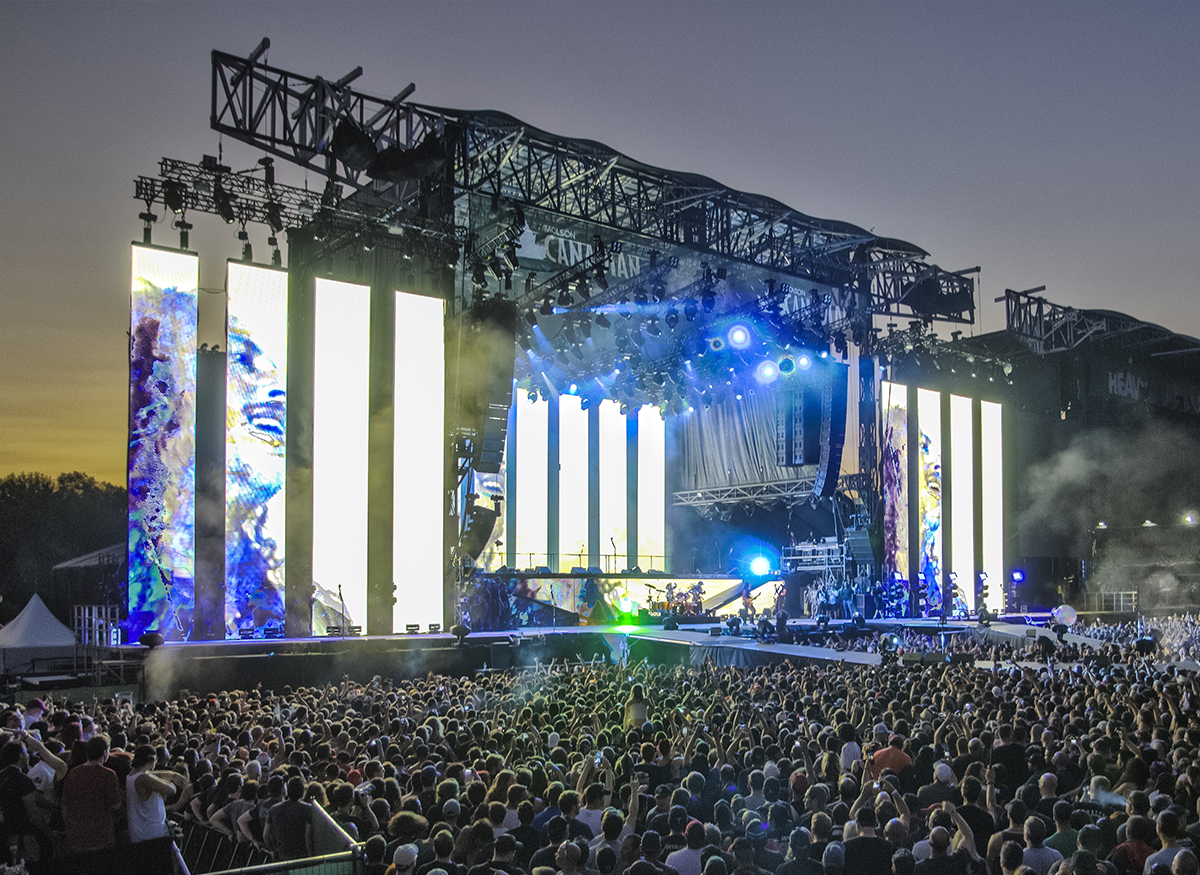
Stageline says its equipment works more than 30,000 events each year in over 50 countries. Its customers are the people who make public gatherings physically possible: production and rental companies, municipalities, promoters, sports organizations, brands and corporate-event teams. The audience may see Delta's centennial party in a stadium or a city concert in a park. The buyer sees trucking, permits, labor, rigging capacity, weather procedures and a hard deadline.
The product is compressed coordination
A conventional outdoor stage can be a temporary construction project assembled from separate systems: floor, roof, truss, ballast, stairs and loading areas. Each piece adds a crew, a handoff or a chance for the schedule to wobble. Stageline's original move was to integrate those jobs into one engineered machine that travels on public roads. Hydraulics lift and unfold the structure; built-in components reduce loose inventory; stamped drawings and model-specific load tables make the safety conversation repeatable.
That distinction matters. A mobile stage is not merely a faster platform. It is a productized workflow. The factory absorbs complexity once so the customer does not rebuild the same argument at every site. Stageline manufactures, assembles and load-tests equipment before delivery. It trains operators and provides structural and rigging information. In Canada and the United States, it handles the thicket of road and building-code documentation. The visible stage is steel and aluminum. The less visible sale is certainty.
The old workflow, folded
The catalog is a ladder. SL stages serve community programs, brand activations and mid-size concerts. The SAM450, SAM575 and SAM750 move into large productions. Promobile and Mobile Space turn the roadable structure into hospitality, exhibition or marketing real estate. HyTower, front-of-house units and the newer HyRig support the equipment around the performance. The ST100 and SP100 carry LED screens instead of performers. Stageline began offering those screen trailers for rental as well as sale in 2026.
The product names contain a little shop-floor mischief. SL means Stageline. SAM was a nod to Uncle Sam when the Quebec company aimed at the American festival market. Inside the business, it also became Scène à Miron, for founder Yvan Miron, and Scène à Marius, for longtime technical director Marius Chouinard. It is rare for industrial equipment to carry three origin stories and still fit on a mudflap.
What failed first
The clearest answer comes from a customer, not a brand manifesto. Infinite Event Services in Alberta had built a broad rental business, but larger outdoor jobs exposed the limits of ground-built stages. They were slow and labor-intensive. Bad weather invited doubt. The finished result did not always look as polished as clients expected. The company did not leap directly to Stageline's largest product. It bought SL50 and SL75 units for the awkward middle of the market: events too demanding for a basic platform but too small for a stadium machine.
That changed what Infinite could bid on. CEO Sheldon Fingler called the stages a turning point because they opened work the company could not previously service. The lesson is not “buy an expensive trailer.” It is to find the operational bottleneck that prevents customers from moving upmarket, then build the smallest credible bridge across it. Stageline's lineup lets an operator start with a compact unit, prove demand and add capacity. The manufacturer says a third of annual business comes from owners adding another stage to their fleets - industrial expansion revenue, with axles.
| Buyer problem | Stageline answer | Trade-off |
|---|---|---|
| Long, crew-heavy builds | Pre-assembled hydraulic deployment | Higher upfront capital |
| Changing weather | Engineered ratings and procedures | Configuration limits still matter |
| Scattered suppliers | Integrated deck, roof and rigging | Standard geometry |
| One-off demand | Rental fleet and owner network | Availability and freight |
What it costs - and what the price buys
Stageline sells by quote, so there is no tidy menu. Public procurement records provide useful snapshots. A July 2024 quote to Williams County Parks in North Dakota priced an SL75 at US$90,000 before options and services, and US$121,350 all-in before tax. A 2026 municipal proposal in Missouri listed a refurbished SL250 package at US$150,000. On the rental side, one Texas operator advertises an SL260 from US$6,500 for the first event day, plus delivery and extras. None is a universal rate. They are evidence of the decision range: rent for occasional use, buy when utilization can carry the machine.
The ownership pitch rests on durability, residual value and repeat bookings. Stageline says regularly maintained units can last more than 25 years and retain 50 to 75 percent of their value after a decade. Those are the manufacturer's claims, but they reveal how the sale is framed: not as scenery, which is consumed, but as production equipment with a secondary market. Training, inspection and maintenance are part of the economic product because idle hardware earns nothing.
This is also why the rental operation matters. Stageline says its own fleet and network of owners provide broad North American coverage. Rentals let buyers access a larger model for a peak job, test demand before purchasing or avoid owning a machine that would sit through the off-season. Sales seed the network; the network makes the brand easier to specify; familiar specifications make the next sale less frightening. That flywheel is less glamorous than a festival poster and much harder for a new factory to copy.
The moat lives around the trailer
Direct alternatives include APEX, Mega Stage, Century Industries, StageRight, Wenger and other mobile-stage makers. A buyer can also assemble a conventional stage or hand the entire job to a local rental company. Stageline differentiates through a stack rather than one magical component: a wide size range, engineering documentation, road compliance, training, parts, maintenance, used-equipment support and a deep installed network. Product feedback travels back from technicians and producers into the next model.
The SAM575 is a neat example. Stageline has said customer discussions shaped its rigging capacity and wind protection. That is the industrial version of watching session replays: send the product into ugly real conditions, listen to the operator, then alter the structure. In January 2025, Stageline bought Scène Éthique, a Quebec specialist in custom scenic structures and mechanized welded equipment. The deal expands the standardized mobile-stage company into more bespoke infrastructure without abandoning its core skills in design, engineering and fabrication.
The adjacent move into LED is equally legible. Outdoor screens need road transport, structural support, hydraulics, wind thinking and fast deployment. Stageline already had those muscles. The ST100 arrived in 2022, followed by the SP100 and HyRig in 2024. In May 2026, the line helped the company win A/V Supplier of the Year at the Canadian Live Music Awards. A good adjacency keeps the customer and the hard-earned capability while changing the payload.
A heavy product with a lighter argument
A company welding 75-ton stages cannot credibly pretend to be weightless. Stageline instead argues relative impact and longevity. It says its mobile format can use at least 50 percent less transport fuel and 80 percent less setup machinery and labor than conventional equipment. It describes its stages as 75 percent recyclable. Its L'Assomption campus includes a LEED-certified industrial building reported to consume 69 percent less energy than a comparable code-compliant facility.
There is useful texture behind that building. Lise Morissat, then vice-president of strategic development, said her children persuaded her to build green. The process felt like returning to school. That is more believable than corporate sainthood: a family nudge, a difficult build and measurable energy use. Long equipment life may be the stronger environmental argument anyway. The greenest festival structure is not necessarily the newest one. It may be the maintained trailer still earning rentals in year 20.
When the shortcut is the wrong road
The model has boundaries. A tiny event with two bookings a year cannot make a six-figure purchase behave. A site without safe truck access cancels the mobile advantage. Extremely bespoke scenic designs may still favor a custom ground build. Wind ratings are not permission to ignore forecasts: walls, banners, rigging loads, anchoring, leveling and operating procedures can change what a structure can safely withstand. And a hydraulic stage without trained operators, inspections and maintenance is merely complicated machinery parked near a crowd.
Stageline works best when the problem repeats: similar events, hard deadlines, outdoor exposure, meaningful rigging loads and enough utilization to reward speed. Its story is not that every stage should become a trailer. It is that a messy service can become an enduring product when the maker understands every ugly handoff. The concert begins when the lights come up. Stageline's business begins much earlier, when a truck backs into an empty field and somebody checks the wind.
Keep exploring
See the equipment unfold, hear the operator stories and inspect the technical details directly.