A room can be full and a message can still go missing. People arrive, the lights come up, the presentation runs beautifully. Then Monday arrives with its own agenda. For Jacque Patterson, the interesting question lives in that interval: what carries from a gathering into the work people do together afterward?
It is a useful question for the CEO of August Jackson, a Chicago-based creative agency working in events and communications. It also offers a way of reading her career. Patterson came to the top job through employee engagement, organizational change and client relationships. Her professional history includes the less photogenic business of helping organizations function. An event gives that work a stage; the stage alone cannot finish it.
Consider the contrast in the job itself. An agency can plan a conference down to its last cue. Leading the agency means dealing with people whose questions, ambitions and judgments cannot be put on a production schedule. Patterson has worked on both sides of that problem: advising clients about their organizations and taking responsibility for the organization giving the advice.
The assignment before the title
When Patterson joined August Jackson in March 2019, she had a defined brief. As executive vice president, she would help expand its employee engagement practice. She would also direct internal people and culture efforts. The job linked the service the agency sold with the working environment it needed to provide for its own employees.
That was a consequential moment to arrive. August Jackson reported that its revenue and staff had both doubled over the preceding three years. Growth gives an agency more opportunities, and more relationships to manage. A larger team needs ways to work together that do not depend on everyone knowing everyone else. Patterson's appointment addressed the people side of that expansion.
She brought a 25-year career, as described at the time, including human resources work at Jack Morton Worldwide, Omnicom and ACT. More recently, she had worked independently and at Slalom Consulting, guiding organizations through changes in design, culture and behavior. These are assignments in which the announcement of a new direction is merely the beginning. Someone must work out how the direction changes an ordinary day.
The two parts of her August Jackson brief made a revealing pair. Clients needed engaged employees; the agency needed to develop its own talent as it grew. The same executive was asked to pay attention to both. It is easy to promise an audience a sense of purpose. It becomes a more demanding proposition when the audience includes your colleagues.
A succession with someone to thank
On January 23, 2025, August Jackson announced that Patterson, then chief client officer, would become CEO immediately. Laura Shuler, CEO since 2016, would retire at the end of February. Patterson had spent the preceding six years as an executive on the client team, working closely with Shuler on the agency's culture and capabilities.
The handover mattered to Patterson personally. In her announcement remarks, she described Shuler's example as an inspiration to women and working mothers, including herself. She also singled out the standard Shuler had established, “with trust at the center of everything.” That detail gives the transition a human scale. Before there was a succession announcement, there was a working relationship.
Her client experience ranged across organizations including Grant Thornton, Yale, Duke University and DXC Technology. The roster crosses professional services, education and technology. These organizations have different audiences and different reasons to gather. The common assignment is to help people understand something together and carry that understanding into their own work.
Taking over after a valued leader presents a particular challenge. The new CEO must decide what deserves continuity and what needs her own judgment. Gratitude can acknowledge the foundation without supplying the next set of decisions. Patterson's subsequent account of her first year makes clear that preparation and experience did not remove the need to learn the job by doing it.
A little room for a diva
By December 2025, Patterson was writing candidly about that learning. She described a planned succession into a strong business and culture, then examined the adjustments the role required. She was moving attention away from tasks and toward strategic questions, making room to think and learning to let capable colleagues take responsibility.
Her funniest admission concerned the practicalities of authority. She had caught herself apologetically describing requests about calendars, travel and email as a little diva-like. The joke lands because the needs are so ordinary. Nobody is demanding a dressing room full of orchids. The person responsible for the business is trying to get her calendar arranged.
There is a recognizable tension here between being considerate and stating what a role requires. A request can be necessary even when making it feels awkward. Patterson's willingness to describe that awkwardness gives her reflection texture. The title changes immediately; the habits of the person holding it take longer to adjust.
“I don't mean to be a diva, but …”
Jacque Patterson, reflecting on her first year as CEO
A vision that can survive Monday
Patterson's writing about organizational vision offers a practical companion to her career. In her account of what August Jackson calls vision architecture, a statement gains usefulness when it connects ambition to goals, group identity and everyday conduct. The employee needs a way to act on the idea.
Her approach asks what the organization is trying to accomplish, how its work advances that purpose, who the people doing it are, and which behaviors support their shared effort. The result is meant to be usable inside a working culture. A value has to become something colleagues can practice.
There is an appealingly domestic test for grand corporate language: can anyone use it before lunch? An aspiration can sound elegant in a meeting while leaving a team uncertain about its next decision. Patterson's framework draws attention to that gap. It asks for connections between what people hear and what they do.
An editorial diagram of Patterson's vision architecture approach.
The people who return
A career in agencies produces a network of former colleagues. Patterson's appointments have given some of those relationships a second chapter. In July 2025, Lindsay Grinstead joined August Jackson as executive vice president of growth, with responsibility for a major client relationship and the agency's marketing and growth efforts.
Patterson and Grinstead had first worked together at Jack Morton in San Francisco more than 20 years earlier. In welcoming her, Patterson described a relationship maintained across their subsequent careers. They had continued to cheer each other on. The appointment put that long acquaintance back inside a shared business.
In March 2026, Grinstead became chief client officer as part of a broader leadership restructuring. Mike Sinsheimer became chief operating officer, and Annie Ishola became chief creative officer, overseeing an integrated creative and design department. The arrangement brought growth and client service, operations, and creative work into a clearly defined executive structure.
Patterson framed those changes around empowering people already experienced in their areas. The aim was to make the agency responsive while preserving the attention clients expected. It was a concrete organizational decision: who owns which work, and how those responsibilities meet. A leadership philosophy becomes easier to assess once names and jobs are attached to it.
Another reunion followed in June 2026, when Christopher Laue became chief innovation officer. Patterson had worked with him earlier in her career. His remit included new areas of business, innovation practices and mentoring talent. His appointment followed work with August Jackson on HPE Discover Las Vegas 2026, bringing recent collaboration as well as an established relationship into the decision.
A conversation beyond the office
By July, Patterson was taking part in a different kind of gathering. August Jackson and MAKERS brought leaders from sports, business, marketing and communications to Soho House Chicago during WNBA All-Star Week. Patterson spoke alongside Alicia Hatch, Deloitte's U.S. sports chief commercial officer and women's sports leader. Chicago Sky co-owner Nadia Rawlinson welcomed the group.
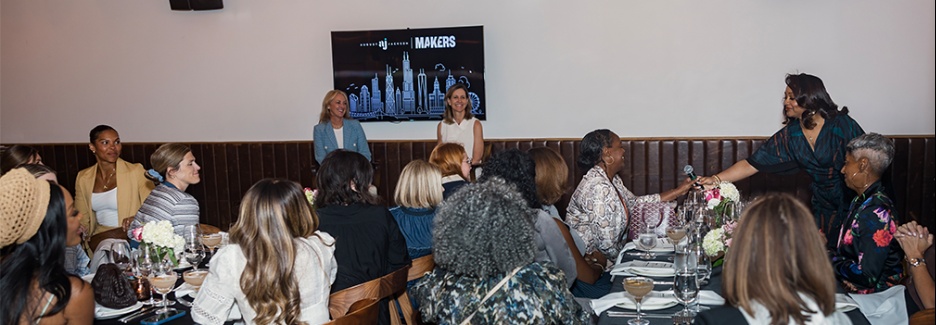
The conversation explored the growth of women's sports and the opportunities it presents for brands. It also addressed trust, personal stories and the support that can change a career. That last subject has a clear place in Patterson's own account of leadership: she has publicly credited a mentor and welcomed colleagues whose work she knew from earlier chapters.
A salon is a useful setting for such questions. The scale permits conversation, and the subject reaches beyond one company's agenda. For an executive whose work includes bringing audiences together, participating in the discussion also puts her inside the kind of shared experience her agency creates. Here she was one of the people contributing to the room.
The next day's work
The story of Patterson's leadership so far is visible in these choices: a people-and-culture brief, years of client work, a succession shaped by mentorship, and a set of appointments that distribute responsibility. Her career gives her experience with the organizational work that continues after a message has been delivered. As CEO, she has the opportunity to apply that experience at home.
The appointments do not supply a verdict on the future. They show how she is organizing for it. There are people responsible for client relationships, production, creative work and innovation. There is a CEO who has described learning to make room for strategic thought and for other people's decisions. The work is specific enough to watch.
That brings us back to the room and the morning afterward. An audience can applaud a vision; colleagues have to make decisions with it. Patterson's professional interests keep those two moments in view. The event ends on schedule. The people go back to work, and the idea gets its next chance to prove useful.