The ordinary conference begins with a date. Someone secures a hotel, orders a stage and starts calling speakers. Richard Attias & Associates begins somewhere else: with the absence in the room. Which people are not talking to one another? What idea has no credible place to live? What does a government, company or institution want the world to believe - and what would make that belief useful?
This is why calling RA&A an events company feels like calling a restaurant a plate company. The New York firm certainly produces events. It also shapes the argument, recruits the network, handles the television logic, choreographs the private encounters and manages the machinery nobody is supposed to notice. Its current offer spans consulting, live experiences, digital, hospitality, sports and AI. The finished object might be a summit, a ceremony, an exhibition or a recurring institution. The underlying product is convening power.
A summit is a machine for making proximity
Richard Attias founded the company in 2008 after a career that ran from civil engineering and IBM to Publicis Events and the World Economic Forum's annual meeting. That biography explains the blend. RA&A thinks like an engineer about delivery, like an editor about content and like a diplomat about access. Its customers are governments, sovereign institutions, large companies, NGOs and leaders with an objective too complicated for an advertising campaign and too public for a private memo.
Consider the 2016 Argentina Business & Investment Forum. The assignment was not simply to fill seats in Buenos Aires. It was to give a government returning to international capital markets a credible place to meet investors. The event reported 4,200 delegates from 68 countries, including 1,000 chief executives, and associated itself with $30 billion in investments. A number like that should not be read as a clean causal claim - investment decisions do not spring from lanyards - but it shows the intended unit of value. RA&A wants to be judged on what the room unlocks.
The RA&A platform loop
That last step separates RA&A from a production vendor. The Future Investment Initiative began in Riyadh in 2017 and became a recurring global platform. The New York Forum produced an Africa edition. Fashion Futures moved among Riyadh, Paris and New York. Repetition creates memory, rituals and a network that is easier to reconvene next time. The client is not merely buying a show. It is buying the beginnings of an institution.
The pandemic broke the format, not the premise
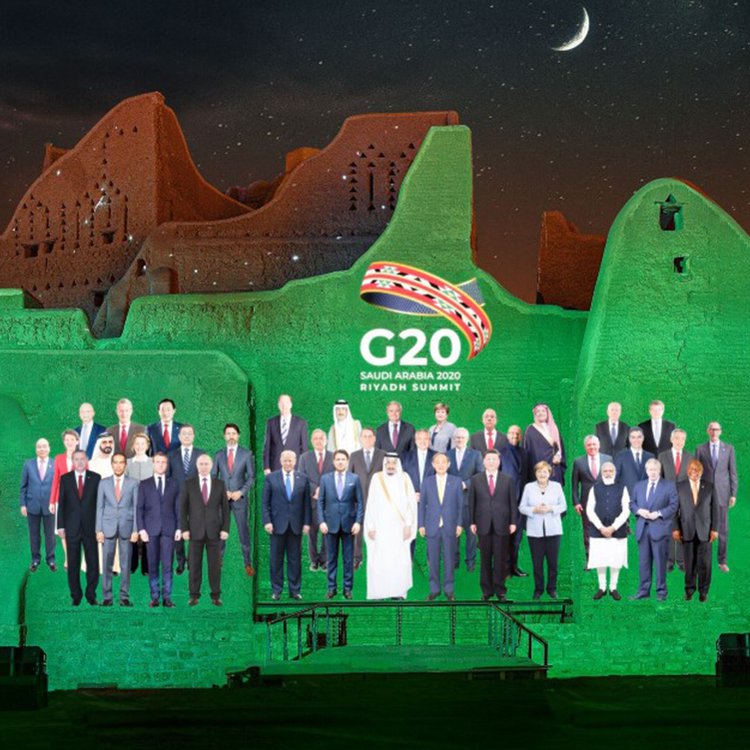
In 2020, the first thing to fail was the default assumption that influence required a shared physical room. Saudi Arabia held the G20 presidency just as borders closed. RA&A helped execute 50 physical meetings, 150 virtual meetings and the first fully virtual G20 World Leaders' Summit. A year later, it used extended-reality production for a live, multi-hub edition of FII. The company did not decide that software had replaced gatherings. It decided that the room could become a broadcast system and still preserve some of its hierarchy, ceremony and urgency.
The change is visible in later work. Sync, a digital-wellbeing summit organized with Ithra in 2022, reported more than 9,000 registered delegates, 39,000 livestream viewers and 15 million online engagements. Those are several audiences, not one: the people in the hall, the people watching and the people encountering fragments later. RA&A's task expanded from producing a moment to managing its distribution.
“We need always to be here to have conversations, even if you don't agree with your counterparts.”Richard Attias, speaking to TIME in 2024
The reputational load arrives before the trucks
There is an obvious complication in building rooms for power: the room inherits the politics of its host. The 2018 Future Investment Initiative faced withdrawals after the murder of journalist Jamal Khashoggi. The stage could still run - Attias later said more than 4,000 delegates attended - but the reputational layer had fractured first. Sponsors, speakers and media organizations can reconsider faster than production teams can rebuild an agenda.
RA&A's position is that conversation should continue even across disagreement. That is a business conviction as well as a philosophical one. It also marks the condition under which this model is least portable. A convening platform struggles when invitees see attendance itself as endorsement, when the host cannot tolerate unscripted disagreement, or when there is no plausible action after the photographs. Access can assemble a room; it cannot manufacture trust on command.
What the invoice does not reveal
RA&A publishes no rate card, and public contract values for its bespoke engagements are scarce. That is unsurprising: a summit may combine months of advisory work, research, speaker recruitment, broadcast technology, security, hospitality and production across several countries. The honest price is “privately negotiated,” not a fictional per-attendee estimate.
A consultancy with a control room
The competitive set changes depending on which part of the work you notice. Freeman, George P. Johnson and Jack Morton can deliver large experiences. Teneo, APCO and Brunswick advise leaders through political and reputational problems. The World Economic Forum and Milken Institute own influential convening brands. RA&A sits in the seam among them. Its pitch is that strategy, content, invitation, spectacle and execution improve when they are designed together.
Its footprint mirrors that proposition: New York, Paris, Riyadh, Manama, Abu Dhabi, Dubai and Dakar. LinkedIn places the private company in the 51-to-200-employee band. Sanabil Investments, an arm of Saudi Arabia's Public Investment Fund, owns roughly 75 percent according to Attias, with the founder holding the rest. The ownership makes RA&A's Gulf depth legible, while its portfolio ranges from the Bloomberg New Economy Forum and One Planet Summit to the African Games and the Red Sea International Film Festival.
WPP saw the appeal early, buying 30 percent in 2013 and eventually holding 49 percent before selling its stake back to existing shareholders in 2019 as the advertising group simplified its portfolio. In 2025, RA&A began preparing for a possible Saudi stock-market listing and worked with banks including Evercore. By June 2026, Attias was saying he was in no rush. Conditions in the Gulf events sector and public markets had become less hospitable. For a company that sells timing, postponement was not necessarily defeat. It was timing applied inward.
The part anyone can copy
Very few readers can summon heads of state or build a television studio in a desert. The transferable lesson is smaller. Start a gathering with a sharp question, not a date. Invite people who can alter the answer, not merely decorate the program. Design the informal collisions as carefully as the speeches. Publish an artifact - a report, pledge, investment pipeline or working group - that survives the closing music. Then decide whether the idea deserves a second edition.
This works when the organizer has a genuine thesis, the participants have agency and somebody owns the follow-through. It works poorly when the audience is ornamental, the conclusions are predetermined or the spectacle grows larger than the purpose. Scale is not the magic ingredient. BRIDGE's inaugural Abu Dhabi edition in 2025 reported 40,000 attendees, 400 speakers and 182 countries, but the more instructive detail came before opening day: curated roadshows and meetings in cities including New York, Washington, London, Dubai and Osaka. The large room was assembled through many small ones.
That is the trick RA&A has spent nearly two decades refining. A summit appears to last two days. Properly built, it starts months earlier, continues for years and leaves behind a network with a reason to return.