A business can be ready for sale long before its owner is ready to sell. Luc Pinard has spent years addressing the awkward space between those two dates. In 2015, his advice to prospective buyers was to allow time, exercise tact and move at the seller's pace. Then came the explanation, in a short French phrase: C’est son bébé qu’il cède.
The owner is handing over their baby.
That is an unusually domestic image for the business of development capital. It also explains much of Pinard's public work as president and chief executive officer of Fonds régionaux de solidarité FTQ. Buying an established company means taking responsibility for something another person built. A valuation can assign a price to the shares. It cannot persuade the founder that Tuesday morning will be tolerable without the office keys.
Based in Magog, Quebec, Pinard leads a financing network whose work reaches across the province. His recurring subject is the next owner: how to prepare them, how to finance them and how to help a company remain part of its region when the names on the ownership documents change. There is money in this story, naturally. There is also a considerable amount of waiting.
The baby and the balance sheet
Pinard's 2015 comments paired patience with a warning about debt. Paying for the acquisition should leave room for the company to grow afterward. The buyer needs a future as well as a purchase agreement. His argument placed two different constraints side by side: the emotional pace of the seller and the financial capacity of the business.
By 2019, the same thinking was visible in the transfer of Laval printer L'Empreinte. The regional fund became a shareholder as Jean-Pierre Rose succeeded founder François Chartrand as president. Rose described export growth and diversification as uses for the new capital. Pinard emphasized an orderly, well-planned transfer and urged both sides to allow the time needed to complete it.
It is a revealing emphasis. The sale was accompanied by a growth plan, rather than treated as the company's final achievement. In Pinard's account, a handover earns its value through what follows: an enterprise able to continue, employees with a future there and new owners with enough room to make decisions of their own.
“C’est son bébé qu’il cède.”
Luc Pinard, 2015
A medal for taking over
On June 8, 2022, Pinard attended the gala for Les Médaillés de la relève and presented the silver entrepreneurial succession award to the buyers of Microbrasserie Pit Caribou. Jean-François Nellis and Vincent Coderre had joined forces to take over the Gaspésie brewery. He praised their complementary strengths and the way they preserved the company's character while promoting its products and region.
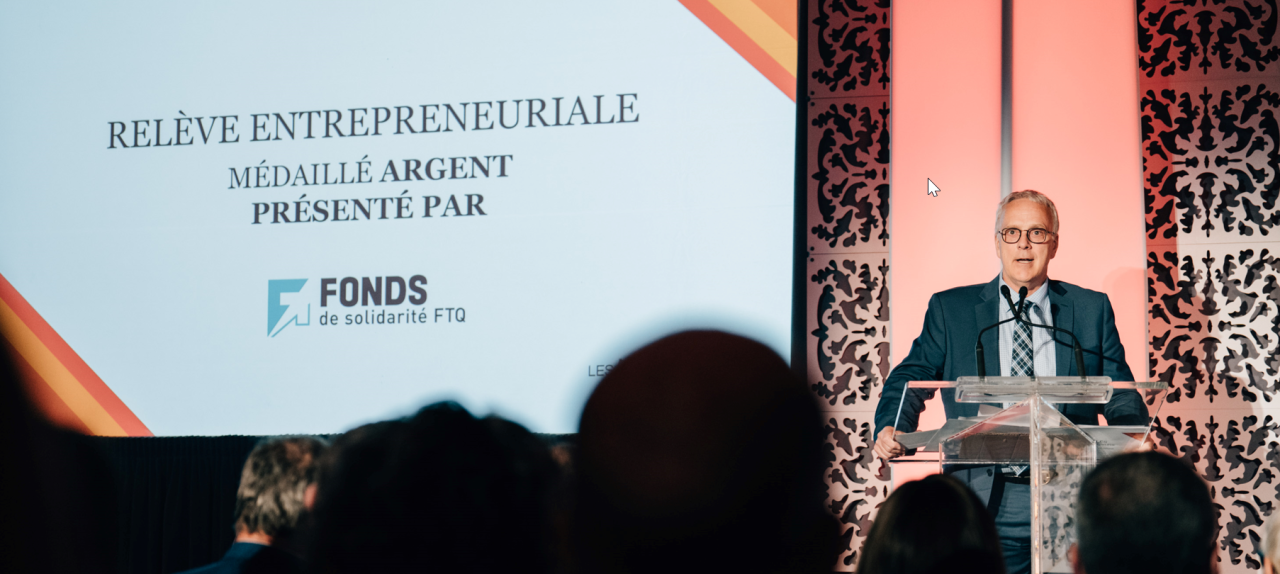
Three award winners that evening were partners of the regional or local fund networks. Alongside Pit Caribou were mining exploration consultancy Technominex, in Rouyn-Noranda, and dock systems business Multi Online Distribution, in Saint-Jérôme. The selection makes a useful miniature of his world: beer, mineral exploration and docks, linked by the problem of who takes over.
Succession rarely enjoys the romance attached to founding a business. The gala gave it a stage, a lectern and medals. Pinard's own account lingered on the buyers' effort and the sellers' preparation. The brewery supplied an agreeable illustration: keeping a company's identity need not prevent someone new from running it.
Local knowledge, distributed
Pinard was already speaking as the regional network's CEO in June 2013, when it reported a portfolio of 350 partner companies. That announcement described a new partner arriving roughly every week. The work covered businesses across Quebec, making familiarity with individual places part of the operating problem.
In 2014, discussing the Côte-Nord, he pointed out that the employees and regional board members came from the region. The investments included hospitality businesses such as Motels de l'Énergie, at the foot of the Manic-5 dam, and the Château Arnaud development in Sept-Îles. Geography appeared in the choices of projects and in the people evaluating them.
His model joins province-wide resources to regional judgement. A team that understands a particular area can place a company's plans in context; a network can bring capital and other expertise to the table. Pinard repeatedly credits those teams. His presidential message describes the funds as partners who understand both a region and the industries working in it.
Two networks, one practical connection
In April 2015, Pinard was also president of Fonds locaux de solidarité FTQ when he announced Éric Desaulniers as its new director general. Desaulniers succeeded Jean-René Laforest, who had led the organization since its creation in 1991. Pinard highlighted the incoming director's experience within the network and understanding of municipal affairs.
The connection between local and regional funds was deliberate. The Fonds's 2015 annual report described giving Pinard the local fund presidency to encourage closer cooperation between the two investment networks. They remained distinct, with the aim of responding more effectively to businesses across Quebec.
This is the administrative side of proximity: organizations have to know how to work together before an entrepreneur can benefit from their combined reach. Pinard's role connected two levels of economic development. The structure matters because the company arriving with a project has its own timetable, ambitions and financing needs. Institutional boundaries are unlikely to be its favourite subject.
The numbers grew. The question stayed.
The regional network crossed $1 billion in cumulative unsecured capital invested during its 2019-2020 financial year. That year's investment reached $146 million across 137 companies. Pinard was leading an organization able to work on a larger financial scale, while continuing to address the ownership questions of smaller businesses.
In a 2020 interview, he described a typical supported company as having 25 to 50 employees and annual sales of $10 million to $15 million. He also expected ownership transfers to account for 40 to 50 percent of interventions in the following years. Those were descriptions and expectations at that date, and they locate the sort of business occupying his attention.
The next chapter made succession increasingly prominent. In 2024-2025, the funds invested $232 million overall, with $119 million supporting the succession of 70 SMEs. Pinard again emphasized assistance for the people involved alongside financial backing. The public language remained remarkably consistent as the investment totals increased.
Annual investments, selected years
Canadian dollars. Organization-wide annual totals, rather than Pinard's personal investments. Selected reporting years; gaps are intentional.
Keeping the people in the picture
In November 2021, Pinard discussed another reason to acquire a company: its employees. He expected more buyers to pursue businesses for their workforce, with human capital gaining weight relative to equipment. The people who know how to do the work can be central to the acquisition itself.
There is a connection between that observation and his advice about sellers. Both give people a place in a transaction that could otherwise be described entirely through assets, borrowing and ownership percentages. A business changes hands with experience still inside it. Keeping that experience useful becomes part of what the transfer is meant to accomplish.
His leadership appointments show a related attention to local relationships. When David Lord became a regional vice-president in June 2020, Pinard stressed his ties to the Bas-Saint-Laurent and Gaspésie business communities. Earlier that year, announcing Frédéric Bernard's appointment for Quebec and Chaudière-Appalaches, he thanked outgoing leader Jean Roy for leaving an experienced team firmly established in those regions.
Advice has an address
Pinard joined the Centre de transfert d'entreprise du Québec board in February 2025, alongside Jean-Philippe Ménard and Yvon Roy. The appointment brought his strategic management and business transfer experience into an organization dedicated to matching and supporting sellers and buyers. He publicly welcomed the shared mission of keeping Quebec businesses going.
By June 2026, the organization, now Repreneuriat Québec, named him among its departing directors. It welcomed new board members including Amélie Craig, vice-president for strategy and business solutions at the regional funds. His board service was a chapter in that relationship; the funds' wider collaboration with the succession organization continued to appear in their work.
The relationship extends beyond boardrooms. A regional tour with the École d'Entrepreneurship de Beauce brought buyers and sellers together to discuss the financial and human aspects of transfers. By May 2026, nearly 230 participants had attended events in nine regions since autumn 2024. The format placed advice near the businesses expected to use it.
The day after the signatures
The funds also partnered with EntreChefs PME's seven regional forums in autumn 2025. The meetings explored practical innovation through business testimony and workshops. New clubs for business buyers launched at the Montreal forum. The premise was straightforward: a new owner still needs peers, experience and guidance after the transaction.
Examples discussed during that tour included automated production at container-chassis maker Max-Atlas and changes in management, products and packaging at Chocolaterie des pères. Pinard's argument for supporting innovation includes established industries. A successor inherits a business with a history, then has to decide how it should operate in the conditions ahead.
For 2025-2026, his network reported $241 million invested in 172 Quebec SMEs and support for 91 business transfers. More than half of the capital went to succession. Pinard described the human dimension as critical to a successful handover. The scale had changed considerably; his attention still returned to the people doing the handing over.
That is the question running through his public career: how does an enterprise continue when its owner moves on? Pinard's answers involve preparation, regional relationships, capital and time. The medals make for a good photograph. The more demanding result comes afterward, when a new owner turns up for work and the company gets on with its next chapter.
Follow the conversation
- Luc Pinard on LinkedIn
- His account of the 2022 succession gala
- Watch: Un allié ancré dans la région (French)
- Fonds régionaux de solidarité FTQ
- 2025-2026 investment results
- Regional forums and innovation
- Repreneuriat Québec’s June 2026 board announcement
- The 2015 business transfer feature
- Fonds FTQ videos on YouTube