Janie Béïque could have cinema and mining on her desk in the same day. She has described that range herself: one investment file concerned a film, another the extraction of resources. The distance between a screenplay and a mine is considerable. Both, however, need someone willing to ask what an enterprise requires, what could go wrong and whether the money should follow. Her route to the leadership of the Fonds de solidarité FTQ passed through precisely that kind of variety.
She arrived in 2000 as a lawyer. Twenty-one years later, she became the first woman to run the institution. Between those dates, her responsibilities spread across legal affairs, venture capital, industrial investment and strategy. She did not describe the presidency as her original objective. The opportunity grew out of the work, with encouragement from people who thought she could take on more.
A detective story, before the balance sheets
Long before the investment files, there were detective novels. As a young reader, Béïque liked the prospect of solving a puzzle and seeing justice prevail. Her father served as an expert witness, and his accounts of cases fascinated her. Law offered a professional home for those interests. A childhood enthusiasm for finding the answer had acquired procedures, clients and considerably more paperwork.
She earned a law degree at Université de Montréal and was called to the Quebec Bar in 1991. After experience in legal aid, she completed her articling at McCarthy Tétrault. She stayed with the firm and became a partner, working in business and corporate law. The practice involved complex transactions and a changing assortment of files. It was useful preparation for a career that would keep widening its brief.
Moving to the Fonds brought her inside an organization rather than leaving her in the position of an outside adviser. As vice-president of legal affairs and corporate secretary, she had a new view of how an institution makes decisions. The next change would put investment itself within her responsibilities.
A career with several doors
In 2008, Béïque moved into the investment sector. Her senior roles covered the new economy, then natural resources, industries, entertainment and consumer goods. These categories describe very different businesses. They also explain why her career resists a neat description as a specialist’s march through a single market. She stayed at one institution while repeatedly changing the work she did within it.
Joins the Fonds
Changes the brief
Investments
April 1
She added an MBA from Georgetown University and ESADE University in 2015. In 2017, she became chief of investments and strategic investment initiatives, with responsibility for operations and future investment direction. The executive vice-presidency of investments followed in 2018. By the time she succeeded Gaétan Morin on April 1, 2021, she had worked at the Fonds for more than two decades.
Being the first woman in the job gave the appointment a place in the institution’s history. Her long service gave it another meaning: the new CEO knew the organization from several vantage points. She had been involved in the rules around the decisions, the investments themselves and the strategy connecting them.
Recognition arrived at several stages along the way. In 2005, Lexpert named her among its Top 40 Corporate Counsel Under 40. In 2014, she received a ZSA award in the Accomplishment and Business Strategy category. The federal government named her an Innovation Leader in 2016 and again in 2018, asking her to moderate roundtables in Quebec and the Maritimes. In 2022, the Québec MBA Association gave her its MBA Inspiration Award. The sequence follows the changing work: law, business strategy, innovation and management. It also makes clear that her public career had already accumulated several chapters before the CEO appointment introduced her to a wider audience.
The people who saw it first
Béïque’s account of her rise includes other people by name. Hubert Lacroix, whom she knew during her legal career, became a lasting mentor. Raymond Bachand gave her a place on the Fonds’ management committee when she was 33. Morin encouraged her to stretch as her capacity grew. She has credited both women and men with helping her find room to develop.
The relationship with Lacroix endured through changes of role. In a 2024 interview, she said she had started working with him at 19 and still saw him every three months. Over time he had been her boss, colleague, mentor and friend. That is a different timescale from the announcement of a promotion. It suggests how much of a career happens between the dates that appear in a biography.
“Je ne visais pas la présidence quand je suis arrivée dans l’organisation en 2000.”
Janie Béïque, 2021
She had not joined the organization with the presidency in mind.
Her argument for different perspectives is practical. In 2020, she discussed the danger of groupthink in a business: when everyone approaches a problem in the same way, a decision can miss something essential. People with different experiences bring different information. Her case for diversity reaches into the quality of the decision itself, beyond the composition of the photograph afterwards.
Two promises, one pool of savings
The Fonds’ origins help explain the job she inherited. Created in 1983 on the initiative of Quebec’s labour federation, it connects retirement saving with business investment and economic development. Its shareholders are savers. Its capital goes to work in an economy where those savers and their communities also have a stake. The future retirement account and the present working life meet inside the same institution.
That arrangement asks its leader to keep several interests in view. Financial performance matters to someone preparing for retirement. Capital and support matter to a business planning its next stage. The employment consequences matter to workers. These interests can overlap, but each asks its own questions of a proposed investment. Béïque’s public language gives a name to the wider ambition: societal returns.
savings→Quebec
businesses→Financial +
societal returns
At a November 2022 talk in Montreal, she put the Fonds’ continuing role in retirement savings and social and economic development at the centre of her discussion. Her vision included environmental progress as well as financial results. Under her investment leadership, the Fonds’ average investment volume in Quebec over five years doubled. It was a change in the amount of capital put to work.
A hockey player’s way of putting it
For all that institutional vocabulary, Béïque has a less formal way of describing her willingness to act. When she became CEO, she talked about having played hockey and being willing to go into the corners for the puck. The image is familiar to anyone who has watched a game: progress occasionally requires entering the crowded part of the rink.
It fits her description of herself as energetic. It also gives the executive biography a welcome interruption. There is a person behind the sequence of vice-presidencies, someone who can explain resolve without commissioning a diagram. Hockey supplies a compact metaphor; the work supplies the considerably longer test of whether the resolve holds.
The company she keeps
Her interests extend into culture. Béïque once wanted to become an artist, and art remains part of her life. She enjoys cycling and running, and her Labrador, Samy, helps her switch off at home. A dog, one suspects, is a useful audience for an executive: attentive enough, with limited interest in the quarterly presentation.
Her board work includes Groupe CH, the Orchestre symphonique de Montréal and the Chamber of Commerce of Metropolitan Montreal. These commitments put sport, music and the business community within the same public biography. They sit comfortably beside a career whose investment remit once included entertainment. The interests survived the choice of profession.
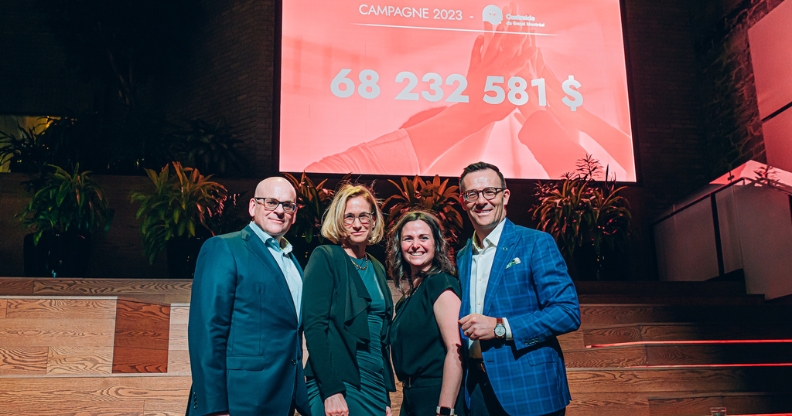
In 2023, she co-chaired Centraide of Greater Montreal’s 50th fundraising campaign with Desjardins president and CEO Guy Cormier. The assignment involved mobilizing a cabinet drawn from business, institutional and union leadership, and encouraging fundraising in workplaces. It brought the networks around two financial institutions into a community campaign.
In February 2024, Centraide announced C$68.2 million raised. The funds were intended to support 375 community agencies and projects in Montreal, Laval and the South Shore. Béïque thanked the people who organized fundraising activities and the wider business community that joined in. The result belonged to a large effort, with the co-chairs helping bring its participants together.
The numbers have neighbours
The scale of her current responsibility is visible in the Fonds’ May 31, 2026 results: C$23.7 billion in net assets and more than 828,000 shareholders. During fiscal 2025-2026, the Fonds and its regional, local and real estate network invested C$1.9 billion in Quebec’s economy. Those are institutional figures. They describe the resources and obligations attached to her role.
in Quebec, 2025-2026
The same results connected the totals to places and enterprises: fibre-laser company Femtum in Quebec City and contractor Constructions Cotton in Gaspé, for example. Such details bring a provincial balance sheet closer to the businesses it finances. In her remarks, Béïque pointed to the pressure on family budgets and the uncertainty facing partner companies. The savers and businesses remain visible even when the numbers run into billions.
On May 21, 2026, she received the Canadian Chamber of Commerce’s Canadian Business Leader of the Year award at its Montreal ceremony. Jacynthe Côté and Alain Bouchard were also honoured that evening, in separate award categories. Recognition adds a date to the biography. The continuing work lies in the connection Béïque has spent years managing: money set aside for a future retirement, invested in the places where people build their lives now.