In January 2025, Serge Godin gave his daughter Julie the executive chair of CGI and supplied a small correction for anyone preparing a retirement tribute: “I am not retiring.” After almost half a century, the founder was changing jobs inside the company he had started in a basement. He would become board co-chair, concentrating on major acquisitions and large client engagements. There would still be work on his desk.
This was a succession with an unusually long rehearsal. Godin said he and the board had worked on it for nearly two decades. Julie had served on the board for 12 years and accumulated responsibilities across the business. A company that sells clients the virtues of planning had apparently decided to try some at home.
The move puts an interesting question at the centre of Godin’s life. Starting a business requires someone willing to take responsibility. Making it last requires other people to take responsibility too. CGI began in Québec City in 1976 with $5,000. By its fiftieth anniversary year, the question had grown considerably larger than the basement.
Before the basement, a sawmill
Godin was born in 1949 in Shipshaw, in Quebec’s Saguenay region, the fourth of nine children. His father ran a lumber business. The young Serge worked there during summers and enjoyed talking to customers. His first education in business took place among people who made things, sold them and knew the people buying them.
At 16, he saw the family’s sawmill burn down. It was uninsured. The children helped support the rebuilding; Serge worked evenings in a convenience store and Saturdays at a dry cleaner. The event belongs in his business story because it makes the word continuity less abstract. A family enterprise could disappear in a day. Keeping it going required everyone’s labour.
Computers offered another direction. He earned a computer-science diploma, obtained the equivalent of a bachelor’s degree in management and took courses toward an MBA at Université Laval. The distinction matters: his education included MBA study, rather than a completed MBA. His eventual business would sit between technology and management, helping organizations decide what computers should actually do for them.
He spent six years working for consulting firms in Québec City before starting CGI. The sawmill had supplied the example of entrepreneurship. Consulting supplied a market in which to attempt it.
A small sum with a long working life.
A market study with consequences
The founding began with an assignment from his employer, IST: assess the opportunity for a computer-services consulting division. Godin found a market. He also found a conflict. IST sold machine time, and he believed advisers should be independent of the supplier whose services they might recommend. His proposed consulting business should therefore sit outside that structure.
That disagreement gave the enterprise a reason to exist before it had much furniture. CGI opened on June 15, 1976, with a Quebec government contract. André Imbeau, a longtime friend, joined in October to help with a second assignment, computerizing student records across the Université du Québec network. The cofounders had clients with actual records to manage and actual work to deliver.
Godin invested $5,000 and used his basement as an office. First-year sales reached $138,000. The arithmetic is modest enough to understand without a financial adviser: a little savings, a contract, another person and more assignments. The basement deserves its place in the story, although the market study may have been the more useful piece of equipment.
The initials came from Conseillers en gestion et informatique. Management and computing were present together in the name. Even at the beginning, the work involved connecting technical capability to somebody else’s organizational problem.
Two people became 94,000
When the assets take the elevator
At his Concordia honorary-degree ceremony in 2000, five principles were attached to Godin’s approach: take one client at a time, keep words and actions consistent, honour promises, remain independent of suppliers and work as a team. None requires a dramatic presentation. Every one becomes awkward when a deadline approaches and the easy answer is to promise too much.
The same account described profit sharing and an employee share-purchase arrangement. These were practical ways to give the team a stake in the outcome. In a consulting firm, an employment contract can secure someone’s time. It takes more work to secure their judgment, attention and willingness to tell a colleague that a project is going wrong.
Godin’s own explanation of his enthusiasm is disarmingly short: “I love to serve.” His interest in people and clients recurs through his public accounts of the business. At an October 2024 conversation with technology executives, moderated by Druide Informatique chief André d’Orsonnens, he again emphasized staying close to clients. The advice had survived several generations of computers.
That consistency helps explain the person behind the corporate vocabulary. He returns to the transaction between people: who needs help, who can provide it, and whether they can enjoy working together long enough to do it well. A service company has to keep answering those questions after the sales meeting ends.
“I love to serve.”Serge Godin
The acquisition that emptied the room
Growth did not always vindicate the method. In an early expansion, CGI bought Toronto consultancy Gellman Hayward & Partners as it expanded beyond Quebec. Looking back in 2025, Godin recalled a business with 100 senior consultants. Six months after the transaction, only the two founders remained. He acknowledged that CGI had handled things incorrectly.
It is a useful interruption to the smooth curve of a corporate timeline. The purchase agreement could transfer ownership. It could not make the consultants stay. For a business whose work lives in people’s experience and relationships, losing the people changes what has been bought.
Godin connected that failure to the development of the management structure CGI uses to bring newcomers into its culture. The lesson was about integration: people arriving through a transaction needed to understand the organization they had joined. A signature was the beginning of that job.
There is an irony in a founder buying expertise and discovering how quickly expertise can walk away. The episode also gives some weight to his repeated concern with participation. It had a cost when neglected. In Godin’s account, the unpleasant transaction became material for improving the next one, rather than a story quietly removed from the anniversary album.
Following the client across the map
CGI went public in 1986, obtaining capital for acquisitions and expansion. Its clients’ needs were changing: outsourcing required a supplier large enough to assume substantial responsibilities. As those clients operated internationally, a firm serving them from one geography had a growing practical limitation. The relationship could be local; the work increasingly crossed borders.
The transactions became larger. Bell Sygma in 1998 brought a significant expansion. American Management Systems in 2004 deepened CGI’s presence in the United States and Europe. These deals followed the same underlying problem: how to provide more of the capabilities existing and prospective clients needed, in the places where they needed them.
On August 20, 2012, CGI completed its acquisition of Britain’s Logica. The combined organization had about 72,000 professionals in more than 40 countries. CGI paid approximately C$2.7 billion for the shares and assumed roughly C$0.9 billion in net debt. Those figures make the original $5,000 feel almost like a rounding error, although they describe very different moments and obligations.
The Logica announcement included a new operations leadership team. That detail is revealing. A transaction of this size immediately raises questions about who runs which business, how decisions travel and how clients experience the combination. Buying a company is a date on a calendar. Running the combined company occupies the years that follow.
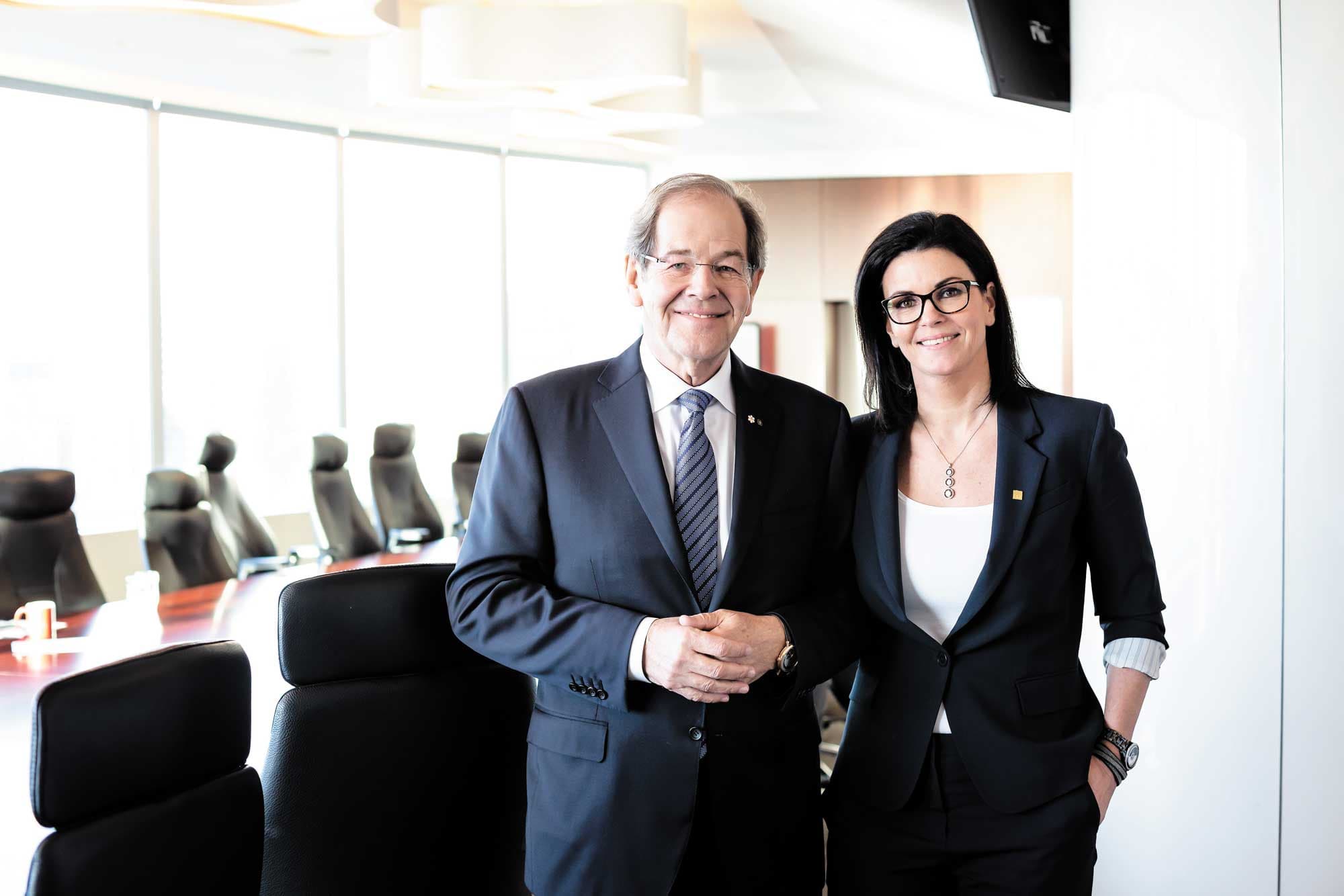
A founder makes room
Godin had already changed his relationship with the business once. In 2006, after leading CGI as president and chief executive since its founding, he became executive chairman. The 2025 move to co-chair was another step in distributing authority. Julie became executive chair; Serge retained a defined brief and remained the controlling shareholder.
That combination deserves a careful reading. Succession here does not mean the founder vanished, and a new board title does not make Julie chief executive. Responsibilities were being rearranged within a company whose ownership still gave its founder influence. His stated ambition was that CGI continue to thrive for decades. The succession was meant to serve that ambition.
The family’s work also extends beyond the business. Godin established the Godin Family Foundation in 2000, supporting disadvantaged young people through poverty relief and education. Public recognition followed across his career, including induction into the Canadian Business Hall of Fame in 2008 and, in 2024, France’s Légion d’honneur and an EY Quebec lifetime achievement award.
An award can put a career in the past tense rather efficiently. Godin has kept resisting that grammar. His co-chair responsibilities still concern the next engagement and the next major transaction. Meanwhile, other people carry more of the institution he once wanted his small consulting firm to become.
- 1976-2006President & CEO
- 2006-2025Executive chairman
- Since 2025Board co-chair
Fifty years, with the work still open
At the end of fiscal 2025, CGI reported 94,000 consultants and professionals and annual revenue of C$15.9 billion. It marked 50 years in business in 2026. These are dated measurements, useful for seeing the distance travelled without pretending that an organization ever stops moving long enough for a definitive photograph.
The milestones make a steep chart. The more personal story concerns the recurring decisions underneath it: insist on independent advice, invite a friend into the business, share an interest in the result, learn from colleagues leaving, and prepare someone else to take the chair. Different decades; recognizably related problems.
Godin began by trying to serve a client well enough to earn another assignment. He is now working on an organization large enough to continue that exchange without depending on his presence in every room. The founder has moved seats. The work, as he was quick to point out, continues.
Keep the conversation going
Read more about the decisions, the people and the years behind the story.
Godin’s CGI biography ↗CGI’s fifty-year history ↗The 2024 conversation with technology founders ↗Watch: the Horatio Alger member video ↗A 2025 interview on growth and lessons learned · French ↗The January 2025 succession announcement ↗