Consider the moment a box leaves a truck. The journey sounds almost finished. In fact, a fresh collection of questions has just arrived: which cart, which shelf, which temperature, which outgoing vehicle? Logistics becomes expensive when those answers disagree. Yusen Logistics has made a business of taking responsibility for the spaces between them.
- Freight forwarding gets goods moving; warehousing and distribution keep the promise going.
- A roughly €1.27 billion healthcare acquisition added specialist European storage, transport and technology.
- The useful lesson: coordinate a complete workflow before buying machinery for one small piece.
The expensive part is between the arrows
A shipping route looks reassuring on a map. Origin, destination, a tidy line. A business experiences it as a succession of obligations. Someone books space. Someone handles customs. Someone receives inventory and decides what happens next. Yusen sells services across that sequence: international air and ocean forwarding, land transportation, contract logistics and supply-chain management.
Its customers are manufacturers and retailers, with specialist work in automotive, aerospace, technology, healthcare, food and retail. These businesses have different definitions of disaster. A component misses a production schedule; a medicine loses its permitted storage conditions; a retailer’s stock sits in the wrong place. The common problem is that moving something and making it available are separate achievements.
For scale, an August 2026 joint announcement describes more than 30,000 employees across over 733 locations in 47 countries. Armstrong & Associates lists approximately $5.16 billion in 2025 gross logistics revenue, using company-reported figures or estimates. Yusen occupies the international logistics market alongside DHL, DSV, Kuehne+Nagel and Nippon Express. Its proposition combines geographical coverage with sector-specific handling.
A travel agent grows a supply chain
The origin is pleasantly unexpected. In February 1955, predecessor Kokusai Ryoko Kosha began as an IATA-accredited agent for passengers and freight. People and packages shared the same commercial starting point. In 1959, it became an NYK subsidiary and adopted the Yusen Air & Sea Service name. The travel division eventually departed in 1994 as Yusen Travel.
The modern Yusen Logistics identity emerged in 2010 as NYK integrated its logistics businesses; overseas integration followed in 2011. The sequence matters. This company accumulated forwarding and operational capabilities over decades. Its history offers an explanation for the breadth of the offer: each stage of a customer’s journey presented another service somebody could take on.
Ownership still shapes the business. Yusen belongs to NYK Group, whose March 2023 medium-term plan designated logistics a core business. In April 2025, global headquarters functions moved into Yusen Logistics Global Management, separating group management from Japan-region operations. NYK described the change as a way to clarify responsibilities and improve decision-making. Coordination, evidently, also requires attention upstairs.
Its published values are Connected, Committed and Creative. Those words become more interesting beside the Indonesian joint venture’s description of kaizen: continuous improvement at every level, supported by standardised processes and health and safety commitments. For a customer, the practical question is whether small operational lessons travel between sites as readily as the goods do.
A price tag with a footnote
Northampton supplies the physical expression of that ambition. In February 2024, Yusen UK agreed a 15-year lease with property company SEGRO for a warehouse of roughly 110,000 square metres. The announced commitment was approximately £280 million, including the total lease amount and capital investment. Calling that the building’s purchase price would miss the economics.
Northampton: total lease amount plus capital investment over a 15-year lease.
Movianto International: approximate cash acquisition consideration, completed December 2025.
The site’s attraction includes access to a strategic rail freight interchange. The announced design accommodates consumer goods and pharmaceuticals in dedicated temperature-controlled space. A company selling long-term warehouse services must commit to capacity before every future order is certain. The revenue model combines forwarding charges and margins with contracted storage, handling, distribution and management work.
Medicine dislikes improvisation
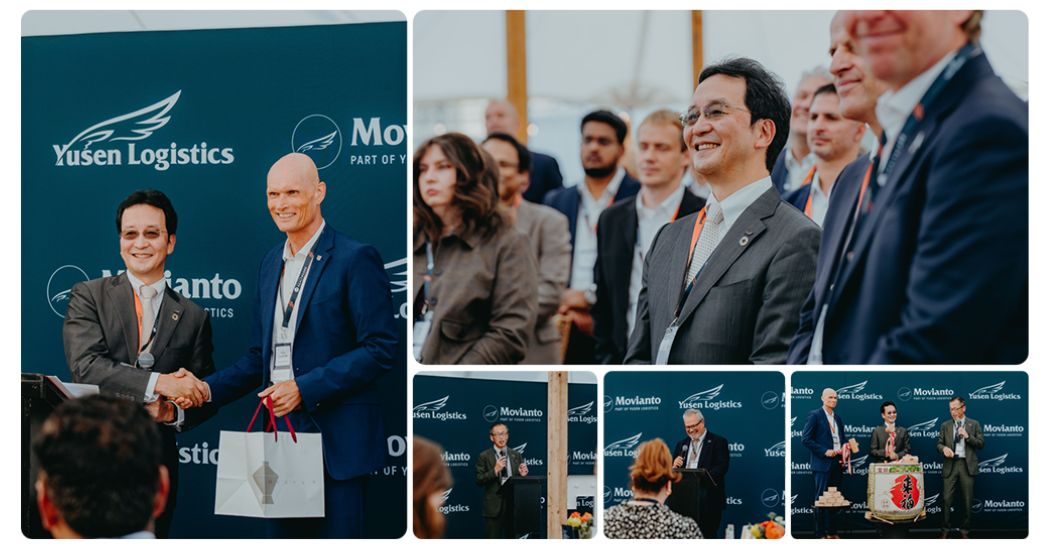
Yusen’s European healthcare expansion makes the same logic more demanding. On December 10, 2025, Yusen Logistics Europe acquired Movianto International. The healthcare portfolio included Movianto, Eurotranspharma, Transpharma International and Walden Digital. NYK’s subsequent financial disclosure recorded approximately €1.27 billion in cash consideration, with advisory expenses reported separately.
These names represent different jobs: storage, specialist delivery, international transport and technology. Put together, they offer a pharmaceutical customer more of the chain through one group. In June 2026, Movianto’s Aalst facility increased temperature-controlled pallet capacity from 14,000 to 25,000. It supports ambient, refrigerated, frozen and ultra-cold products, with dedicated arrangements for sensitive categories.
transport
storage
delivery
Digital coordination runs across the journey.
September brought the opening of a pharmaceutical hub in Wiesloch, Germany, with full operation expected in November. Its 10,000 chilled pallet positions connect to Eurotranspharma’s healthcare distribution network. Cold storage acquires much of its practical value from what happens after a product leaves it. A refrigerator with no reliable next step is an awkward business proposition.
Let the cart tell the robot
The same concern appears at warehouse scale. In August 2026, Yusen’s Americas business announced a collaboration with Destro AI for transload operations. Incoming freight must be received, staged and sent onward while volumes and labour availability change. The initial deployment focuses on cart movements, coordinating employees and autonomous mobile robots through one platform.
“Automation is most effective when it helps our people work smarter”Rick Brunelle, Yusen Logistics Americas, August 2026
The announcement describes plans to evaluate pallet movement and workflow verification later. That order is instructive: begin with a bounded operational problem, then consider adjoining tasks. The sensible thing to copy is the sequence. Map where work waits, establish who signals readiness, and judge automation by the completed process. A machine’s movement alone tells only part of the story.
Buy the handoff, too
A customer can start more modestly. Yusen Vantage Focus offers digital quotes, bookings, document management and shipment tracking. Enter cargo details, compare available rates and manage the booking. More involved engagements can include warehouse operations and supply-chain coordination. The useful procurement question is how much responsibility the business needs a partner to carry.
There are limits to buying integration. A sporadic, uncomplicated shipment may justify a narrower service. Complex outsourcing needs clear operating information and agreed treatment of exceptions. Movianto’s pre-acquisition agreement with Portugal’s Rangel illustrates another limit: an established local partner offered faster market access than building a fresh organisation. Even a broad network benefits from knowing when somebody else already understands the next handoff.