He found a slow lunch line unforgivable. So he built the checkout that fixes it, then pointed it at every shop counter he could reach.
Founder & CEO, Kody · Taiwan-born British
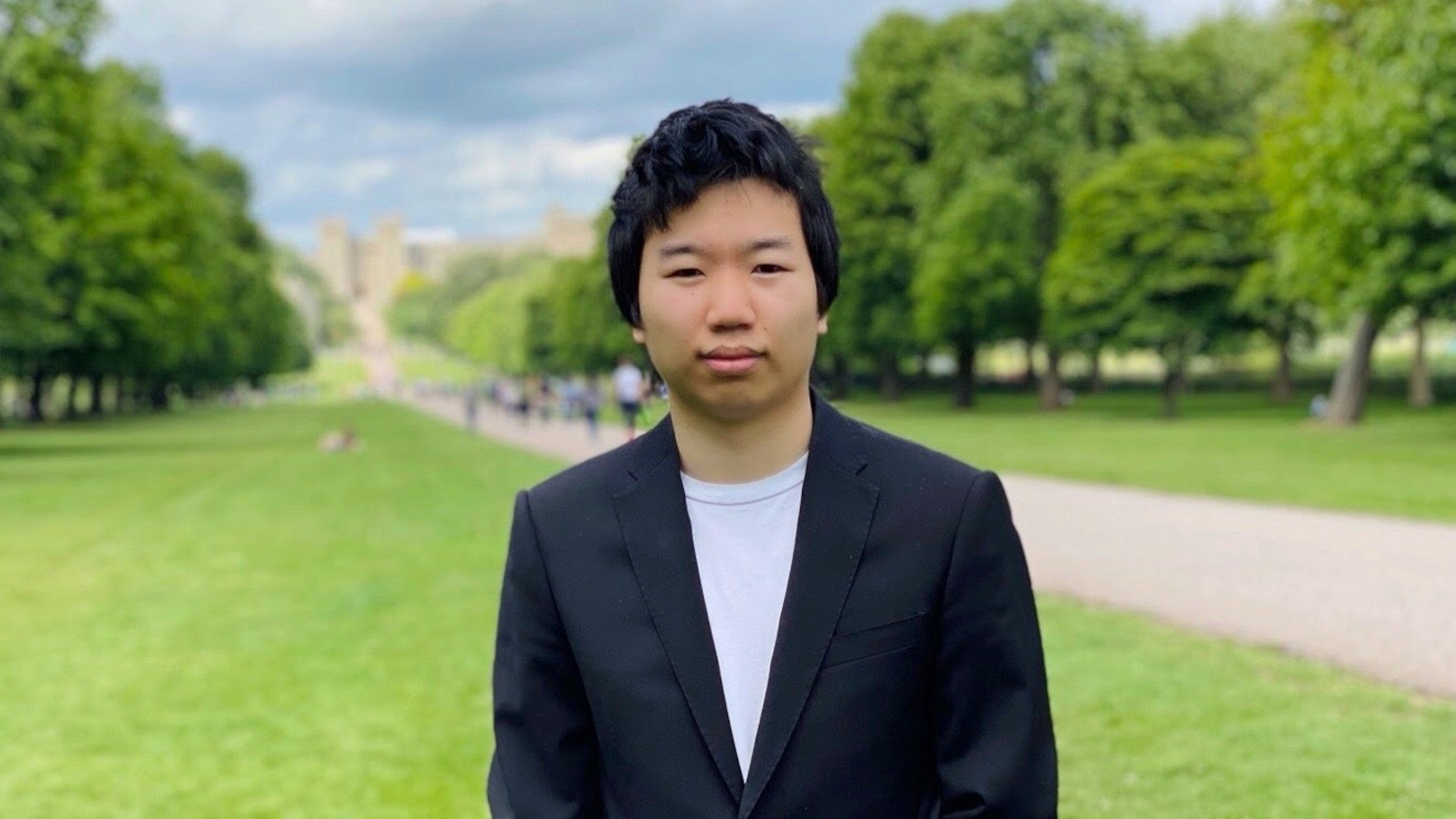
The Long Walk at Windsor behind him. The queue he hated, somewhere off-frame.
Walk into a restaurant Kody runs the till for and the cash register has quietly disappeared. There is no bulky terminal, no integration project, no six-week onboarding. A merchant downloads an app, and the counter starts taking cards, e-wallets and QR payments. That is the bet Yoyo Chang has been making since he was a teenager: that the friction of paying in person is a solvable problem, and that solving it is worth a billion dollars in volume a year.
Kody, the company he leads as founder and CEO, is a platform that stitches financial infrastructure to operational software. It does the unglamorous work behind a transaction, clearing the payment, settling the cash, then layers on the parts a venue actually feels: analytics that track how customers behave, tools to sharpen loyalty programs, and near-instant access to the money a business has just earned. The pitch to a shop owner is blunt. Cut the operating cost, see the data, get your cash faster.
By late 2024 the company had closed a $20 million Series A, bringing total funding to roughly $30 million, and pushed its annualised processing volume toward $1 billion. The plan for the new money was geography: hiring across the UK, continental Europe, Hong Kong and Singapore, chasing larger merchants who run many venues at once.
Our ultimate aim is to bring the ease and optionality of online payments to brick & mortar businesses.
The product that became Kody began as a complaint. At his school in the UK, lunch meant cash and a line that never moved. Chang and a small group of final-year students decided the line was a software problem. They built a way to pay from a phone and skip it. More than 2,500 students on campus tested the pilot, and it worked.
The detail that explains the rest of the story is who paid for that pilot. Chang did, with his own money, roughly £120,000 of it, drawn from profits he had made trading stocks since the age of 13. He had learned the markets from a teacher who had been a vice president at JP Morgan, then started managing money for family and friends and built a six-figure portfolio before he was old enough to vote. In late 2016 he posted returns above 80% in a single quarter, led his school team to first place in a national investing competition, and was named the UK's No.1 junior investor by the Institute For Fiscal Studies.
When he told his parents, who had emigrated from Taiwan in 2003, that he wanted to skip a clean career in banking to build a technology company, they were alarmed. He did it anyway, co-founding KodyPay in 2018 with Jack Howell and others while still a student, splitting his undergraduate years between the University of York and Cambridge.
No.1 junior investor in the UK (2016). Silver in the UK Intermediate Mathematical Challenge. A family office, IIC Holdings, founded the same year. And, for good measure, a Level 1 tennis coaching qualification a year later.
Surround yourself with a group of people who will nurture you.
Bars indexed to total funding raised. Figures from public funding announcements.
Starts trading stocks at 13, taught by a former JP Morgan VP. Part-time stint at ATEN UK along the way.
80%+ quarterly returns, national competition win, UK's No.1 junior investor. Founds family office IIC Holdings.
Co-founds KodyPay at 19, seeding it with ~£120,000 of his own trading profits.
Bloomberg profiles him as a Gen Z trading prodigy winning over Wall Street backers.
Co-founds Nerd Ventures with the founding team. October trial lands.
Public beta in July. Raises $5M, total funding hits $10M. GPV pushes past £100M annualised.
Closes a $20M Series A. Annualised volume approaches $1 billion. Expansion across Europe and Asia.
A list that reads like a fintech roll call decided the idea was worth backing before the founder had finished his degree.
Former CEO of cross-border payments firm Earthport, an early chairman-level believer in the company.
Co-founder of Monzo Bank, lending challenger-bank credibility to a hardware-free checkout idea.
Former president and CFO of SoftBank Group International, a heavyweight name on the cap table.
Chairman of Coinfloor, bringing a markets-and-crypto lens to the early rounds.
An IBM partner backing the technical build, with Visa and Mastercard among the rails it rides on.
Jack Howell and the school-and-university cohort who built the first pilot, later spinning up Nerd Ventures.
He points to The Big Short as a framework for building an investment thesis, and to The Social Network as a fairly accurate mirror of the startup experience. Steve Jobs supplies the persistence.
Spend less chasing new customers, he argues, and more keeping the ones you have. Retention over acquisition, with the math to back it.
The stated long-term aim is to route payments-industry profits into causes, so the people using Kody end up making a direct, positive impact on others.
Son of Taiwanese parents who emigrated to the UK in 2003. The Chinese name on his profiles: 張耀昀.