Imagine checking an advertisement from your desk and concluding that everything works. The price is right. The landing page opens. The language makes sense. Then a customer in another country sees something different. The advertisement has passed your test, but your test has missed the customer. In this small gap between where a business sits and where its audience lives, YouProxy has something to sell: a different return address.
- Rent dedicated addresses for regional checks, data collection and recurring online work.
- Choose among datacenter IPv4, IPv6, static ISP and rotating mobile connections.
- Compare the full rental term and compatibility, then read the replacement conditions.
The address is the product
A proxy sits between a client and a destination. Requests travel through it, and the destination sees its address. YouProxy packages that arrangement into a purchasing decision: country, proxy type, quantity, rental period. The company says it has supplied private proxies since 2017. Today, its catalog serves people whose work depends on seeing the web from a particular place or keeping a consistent connection.
That includes SEO specialists checking regional search results, ecommerce analysts watching prices, marketers verifying advertisements and developers testing location-dependent behavior. These are customer groups the company targets, rather than a roll call of famous clients. The attraction is concrete. A regional test needs a regional viewpoint; a recurring session may need an address that stays put. Both requirements can get lost in a shopping list headed simply “proxies.”
Four ways to leave a return address
YouProxy’s IPv4 product uses dedicated datacenter addresses. Its ISP product offers static addresses associated with internet service providers. Both can provide a fixed identity for an ongoing task, although their network origins differ. The company names providers including AT&T, Frontier and Windstream in its ISP description. Those names describe the address supply; they do not, by themselves, establish a formal commercial partnership.
IPv6 introduces another distinction. A buyer may receive an IPv4 gateway address with separate ports that connect through individual IPv6 endpoints. Receiving an IPv4-looking connection detail does not mean the order is wrong. The destination still needs to accept IPv6. This is the kind of unglamorous compatibility question that should be settled before buying a thousand cheap addresses.
The mobile product behaves differently again. YouProxy advertises carrier connections with rotation by time or by link, depending on the operator. That suits work requiring changing network identities, including tests of what happens when a connection changes. A task requiring an uninterrupted fixed identity deserves a different choice. Four products sit in the catalog because “an IP address” is an incomplete description of the job.
The arithmetic of staying put
The pricing makes more sense when the unit is kept intact. In the displayed one-week IPv4 table, five addresses cost $3.25. In the one-week ISP table, five cost $6.35. The IPv6 table displays 20 addresses for $1.59 over one month. These are different products and periods, so lining them up as interchangeable bargains would be misleading. The checkout variables matter as much as the headline number.
Different products, different terms. Confirm the selected order before paying.
YouProxy earns money from these rentals, with discounts for quantity and duration. It advertises unlimited bandwidth for IPv4 and IPv6. For a team repeatedly moving data through a suitable fixed set of addresses, that offers a predictable rental bill. The useful calculation, however, is cost per successful task. A low invoice loses its charm if unsuitable addresses produce repeated failures or hours of configuration work.
That places YouProxy in the proxy-infrastructure market alongside alternatives such as Webshare, IPRoyal and Proxy-Seller, with Bright Data and Oxylabs also competing for data-access budgets. YouProxy’s buying proposition centers on dedicated rentals, several address types and straightforward term selection. A comparison should begin with the required session behavior, geography and billing unit. A price divorced from those conditions tells the buyer very little.
Private does not mean pristine
One of YouProxy’s more revealing statements lives in its FAQ: addresses accumulate history after use. Exclusive access concerns who uses an address during a rental. Reputation concerns what a destination already thinks about it. Confusing the two turns a purchasing preference into an impossible promise.
“I get the same proxy subnet”
Nisarg P., customer review reproduced on YouProxy’s website
The company even reproduces that customer’s complaint about repeated subnet allocation, alongside praise for support. Several individually dedicated addresses can still belong to the same network neighborhood. For a buyer who needs diversity across networks, quantity alone is an inadequate specification. The practical lesson is to ask about distribution before ordering, rather than discover afterward that a larger list has not supplied the variety the task required.
A working connection is the finish line
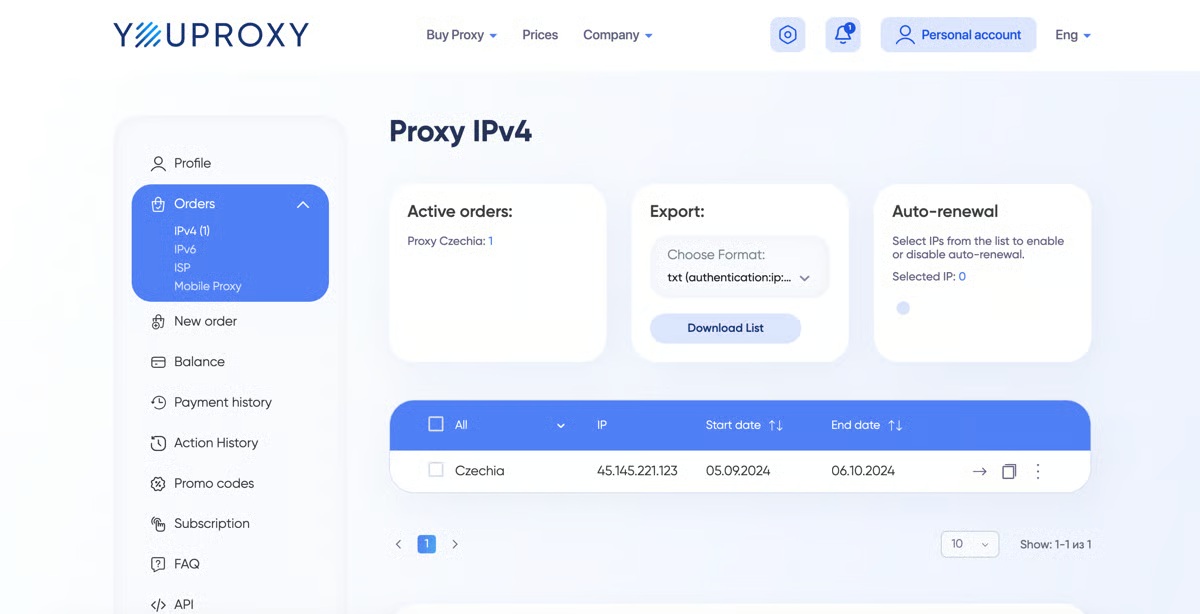
The dashboard exports connection lists for external software. The public API documentation explains API-key authentication, allowing customers to bring management into their own tools. Setup remains part of the product experience: a connection must have the right protocol, credentials and location before it becomes useful. A screenshot of a tidy account page cannot establish that a particular destination will cooperate.
The detailed refund policy puts that distinction into commercial terms. It prioritizes troubleshooting, replacement or another proxy type. Refund requests generally have to arrive within 24 hours of payment and satisfy stated conditions. Addresses blocked during use are excluded, and custom-software problems have exclusions too. The homepage’s short refund-window description should therefore be read together with the actual policy.
A sensible starting order follows the task backward: identify the destination, confirm the protocol and geography, choose fixed or rotating behavior, then check the relevant terms. YouProxy sells the connection that makes the work possible. Its value emerges when the chosen address produces the observation, session or regional check the customer actually needed.