Thirty contact pages later
Contact pages are an unlikely place to look for an entrepreneurial revelation. They are the sensible shoes of the internet: useful, expected, rarely admired. Yet Yoni Luksenberg and Ariel Klikstein found themselves making them again and again for clients. After a year of building 30 websites, the repetition had become difficult to ignore. Each customer needed something slightly different. The underlying labour remained painfully familiar.
That small accounting of wasted effort helps explain Luksenberg better than a valuation could. He approached the web as someone who had to deliver a finished design, collect a payment and begin the next job. A beautiful result mattered. So did the hours spent getting there. The space between those two obligations became the opening for Elementor.
30 contact pages.The recurring task behind a new kind of editor.
Today he is the company’s co-founder and CEO. But the designer in the story remains visible: someone interested in how an idea becomes a usable thing, and how much unnecessary work sneaks into the journey. A contact page has no ambition to change an industry. It can, however, become extremely irritating by the thirtieth attempt.
A designer enters through the side door
Luksenberg came from Bnei Brak, Israel, and studied in the ultra-Orthodox yeshiva world. His route into technology ran through visual work. His mother was a designer; he learned graphic design himself. Before WordPress became his working environment, he edited video and animated Flash banners, the little moving advertisements of an earlier web.
There is a useful continuity here. Video, animation and website design all involve arranging what another person sees. They also make a practitioner acutely aware of the distance between imagining a result and persuading software to produce it. His later concern with interfaces has a practical ancestry.
Klikstein introduced him to WordPress, its open-source culture and its gatherings. A mutual acquaintance brought the two together in 2010. They began making custom websites, serving both religious and secular customers. Their workplace included a ground-floor apartment in Bnei Brak. This was a business with clients and delivery problems before it was a software company with an international audience.
The rejected themes were part of the education
Before Elementor, there was Pojo, the premium WordPress theme business they launched in 2014 for the Israeli market. Themes offered a way to package design work for repeated use. They also put the partners closer to the frustrations of customers who wanted more freedom than a ready-made structure could provide.
Luksenberg has described earlier products that consumed their effort and limited cash without producing the success they wanted. ThemeForest rejected their themes. He includes that rejection in his own account of the company’s beginnings, with the hindsight of someone who kept working. Failure here was specific: a product, a marketplace, a disappointing answer.
His advice to other founders starts with finding a lock before developing a key. It is a tidy image for an untidy process. Their experience supplied plenty of locks: browser adjustments, custom code and tasks that made freelance projects harder to finish profitably. Elementor grew from that accumulated inconvenience. The founders already knew the customers’ working day because they had been living it.
The editor acquires a neighbourhood
Elementor’s first version arrived in 2016. The basic proposition was direct: give WordPress users a visual way to build pages, with live editing and control over the result. For a designer, shortening the distance between an adjustment and its appearance on screen was a meaningful change in the working day.
In his February 2020 funding announcement, Luksenberg recalled reaching 100,000 active installations within ten months. He also reported 140 meetups across six continents during the previous year. The second number is as revealing as the first. An installation is software on a machine. A meetup requires someone to leave the house.
The surrounding activity became part of the product’s value. Developers made add-ons. Designers shared templates. Freelancers learned from people facing similar jobs. By the end of 2018, Elementor’s annual review recorded more than 130 add-on plugins in the WordPress repository and more than 30 separate Facebook groups, including communities in Brazil, Israel, Italy and the Philippines.
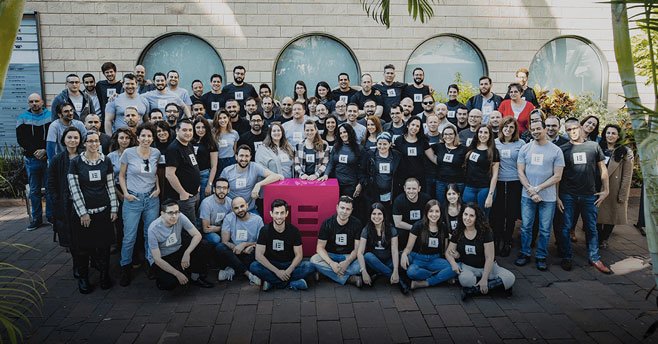
That same review counted 120 videos produced during the year and a team of 55 employees. Tutorials and support occupied real space in the business. A tool could save time only if people understood how to use it. The documentation, the videos and the conversations were part of getting a customer to a finished website.
A right-click can start an argument
A growing community also supplied a rather efficient system for discovering disagreement. When Elementor moved editing controls into a right-click menu, some users objected strongly. Luksenberg’s explanation dwelt on details: cleaning up the design surface, avoiding obstructed controls and making room for actions such as copying styles.
He had expected a warmer reception. Instead, complaints reached the Facebook community, email and reviews. The company spoke with users and reconsidered its communication and education around changes. A designer’s apparently sensible improvement had collided with habits that customers had already invested time in learning.
His account also discussed renaming the Columns widget to Inner-Section after research found people repeatedly using it when they simply wanted another column. Even the name of a widget could become an argument about usability. Leadership at this scale includes explaining why a familiar button has moved. There are less glamorous duties than presenting a new product; this one comes with unusually detailed correspondence.
“I think the danger lies in complacency.”
Yoni Luksenberg, 2020
When other people’s work depends on yours
The stakes became clearer with Elementor 3.0. Released in August 2020, the update brought substantial infrastructure changes and a volume and variety of problems beyond the team’s expectations. Some affected live websites; others affected the editor. In September, Luksenberg published a letter apologising for the experience and the consequences for customers’ businesses.
He described the release as the result of more than a year’s development, intended to support design systems, an improved Theme Builder and future work on the editor. Ambition did not remove the obligation to make the software dependable. The letter addressed testing, release processes and the strain on support when tickets increased.
This episode belongs in a personal profile because it shows what his original promise had come to mean. Customers used the software to earn a living. An interruption could consume the very time the product was supposed to return to them. A founder who began by worrying about his own agency’s workflow was now answering for many other people’s workflows.
The people you meet on the way
Luksenberg’s connections often emerge from the same WordPress circuit that first welcomed him. The acquisition of Strattic, announced in June 2022, followed years of acquaintance with its founders, Miriam Schwab and Josh Lawrence. He recalled conversations at WordCamps, including a flight to an event in St. Louis, and a later meeting at an Israeli WordPress conference.
Strattic’s approach turned dynamic WordPress sites into static versions for delivery. For Elementor, it extended the work beyond designing a page into the infrastructure that keeps a site available and responsive. The deal also illustrated how an industry conversation can develop over years before becoming a business agreement.
Another encounter stayed with him: hearing Fiverr co-founder Micha Kaufman speak in Bnei Brak. Years later, Luksenberg told Kaufman he had been in that audience. When he was invited to speak at a similar event himself, he described the experience as coming full circle. Elementor had joined the first cohort of the KamaTech accelerator while making the transition from studio work to a technology business.
The appeal of that memory is its modest scale. Someone gave a talk; someone else listened. The effect became visible much later. For an entrepreneur outside the usual professional networks, being in the room could matter before there was any obvious reason to put him on the stage.
The founders talk with their community →
Still rearranging the working day
In May 2023, reflecting on WordPress’s twentieth anniversary, Luksenberg returned to the people around the software. Elementor hosted a celebration for the local Israeli community. He wrote about organisers, product makers and longtime participants describing how those connections had shaped their lives and work.
He also acknowledged that Elementor had become larger than its founders, with service providers, developers and integrators building businesses around it. That is an unusual outcome for an attempt to make an agency’s projects less troublesome. A company built to reduce repeated work had created a setting in which other people could do their own work.
His public author biography includes a more domestic construction practice: Lego building. In a 2020 interview, he said he enjoyed playing Lego with his children and reading management and marketing books. The hobby should not be forced into a grand theory of entrepreneurship. Sometimes a brick is simply a brick, and an agreeable reason to sit on the floor.
The working-day question continues. In January 2026, Elementor introduced Elementor One, bringing creation, optimisation and site management into a unified subscription. Luksenberg’s accompanying explanation focused on responsibilities that accumulate after launch: performance, accessibility, updates, client management and growth. He argued that AI should support the creator’s control.
The scale has changed, and the list of tasks has lengthened. His subject remains recognisable: the awkward work between a person’s idea and a functioning website. For Luksenberg, there is still something to rearrange. One suspects the contact page has not heard the last of him.