John O’Nolan once asked Y Combinator for $120,000 in exchange for seven per cent of Ghost. The answer was no. He tried again. Another no. A decade later, he had a rather enjoyable update: Ghost had collected more than $25 million from customers, given away no equity, and become the software beneath Y Combinator’s own blogs. Rejection had acquired a pleasing sense of humour.
He told that story in March 2024. By then, the usual consolation prize for a rejected founder - building something valuable enough to sell elsewhere - had become unavailable to him. Ghost operates as an independent nonprofit foundation. O’Nolan has no shares to cash in. Its constitution prevents the company from being bought or sold. A buyer could admire the business, use the software, or become a customer. Buying the founder’s stake would require a stake to exist.
That arrangement gives his career its peculiar shape. He is a founder and CEO who has deliberately removed the acquisition ending from his own story. The question becomes more interesting than how much Ghost might fetch: what does a person build when he intends the work to continue without a sale?
The musician who found work between the songs
Before the publishing platform came music. O’Nolan studied music and music business at the Brighton Institute of Modern Music from 2004 to 2006. His own account is cheerfully unceremonious: he had dropped out of high school twice and was not a particularly good musician. Friends were better at the musical part. He built their websites and helped promote them. The work around the music became his route into technology.
Freelance design and development followed. He built WordPress sites for local businesses, then worked with clients including Microsoft, Nokia and Virgin Atlantic. Using somebody else’s open source software every day led him to contribute to it. He became deputy lead of the WordPress user interface team, working on the machinery that other people used to put their words online.
The difficulty was that WordPress kept expanding. O’Nolan wanted a tool centred on publishing, while the product was taking on more jobs as a general website system. His proposed answer appeared in a November 2012 blog post. Ghost began as a design argument made in public: a simpler place to write, with fewer distractions between an idea and its reader.
Five thousand people say yes
Hannah Wolfe, his friend and eventual co-founder and CTO, helped turn the concept into software. Their April 2013 Kickstarter campaign asked for £25,000. It finished with £196,362 from 5,236 backers. Those figures carry a more useful meaning than applause: people had agreed to pay before there was a finished product to use.
The prototype was rudimentary. There was a working application and a basic interface, with parts represented by images rather than functioning controls. It demonstrated possibility. It still left the founders with the substantial job of delivering the thing people thought they were buying. The first general public release arrived in October 2013.
O’Nolan was firm about avoiding physical rewards. He had watched other crowdfunding projects spend their time manufacturing and posting T-shirts. A campaign to make publishing software could easily become a campaign to manage parcels. He kept the rewards close to the product. Even at this early stage, there was a designer’s instinct for removing the wrong work.
The project’s name suited the ambition. At a later developer gathering, he explained its connection to ghostwriting: the software should help the author do the work. The person writing should occupy the foreground. The platform could afford to be a little less visible.
7.85 times the original target
An empty place on the cap table
The business that emerged charged for managed hosting while releasing its core software openly. People could run Ghost themselves, or pay Ghost(Pro) to handle the operational work. A paying customer funded development that also benefited somebody using the code for free. The commercial service gave the project a way to pay its bills without making access to the software conditional on buying that service.
For O’Nolan, independence also required a decision about ownership. Neither founder owns part of Ghost. The foundation holds the project’s assets. Revenue stays inside the organisation, supporting its work rather than becoming a dividend for shareholders. Employees still receive salaries; servers still produce invoices. The nonprofit structure changes where the surplus can go, while leaving plenty of ordinary business to attend to.
He has described the model’s difficulties without much romance. Running open source software creates its own complications. Running a nonprofit adds restrictions to the pressures of a regular company. His 2016 account was clear that he would make the choice again, and equally clear that it was hard. There is something reassuring about a conviction that includes the administrative inconvenience.
In a 2019 conversation, he explained that he could eventually retire, but would have nothing to sell. Somebody else could take over the job. The distinction matters for publishers choosing infrastructure: the founder has arranged for his own departure to be possible without making a change of ownership the required event.
- 01Free software
Publishers can self-host - 02Paid hosting
Customers choose Ghost(Pro) - 03Reinvestment
Revenue funds the foundation - 04More development
Improvements return to the software
Paid hosting supports open source development.
The office never opened
A conventional office would have been an odd destination for O’Nolan. He has described himself as English-Irish, born in Scotland, with Dutch as his first language. He grew up across countries including the Philippines, Austria and Egypt. Constant movement preceded Ghost; remote work fitted a life that was already in motion.
His travel stories suggest that being well travelled does not guarantee arriving in the right place. In 2012, he recalled trying to reach one Philippine city named Roxas by a two-hour bus journey and instead ending up on a boat to another Roxas, six hours away, at night. He also admitted to forgetting his laptop charger. Geography was an interest. Logistics could still file a complaint.
Ghost has been fully remote since its founding, with no office in its history. The team meets in person on trips, a useful reminder that working apart and enjoying one another’s company can coexist. O’Nolan’s account of travel on Rediverge folded the personal and professional together: building a company, moving around the world, and writing about what that life actually involved.
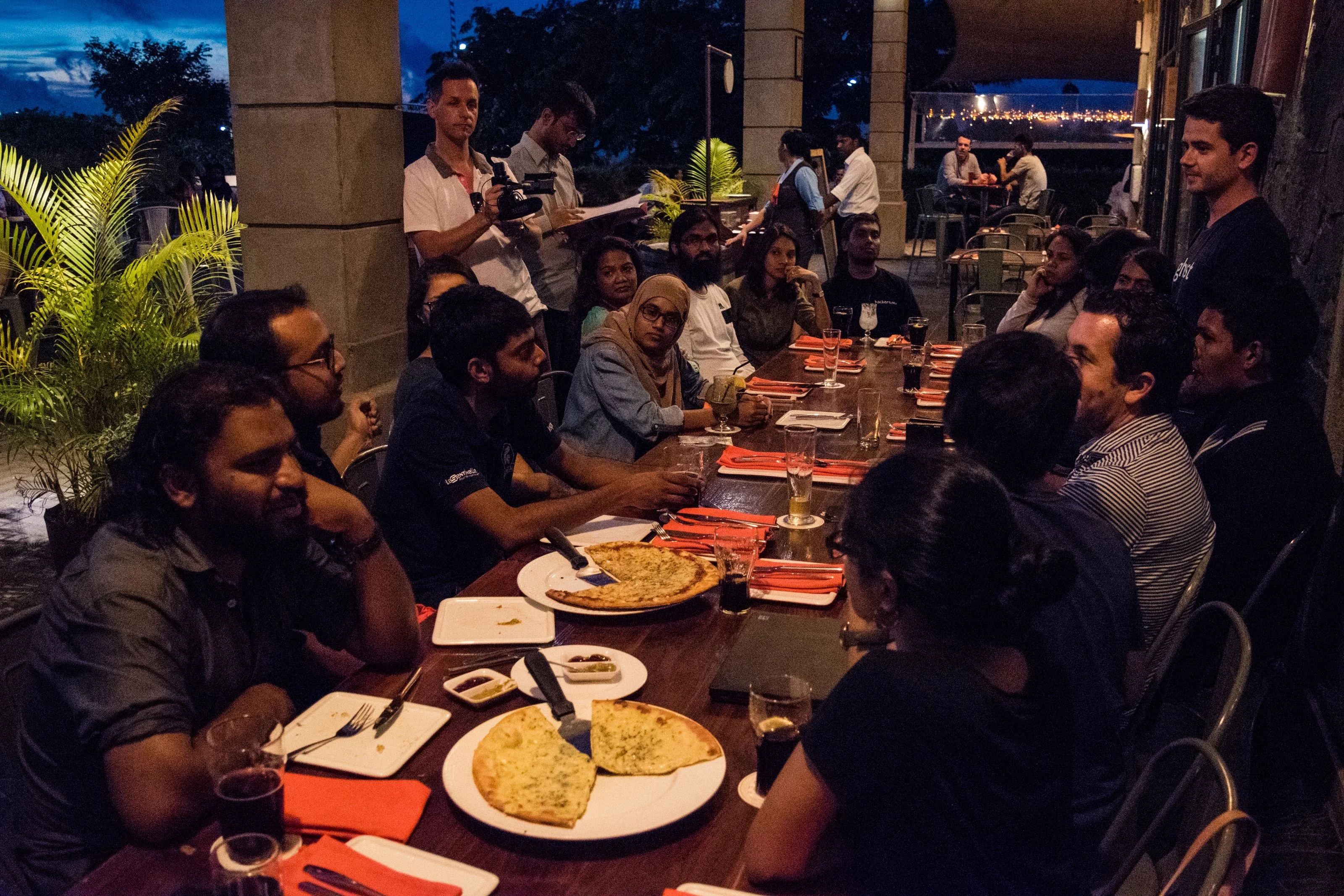
A developer meetup in Mauritius supplies a less polished picture than the nomad brochure. A viewer of his YouTube channel noticed he was coming to the island and helped arrange a gathering at Flying Dodo. Twenty-seven people turned up. He answered questions about Ghost and showed interest in local journalism. The work had travelled with him, and the evening acquired an audience.
A page view is a fleeting acquaintance
In early 2016, O’Nolan sketched memberships and subscriptions for Ghost. Years later, finding those files again, he was struck by how closely the eventual product resembled the drawings. The premise was direct: anonymous visits were less useful to a publisher than an ongoing relationship with subscribers. Blogs and newsletters already existed. Bringing the two together could give a writer a business.
Ben Thompson’s Stratechery was an influence. It showed how a single person could make a subscription publication work. Ghost 3.0, released in October 2019, integrated memberships and subscription revenue into the publishing product. The founders were applying economics they understood from selling software subscriptions to the people using their software to publish.
That change widened the meaning of a good editor. A pleasant writing screen helps someone finish an article. Memberships help them return to write another one next month. The ambition moved beyond removing friction at the keyboard to supporting the recurring relationship between a publication and its readers.
By August 2025, O’Nolan reported two separate cumulative totals: $36 million from Ghost’s managed hosting, and $100 million earned by independent publishers through the platform. Together they made $136 million. The distinction deserves to stay visible. Publisher earnings belong in the publishers’ column; hosting revenue belongs in Ghost’s. Neither figure is the founder’s personal fortune.
Cumulative figures reported 18 August 2025. These are separate revenue totals, not annual revenue or personal wealth.
Please spare the reader the protocol
Ghost 6.0 arrived in August 2025 with native analytics and social web integration. Publications could participate in a network through which people discover, follow and respond to work across services. For O’Nolan, the delicate part was helping people understand the experience without requiring a vocabulary lesson first.
His worry before launch was that the language would chase ordinary users away. ActivityPub, Fediverse, Webfinger: an invitation can start sounding like an entrance exam. He argued that product teams should do more of the explanatory work themselves. Email already offered a familiar precedent. People could use it without mastering the protocols underneath it.
He cares about the structure, then worries about how that structure feels to someone trying to publish. In his reflections after the release, the encouraging sight was people simply using the network rather than stopping to decode it.
“The graveyard of technically superior but user-hostile products is vast.”
John O’Nolan · August 2025
A smaller company, a quieter Sunday
His plans for Ghost include keeping the foundation team to around fifty people and broadening governance as it grows. He has proposed adding trustees beyond the founders, including community-elected seats. These are stated intentions. They describe an organisation meant to draw on more people’s judgement while supporting a wider ecosystem of publishers, developers and service providers.
The reason for the headcount limit is refreshingly free of management theatre: running a big company does not sound fun to him. He would rather remain selective and know people’s names. His ambition allows other businesses room to build around shared infrastructure. A large ecosystem can contain a comparatively small core team.
Meanwhile, in December 2025, he announced Alcove, an RSS reader. He wanted an hour with coffee on a Sunday morning and the things he actually cared to read. His inbox supplied chores. Social feeds supplied detours. Existing readers failed his particular test of comfort. He gave the project a modest motive: ‘Mostly for fun.’
In March 2026, he described building ghst, a command-line tool for Ghost, and trying it through an AI assistant. After more than a decade spent refining an interface, he was experimenting with talking through tasks while using the screen to check the results. He remained willing to question his own design habits.
O’Nolan’s story keeps returning to the same ordinary act: somebody wants to make something, read something, or tell somebody else something. The tools should make that easier. He has spent years building an institution around that belief, while preserving enough curiosity to start another questionable side project. Ghost must keep earning its living. Its founder has made sure selling it will never be his solution.
Keep reading, or hear him tell it
- ESSAYHis ownership and governance plans ↗
- ANECDOTEThe Y Combinator postscript ↗
- SIDE PROJECTThe Sunday-morning reader ↗
- 2026Trying a different way to use Ghost ↗
- WATCHO’Nolan with Tim Soulo on Ahrefs Podcast ↗
- WATCHA conversation about building Ghost ↗
- MEETUPThe evening at Flying Dodo ↗
- GHOSTThe foundation and its public metrics ↗