The water was supposed to keep the dust down. During the early work on a restoration site in Hawaiʻi, crews sprayed the roads and watered small patches of green. Before the full irrigation system was ready, native plants began appearing. Birds and insects followed. For Yishan Wong, who remembered their return with surprise, this was an encouraging kind of unsolicited feedback.
He had spent years helping internet businesses grow. Now he was watching a landscape respond to something as ordinary as water. There was no launch to announce, no new interface to explain. Remove a constraint, and life began doing some of the work itself. The recollection has stayed with his account of reforestation.
The distinction matters because Wong’s ambition sounds, at first hearing, almost aggressively simple: help restore forests at enormous scale. Then come the questions. Where will the seeds come from? Who knows how to grow them? Who pays while seedlings are still seedlings? The longer he looked, the more the apparently simple project acquired a supply chain.
A retirement interrupted
Wong had already reached a plausible stopping point. Raised in Minnesota, he graduated from Carnegie Mellon in 2001. His schoolfriend Jawed Karim, later a co-founder of YouTube, persuaded him to join PayPal. By 2014, after a career that had also taken him through Facebook and Reddit, he considered himself retired in Hawaiʻi. “I wasn’t eager to be a CEO again,” he said. In 2017, he bought a parcel of parched land and began thinking about bringing back its native forest. Retirement had acquired a research project.
His professional itinerary was an education in organizations that kept getting bigger. At PayPal, he worked in engineering from 2001 to 2005. At Facebook, where he became a director of engineering, his work included crowd translation. He left in 2010. Alongside Niniane Wang, he co-founded the Mountain View coworking space Sunfire Offices; he also advised Quora. These were different ways of organizing people around shared work. Reddit would make that problem much more public.
He became Reddit’s CEO in March 2012 and resigned in November 2014. His departure followed a disagreement over a proposed new office, a wonderfully mundane object on which to hang an internet-company drama. Ellen Pao became interim CEO. The familiar ingredients were there: a board, an executive, a location, a budget, and people who could not agree about them. The office dispute became part of his exit story.
Years later, answering questions about Terraformation, Wong described the value of already having been a CEO. Routine organizational decisions no longer required the same amount of deliberation. He could avoid small mistakes and delays. Experience offered a saving in attention, which was useful when the main problem was large enough to consume the rest of it. He had sworn off running a company, then found a reason to start one.
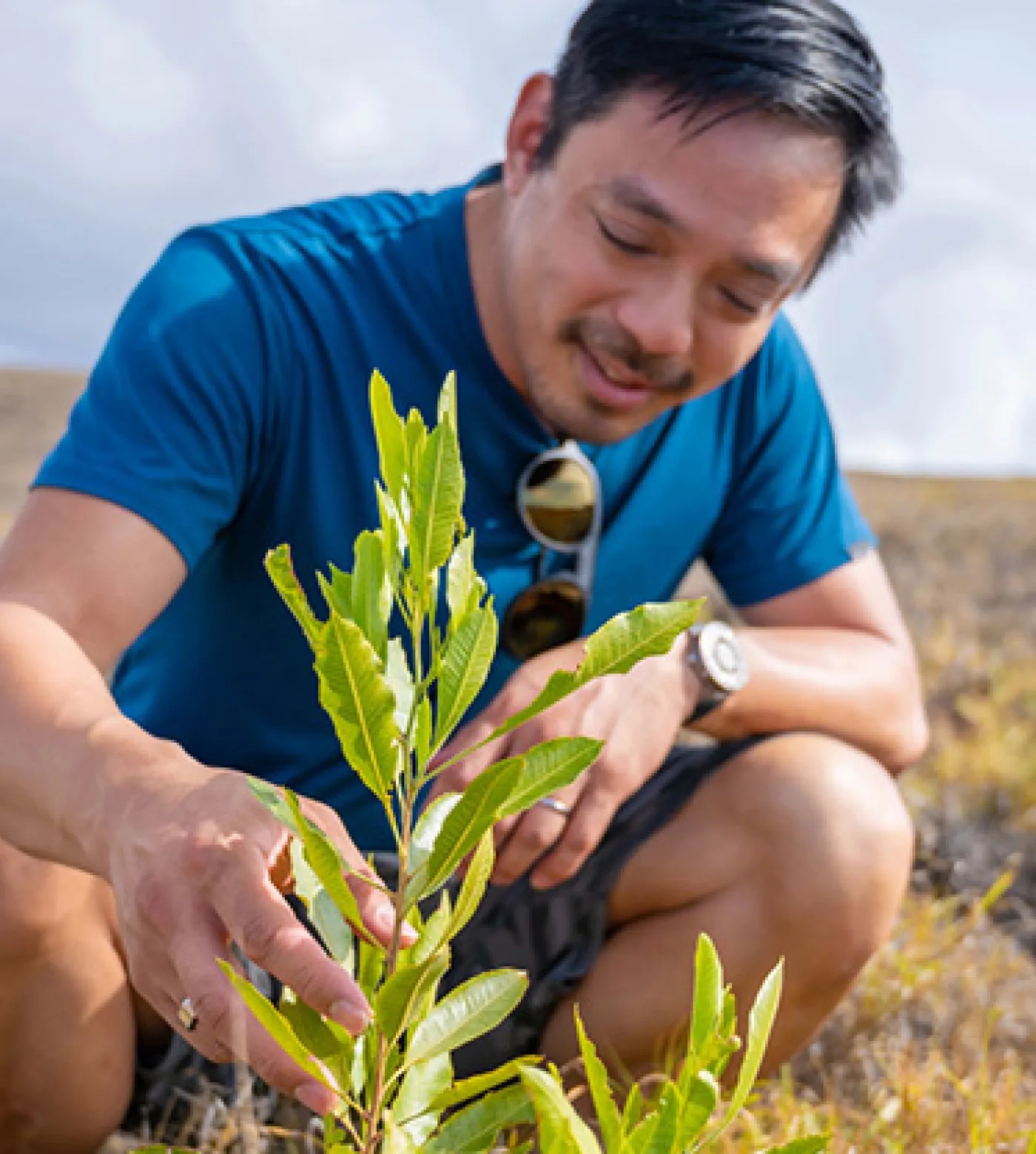
The engineer who distrusts novelty
Terraformation began in January 2020. Its founder brought a piece of technical advice that sounds awkward in a product pitch: use less new technology. In his account, the danger of a new component is the extra uncertainty it introduces. When something fails, you must work out whether the idea itself is unreliable or whether a reliable idea is behaving differently at scale.
Wong illustrated this with phone calls. A small failure rate can seem tolerable in everyday use. Apply it to a billion attempts and the failures become an operation of their own. “New technology is the most unreliable technology,” he wrote. Trees, solar power, and desalination appealed to him because they were already familiar. His argument favored tested components and fewer surprises.
That preference is less picturesque than the image of a technology executive discovering nature. It is also more revealing. Wong’s experience had made him wary of adding another unsolved problem to an already difficult one. A system can be ingenious and still be a nuisance to operate. At a sufficiently large scale, the nuisance gets its own department.
He also made a distinction within the thing he wanted to grow. A forest contains relationships among trees, soil, fungi, insects, and other life. An individual tree’s lifetime is only one part of that continuing system. His case for native restoration depends on rebuilding those relationships, rather than treating all green acreage as interchangeable. Species and place belong in the definition of the project.
“New technology is the most unreliable technology.”
Yishan Wong · 2021
Before the shovel
The early Hawaiʻi work put this reasoning on the ground. At Kaupalaoa, a landscape once home to native tropical dry forest had been degraded by logging and cattle grazing. Restoration meant dealing with wind, limited water, depleted soil, and scarce native seeds. Terraformation assembled foresters, scientists, engineers, and business specialists to address the connected obstacles. The land supplied a practical curriculum.
The infrastructure could be strikingly ordinary. In a 2021 tour of the company’s Hawaiʻi headquarters, Wong showed seed banks inside standard shipping containers. The modular, off-grid units were designed to store millions of seeds across hundreds of species and travel to remote partners. The tour also included nurseries and a solar-powered desalination system. A shipping container is an unromantic place to begin imagining a forest. It has the advantage of being deliverable. The headquarters tour makes those dependencies visible.
Software retained a place in the work, too. Terraware helps forestry teams manage activities such as seed collection, nursery operations, and planting records. In a 2025 conversation, Wong described the value of tracking details that are easy to lose: when a species’ seeds mature, where to collect them, and how often they germinate. Shared records can make one team’s experience useful to another. The usefulness lies in the daily workflow.
- 01SeedsCollect locally.
Store carefully. - 02NurseryGrow seedlings.
Track the details. - 03PlantingMatch species
to place. - 04StewardshipMaintain.
Monitor. Repeat.
In June 2021, Terraformation announced the first closing of a $30 million funding round. Nearly 100 angel investors participated alongside Apollo Projects. Money could pay for the organization and its tools. The harder task was making the work repeatable beyond its first sites. The funding gave that effort room to develop.
Please copy this
One answer borrowed an organizational form from startups. In 2022, Terraformation launched a forest accelerator. Early-stage forestry teams needed access to money, practical training, and infrastructure. The program sought to connect those pieces so a promising restoration effort could become a project capable of attracting support and sustaining its work. The accelerator put resources around existing local effort.
Wong has been explicit about wanting other organizations to repeat successful approaches. In April 2025, he described a company that builds nurseries and seed banks, does restoration itself, and helps other groups learn and raise funds. He also acknowledged a difficulty: persuading funders to value diverse native forests when a large, quick tree count is easier to explain. The work asks people to pay attention to quality and time.
The idea of imitation changes the role of the founder. He can build an organization, but a global restoration effort needs many organizations with their own knowledge and responsibilities. Local expertise determines what belongs on a piece of land. Shared infrastructure can help people act on that expertise. The appealing part of Wong’s argument is its willingness to let the credit become dispersed.
He has carried over another startup habit: thinking about the stage between an idea and a functioning operation. In a 2024 account of the accelerator, he described the difficulty of arranging seeds, water, trained teams, and finance together. He also returned to a company value, “We are ancestors.” It is a compact instruction to consider people who will inherit the outcome. His definition of the work extends well beyond the founding team.
A future worth drawing
Wong’s interests include a less expected piece of climate infrastructure: an appealing picture. In 2021, he organized a solarpunk art contest, asking artists to imagine a future people might want to build. He announced the winners that November; Elijah Johnson took first place. “We need a new and optimistic vision of our world,” Wong wrote. The invitation made room for art alongside engineering.
It is an illuminating detour. A nursery needs seeds and a budget. A collective undertaking also needs people who can imagine joining it. Wong’s contest treated that imaginative work as something worth commissioning. For someone whose career passed through online communities, the interest in what people share, imitate, and gather around feels continuous. The subject matter had changed; the question of participation remained.
The clock belongs to the forest
By February 2026, Wong and Terraformation president Jad Daley were arguing for changes across restoration processes, local capacity, and finance. Their account of the problem was specific: the costs of planting arrive years before some of the outcomes can earn revenue. Funding arrangements need to accommodate that gap. Biological time is an awkward fit for conventional financial schedules.
In April, Terraformation reported more than 5,700 trees committed for planting through its public-backed Hawaiʻi program. These were commitments, with work still ahead. The subscription model brought individuals into financing the stages from seed banking through ongoing care. Wong’s description of the horizon was plain: “Ultimately, our plans are measured in centuries.” That is a long way from a quarterly release cycle.
By October, Terraformation was working through a hybrid structure: a commercial carbon business alongside non-commercial work supported by philanthropy and public funding. Infrastructure, software, and capacity building could receive support beyond the economics of an individual carbon project. The arrangement acknowledges a difficulty familiar to anyone who has built shared tools: the people who need them cannot always pay for everything they make possible. The company’s structure was adapting to that constraint.
The retired executive has chosen a job in which hurrying requires patience. Seeds have seasons. Forests develop over years. The things around them can be improved sooner: a record kept properly, a nursery equipped, a local team supported, money available when the work requires it. Those are modest units of action for a very large ambition. They are also units someone can actually work on tomorrow.